NEW YORK: Elon Musk, CEO of electric vehicle maker Tesla, said on Sunday that the US company will accept bitcoin payments again when the virtual currency is greener.
The American manufacturer caused a sensation in February when it announced that customers could pay in cryptocurrency, an option that became possible at the end of March.
But then Musk changed his mind, indicating that bitcoin were no longer accepted — in the interest of protecting the environment.
“When there’s confirmation of reasonable (~50 percent) clean energy usage by miners with positive future trend, Tesla will resume allowing Bitcoin transactions,” the billionaire wrote on Twitter Sunday.
Bitcoin are produced by powerful computers that have to solve equations and consume huge amounts of electricity in the process.
The science journal Nature recently published a study showing that China’s bitcoin mines, which power nearly 80 percent of the world’s cryptocurrency trade and run in part from coal-fired power plants, risk jeopardizing the country’s climate goals.
Musk on Sunday reacted to an article raising the possibility that with his tweets, which regularly move the value of bitcoin in one direction or another, he is manipulating market prices for the benefit of his business.
“This is inaccurate,” he said. “Tesla only sold ~10 percent of holdings to confirm BTC could be liquidated easily without moving market.
The US automaker announced in early February that it had invested $ 1.5 billion of its ample cash in bitcoin and has since sold part of it.

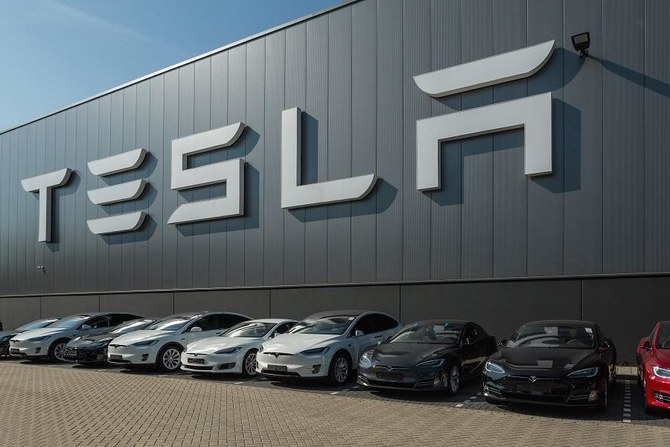
Tesla to accept bitcoin again when greener
https://arab.news/vmzjb
Tesla to accept bitcoin again when greener
- Bitcoin are produced by powerful computers that have to solve equations and consume huge amounts of electricity in the process
Saudi POS stays above $4bn as Ramadan spending lifts outlays on home goods
RIYADH: Saudi point-of-sale transactions remained above $4 billion in the week ending Feb. 14, with spending on furniture and home supplies rising ahead of Ramadan, central bank data showed.
Overall POS activity totaled SR15.34 billion ($4.09 billion), representing a 4.8 percent week-on-week decrease, while the number of transactions dipped 1.6 percent to 252 million, according to the Saudi Central Bank.
Spending on furniture and home supplies rose 5.9 percent to SR697.35 million, marking the strongest weekly increase among major retail categories.
Expenditure on electronics increased 2.9 percent, while spending on construction and building materials rose 1.1 percent.

Sectors that saw declines includes freight transport and courier services, which posted a drop of 5 percent to SR64.86 million.
Pharmacy and medical supplies spending fell 8.2 percent to SR223.81 million, but outlays on medical services rose 5.7 percent to SR539.68 million.
Food and beverage expenditure decreased 4.3 percent, but the total spend of SR2.57 billion meant it retained the largest share of POS activity.
Restaurants and cafes followed with SR1.73 billion, despite a 4.7 percent decline. Apparel and clothing outlays represented the third-largest share of POS spending during the monitored week, up 0.5 percent to SR1.38 billion.

The Kingdom’s major urban centers mirrored the mixed national changes. Riyadh, which accounted for the largest share of total POS spending, saw a 3.4 percent drop to SR5.32 billion. The number of transactions in the capital reached 80.7 million, down 0.8 percent week on week.
In Jeddah, transaction values decreased 4.4 percent to SR2.12 billion, while Dammam reported a 3.3 percent decrease to SR746.29 million.
POS data, tracked weekly by SAMA, provides an indicator of consumer spending trends and the ongoing growth of digital payments in Saudi Arabia.
The data also highlights the expanding reach of POS infrastructure, extending beyond major retail hubs to smaller cities and service sectors, supporting broader digital inclusion initiatives.
The growth of digital payment technologies aligns with Saudi Arabia’s Vision 2030 objectives, promoting electronic transactions and contributing to the Kingdom’s broader digital economy.


