

Germany to set up hydrogen accord with Australia

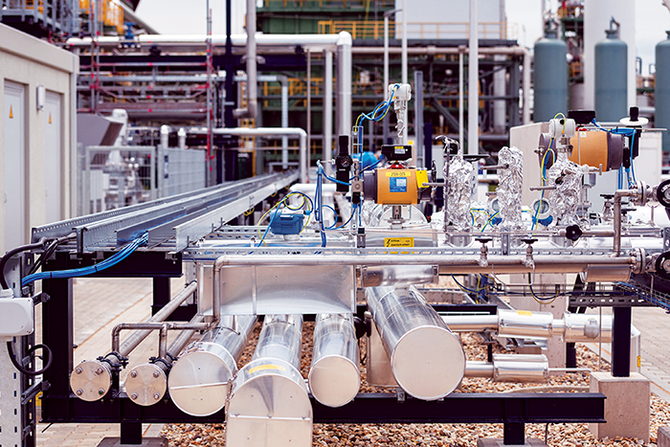
Construction site of the IMWS electrolysis platform, in Leuna, eastern Germany. (AFP)
Short Url
Updated 14 June 2021
Follow

Germany to set up hydrogen accord with Australia

  • Germany’s €9 billion hydrogen strategy launched last summer is based on the assumption that some 80 percent of its hydrogen requirements may have to be imported in the long term

FRANKFURT: Germany on Sunday said it has taken steps toward a bilateral alliance on hydrogen production and trade with Australia to try and facilitate a renewable energy-based hydrogen supply chain between the countries. 

Economy Minister Peter Altmaier and Education and Research Minister Anja Karliczek signed a letter of intent to set up a “Germany Australia Hydrogen Accord” with Australian Energy Minister Angus Taylor, the Economy Ministry said in a press release. It said the cooperation was about enabling “the import of sustainably produced hydrogen in relevant volumes, which is an important factor to reach our tighter climate targets.” Australia wants to develop a clean hydrogen and ammonia production chain to cut carbon, depart from fossil fuels and build up new export markets, Taylor said in an interview in May.

The two countries can take advantage of Australia’s limitless solar resources and employ German electrolysis technology, said Altmaier.

Karliczek said her ministry will fund a technology incubator called HyGate with €50 million ($60.53 million) over three years to test technologies from production through to storage and transport. Germany’s €9 billion hydrogen strategy launched last summer is based on the assumption that some 80 percent of its hydrogen requirements may have to be imported in the long term.


Up to $600m in additional tariffs on Saudi exports to the US

Updated 23 February 2026
Follow

Up to $600m in additional tariffs on Saudi exports to the US

RIYADH: Gulf exports have become targets of US President Donald Trump’s tariffs, which he raised from 10 percent to 15 percent on all countries.

The increase comes after the US Supreme Court ruled that the legal basis Trump had used to impose earlier tariffs was unlawful.

Previously, Gulf countries were among the few that had not raised their tariffs above 10 percent, while many other countries, most notably China, had already been subject to higher tariffs. However, with this latest increase, the Gulf states will be among those affected.

According to the financial analysis unit of Al-Eqtisadiah newspaper, Gulf exports to the US in 2024 amounted to about $26.2 billion, with Saudi Arabia accounting for roughly half of that, at $12.7 billion. These exports are subject to potential additional tariffs of SR637 million ($169 million).

It is likely that tariffs on Saudi exports will grow from $1.3 billion annually to $1.9 billion, a rise of 50 percent, following Trump’s recent increase.

Customs duties on Gulf exports will also increase, from $2.6 billion annually to $3.9 billion.

In 2024, Gulf exports are distributed as follows: $7.5 billion from the UAE, $1.8 billion from Qatar, and $1.6 billion from Kuwait, as well as $1.3 billion from Oman, and finally, $1.2 billion from Bahrain.

Gulf trade with the US in 2024 reached approximately $86 billion, comprised of $26.2 billion in exports and approximately $60 billion in imports, resulting in a Gulf trade deficit of $33.5 billion.

Trump responds to Supreme Court ruling

US President Donald Trump raised the global tariffs from 10 percent to 15 percent in response to the US Supreme Court ruling that his previous tariff implementation mechanism was unlawful.

Trump said in a post on his Truth Social account today: “As President of the US, I will, effective immediately, raise the global tariffs imposed on countries that have been taking advantage of the US for decades with impunity (until I took over!) to the legally permitted and tested level of 15 percent.”

Hours after the Supreme Court ruling on Feb. 20, Trump imposed a 10 percent global tariff on foreign goods, a move aimed at maintaining his trade agenda.

Trump had expressed his displeasure with the Supreme Court’s decision to overturn the tariffs imposed by his administration, asserting that the ruling would not restrict him. He vowed to impose tariffs far exceeding those struck down by the court, indicating that he had stronger alternatives to tariffs, raising questions about his future trade strategy.

The US Supreme Court struck down Trump’s sweeping global tariffs, undermining his signature economic policy and inflicting his biggest legal defeat since returning to the White House.

By a six-three vote, the court ruled that Trump exceeded his authority by invoking the federal emergency powers law to impose his reciprocal tariffs worldwide, in addition to targeted import duties that the administration claims are intended to combat fentanyl smuggling.