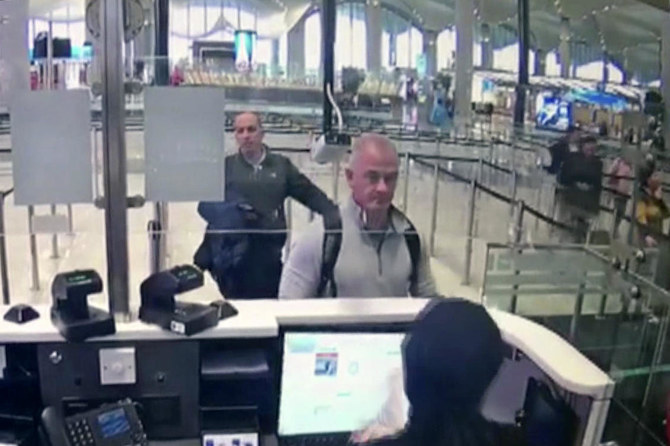
Americans Michael Taylor and his son Peter Taylor go on trial in Tokyo on Monday on charges they helped Nissan’s former chairman, Carlos Ghosn, skip bail and flee to Lebanon in December 2019.
HOW DID THE TAYLORS END UP IN JAPAN?
The Taylors were arrested in Massachusetts in May 2020 and extradited to Japan in March. They have not been released on bail and are not available for comment, which is standard in Japan. They were formally charged in March with helping a criminal escape. Michael Taylor, a former Green Beret, told The Associated Press while still in the US that Peter was not in Japan when Ghosn fled the country. The elder Taylor has helped parents rescue abducted children, gone undercover for the FBI and worked as a contractor for the US military in Iraq and Afghanistan.
WHAT HAPPENED WITH GHOSN?
Ghosn led Japanese automaker Nissan Motor Co. for two decades before his arrest in Tokyo in November 2018. He was charged with falsifying securities reports in underreporting his compensation and with breach of trust. He says he is innocent and the compensation he is accused of not reporting was never decided on or paid. Ghosn says he feared he would not get a fair trial in Japan, where more than 99 percent of criminal cases result in convictions. Japanese prosecutors say he paid at least $1.3 million to organize his escape. Ghosn is on Interpol’s wanted list, but Japan has no extradition treaty with Lebanon.
ESCAPE IN A BOX
Tokyo prosecutors say Michael Taylor and another man, George-Antoine Zayek, hid Ghosn in a large box meant to carry audio equipment, snuck him through airport security in Osaka, central Japan, and loaded him onto a private jet to Turkey. Peter Taylor is accused of meeting with Ghosn to help with the escape. Zayek has not been arrested. A US appeals court rejected the Taylors’ petition to put their extradition on hold.
COURT PROCEEDINGS
The Taylors will go through the Japanese equivalent of entering a plea before a panel of three judges. They may also give statements. They have said they didn’t break any laws because skipping bail is not technically illegal in Japan. But Ghosn was not supposed to leave the country. Deputy Chief Prosecutor Hiroshi Yamamoto said prosecutors will outline the charges, but he declined to comment specifically on the case. Japanese suspects are tried even if they plead guilty.
The Taylors are held at the Tokyo detention center on the city’s outskirts. Their lawyer can visit them, and they can receive snacks and books. Ghosn spent more than 100 days at the center before his release on bail. The cells are simple, with Japanese-style futon mattresses. The facility has an exercise area and clinic.
WHAT LIES AHEAD?
English translations will be provided and media coverage is allowed, but no filming or recording. If convicted, the Taylors face up to three years in prison and a fine of up to 300,000 yen ($2,900). They also could get suspended sentences and not serve time. In principle, people accused of crimes in Japan are presumed innocent until proven guilty. But the conviction rate is higher than 99 percent.
ANOTHER AMERICAN
Former Nissan executive Greg Kelly, also an American, is being tried on charges of falsifying securities reports in underreporting Ghosn’s pay. He says he is innocent and was trying to find legal ways to pay Ghosn, partly to prevent him from leaving Nissan for a rival automaker. Kelly’s trial began in September and a verdict isn’t expected for months. If convicted, Kelly faces up to 15 years in prison.
WHAT DOES GHOSN SAY?
During the interview in Lebanon in May, Ghosn told The Associated Press he was eager to clear his name. He declined to give details of his escape. Ghosn accuses other Nissan executives of plotting to force him out to prevent him from giving its French partner, Renault, more power in their alliance. Renault sent Ghosn to Japan in 1999 to rescue the automaker when it was on the verge of bankruptcy.
HOW IS NISSAN FARING?
Nissan, which makes the Leaf electric car, the Z sportscar and Infiniti luxury models, has struggled as sales slumped during the pandemic. It expects to remain in the red this fiscal year, the third straight year of losses. Ghosn’s successors have promised a turnaround.


Who are Americans on trial in Ghosn’s escape?
https://arab.news/ybcqe
Who are Americans on trial in Ghosn’s escape?

- Ghosn led Japanese automaker Nissan Motor Co. for two decades before his arrest in Tokyo in November 2018. He was charged with falsifying securities reports in underreporting his compensation and with breach of trust


Aramco’s 13% rally helps Saudi stocks post second weekly gain
RIYADH: Saudi Aramco extended its year-to-date rally to nearly 13 percent on Thursday, helping the Kingdom’s benchmark stock index secure a second straight weekly gain despite a weaker final trading session.
Saudi Aramco shares, which carry the heaviest weighting on the Saudi Exchange, closed at SR26.86 ($7.16), leaving the stock 12.72 percent higher since the start of 2026. The stock also remained 3.09 percent above last week’s close, even after falling 1.1 percent in Thursday’s session.
The rise in energy shares came as escalating tensions in the Middle East pushed oil prices above $100 a barrel, after attacks on tankers in the Gulf and the Strait of Hormuz heightened concerns over supply disruptions.
The Tadawul All Share Index maintained its weekly uptrend, rising nearly 1.07 percent week on week to close at 10,778.32, despite falling 0.45 percent in Thursday’s session. Compared with the first trading day of the year, the index has gained 4.01 percent.
Total trading turnover on the benchmark index reached SR5.05 billion at Thursday’s close, with 88 stocks advancing and 176 declining.
Aramco’s performance continued to anchor sentiment after the company reported adjusted net income of $104.7 billion for 2025 earlier this week, while net profit fell 12.1 percent year on year to $93.39 billion, compared with $106.25 billion in 2024, as lower crude prices weighed on earnings despite higher sales volumes across oil, gas and refined products.
On a March 10 earnings call, Aramco CEO Amin Nasser warned that prolonged disruption in the Strait of Hormuz could have severe implications for global energy markets. Roughly 20 percent of the world’s oil normally passes through the waterway each day, but shipments have been largely blocked.
“There would be catastrophic consequences for the world’s oil markets and the longer the disruption goes on ... the more drastic the consequences for the global economy,” he said.
“While we have faced disruptions in the past, this one by far is the biggest crisis the region’s oil and gas industry has faced.”
Saudi equities showed mixed performance in Thursday’s session. The MSCI Tadawul Index fell 5.99 points, or 0.40 percent, to close at 1,476.76.
The Kingdom’s parallel market Nomu gained 132.47 points, or 0.6 percent, to close at 22,370.4, with 38 stocks advancing and 34 declining.
On March 11, the International Energy Agency announced the release of 400 million barrels of oil from its reserves, the largest such move in its history. As part of that, the US said it would release 172 million barrels starting next week.


