

Pakistan steps up COVID-19 vaccine rollout with 100m target

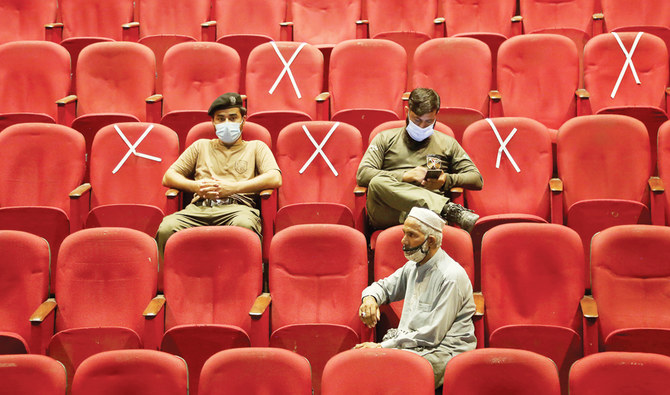
Government employees wait their turn to receive the COVID-19 vaccine in Peshawar. (AP)
Short Url
Updated 13 June 2021
Follow

Pakistan steps up COVID-19 vaccine rollout with 100m target

  • Health authorities budget $1.1bn for Pfizer, Sinovac and AstraZeneca jabs

LAHORE: Pakistan has received 14.5 million coronavirus vaccine doses since it began its vaccination campaign in February, and plans to buy a further 90 million doses to inoculate the adult population in the second half of the year, the country’s health ministry has said.

Announcing its 2020-21 federal budget, Pakistani Minister of Finance Shaukat Tarin said that the government has allocated $1.1 billion to buy coronavirus vaccines and plans to vaccinate 100 million people out of the country’s 216 million population by July 2022.
It has also set aside 100 billion Pakistani rupees ($641 million) to combat coronavirus in the next fiscal year.
According to data shared with Arab News by health chief Dr. Faisal Sultan, as of June 9, the country had received 14.5 million vaccine doses, of which 11.06 million had been bought from pharmaceutical companies, 2.7 million donated by China and a consignment of 1.34 million contributed by Covax, the global dose-sharing platform for poorer countries.
Last November, Pakistan’s government allocated $150 million to buy COVID-19 vaccines from international manufacturers. The fund has been used to buy 11.06 million doses as well as pay transportation costs and buy the equipment needed to administer vaccines across the country, according to Dr. Rana Muhammad Safdar, director-general of health in Islamabad.

HIGHLIGHTS

• As of June 8, about 9.9 million doses of the 14.5 million total doses received had been administered, according to data provided by the health chief.

• According to a government portal, 3.6 percent of Pakistan’s 70 million adult population has been fully inoculated so far.

As of June 8, about 9.9 million doses of the 14.5 million total doses received had been administered, according to data provided by the health chief. According to a government portal, 3.6 percent of Pakistan’s 70 million adult population has been fully inoculated so far.
Of the doses administered, most people — 3,513,088 — have received a Sinovac jab, Sultan said, adding that 2,548,788 people have been given the Sinopharm vaccine.
There are 1,876 vaccination centers in the country, which the government aims to increase to 4,000.
Islamabad, Pakistan’s capital, has vaccinated the highest number of eligible individuals — 320,000 — or 27 percent of the city’s adult population.
Most of those vaccinated in Pakistan have been men, data showed, with the ratio of men to women receiving vaccinations being 60:40.
The country has already placed orders for an additional 90 million doses of the vaccine, the health chief added.
He said that authorities expected to receive 34 million doses of the Sinovac vaccine later this year, including 4 million in June, and a further 5 million doses each month until December.
Pakistan is also securing 18 million doses of the China-produced CanSino vaccine, which includes delivery of 3 million doses of the drug every month from July to December.
The US Pfizer vaccine will be administered across the country as well, with 1 million arriving in July and 11 million between July and  December, totaling 12 million doses.
Separately, Pakistan will receive another 1.23 million dose delivery of the UK-produced AstraZeneca jab this month, donated through the Covax platform.
However, the government has voiced concern at people failing to show up to receive a second jab.
“About one in five people fail to have their second dose,” Sultan said.
But Safdar said that the missed appointments might be the result of a backlog in late May, and that “people are now turning up, including those who missed their dose.”


Russia puts death toll from Ukrainian strike on occupied village at 27. Kyiv rejects accusation

Updated 7 sec ago
Follow

Russia puts death toll from Ukrainian strike on occupied village at 27. Kyiv rejects accusation

Russian authorities said Friday that the death toll from a Ukrainian drone strike they said struck a café in a Russian-occupied village in Ukraine’s Kherson region rose to 27 people. Kyiv denied attacking civilian targets.
Svetlana Petrenko, spokeswoman of Russia’s main criminal investigation agency, the Investigative Committee, said in a statement that a Ukrainian drone strike on a café and hotel in the village of Khorly, where at least 100 civilians were celebrating New Year’s Eve overnight into Thursday, killed 27 people, including two minors. A total of 31, including five minors, were hospitalized with injuries.
A criminal probe on the charges of carrying out an act of terrorism has been opened, Petrenko said.
Kyiv denied attacking civilians. Spokesman of Ukraine’s General Staff, Dmytro Lykhovii, told Ukraine’s public broadcaster Suspilne on Thursday that Ukrainian forces “adhere to the norms of international humanitarian law” and “carry out strikes exclusively against Russian military targets, facilities of the Russian fuel and energy sector, and other lawful targets.”
Lykhovii said that General Staff has published an explicit list of targets that the Ukrainian army struck on the night of New Year’s Eve. The list did not include strikes on occupied parts of the Kherson region.
Lykhovii noted that Russia has repeatedly used disinformation and false statements to disrupt the ongoing peace negotiations.
The Associated Press could not independently verify claims made about the attack.
Russia’s accusations against Ukraine come amid a US-led diplomatic push to end the nearly four-year war in Ukraine. Earlier this week, Moscow alleged that Kyiv launched a long-range drone attack against a residence of Russian President Vladimir Putin in northwestern Russia overnight from Sunday to Monday.
Kyiv has called the allegations of an attack on Putin’s residence a ruse to derail ongoing peace negotiations, which have ramped up in recent weeks on both sides of the Atlantic.
In his New Year’s address, Ukrainian President Volodymyr Zelensky said that a peace deal was “90 percent ready” but warned that the remaining 10 percent, believed to include key sticking points such as territory, would “determine the fate of peace, the fate of Ukraine and Europe, how people will live.”
Trump’s special envoy Steve Witkoff said Wednesday that he, Secretary of State Marco Rubio and Trump’s son-in-law and adviser Jared Kushner had a “productive call” with the national security advisers of Britain, France, Germany and Ukraine “to discuss advancing the next steps in the European peace process.”
Elsewhere in Ukraine, Russia conducted what local authorities called “one of the most massive” drone attacks at Zaporizhzhia overnight.
At least nine Russian drones struck the city, damaging dozens of residential buildings and other civilian infrastructure, head of the regional administration, Ivan Fedorov, wrote on Telegram on Friday. There were no casualties, the official said.
Overall, Russia fired 116 long-range drones at Ukraine last night, according to Ukraine’s Air Force, which said that 86 drones were intercepted, while 27 more have reached their targets.
The Russian Defense Ministry reported Friday that its air defenses intercepted 64 Ukrainian drones overnight over multiple Russian regions.
Vyacheslav Gladkov, governor of Russia’s Belgorod region on the border with Ukraine, on Friday also accused Ukrainian forces of carrying out a missile strike on the city of Belgorod. Two women were hospitalized with injuries, Gladkov said. The strike shattered windows in multiple residential buildings and damaged an unspecified “commercial” facility and a number of cars, according to the official.
