

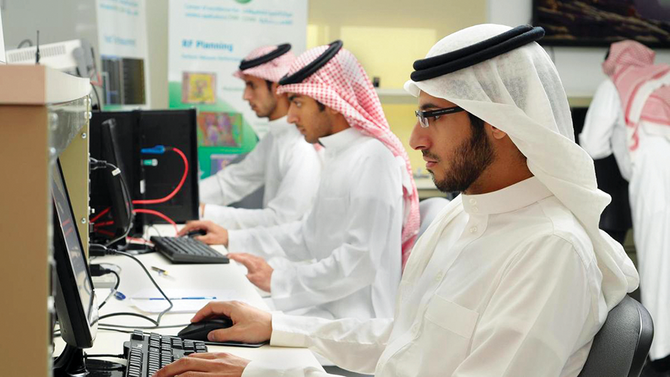

RIYADH: Jobs have been created for about 400,000 Saudi nationals as a result of 11 Saudization agreements put in place since 2018, the Argaam website reported, citing information from Abdullah Abuthnain, vice minister of human resources and social development at the Ministry of Human Resources and Social Development.
Increased privatization and Saudization of roles are the key goals of the Kingdom’s Vision 2030 program.
Finance Minister Mohammed Al-Jadaan last month said that Saudi Arabia is seeking to raise about $54.5 billion over the next four years through its privatization program.
Al-Jadaan expects to raise $38 billion through asset sales and $16.5 billion through public-private partnerships, he told the Financial Times.
The Saudi government has identified 160 projects in 16 sectors, including asset sales and public-private partnerships through 2025.
Asset sales will include government-owned hotels, television broadcasting towers, and cooling and water desalination plants.
The plan does not include Public Investment Fund entities or the sale of other assets of Saudi Aramco. The new privatization law will be enacted in Saudi Arabia in July this year.
The National Privatization Center (NCP) in March also announced the creation of the Registry of Privatization Projects, a comprehensive central database of information and documents related to projects targeted for privatization.
According to the director general of Strategic Communication and Marketing at the NCP, Hani Al-Saigh, the new system seeks to enhance the existing privatization system. One of its most important roles will be to strengthen existing governance and ensure fairness and transparency.
“The law allows participants from the private sector to set up a committee to submit grievances related to the bidding and selection procedures of privatization projects and lay the regulatory basis to compensate the aggrieved in case the gap cannot be addressed,” he told Arab News.
A report by the National Labor Observatory issued in April this year indicated that the percentage of Saudization in the private sector rose to 22.75 percent in the first quarter of 2021 compared to 20.37 percent during the same period last year.
Recent data has shown that seven major job groupings in the private sector have achieved Saudization figures of more than 50 percent. While the rate across the private sector as a whole is around a quarter, Al-Eqtisadiah newspaper reported that the financial and insurance sector had achieved a rate of 83.6 percent, followed by public administration, defense, and mandatory social insurance (71.9 percent), mining, and quarrying activities (63.2 percent), education (52.9 percent), and information and communications (50.7 percent).
Saudi Arabia has the lowest dependence on foreign labor among Gulf Cooperation Council countries at around 77 percent, while Qatar has the highest, at about 94 percent, according to data from S&P Ratings.
While the Saudization figure is moving in a positive direction, some sectors face challenges. In December, the Saudi government added accountancy to the list of professions set to be Saudized, announcing that 30 percent of all accounting jobs at all local Saudi private sector companies with at least five accounting professionals must be filled by Saudi nationals.
The ruling will come into effect on June 21 this year, and it is predicted that the move will create around 9,800 job opportunities for Saudi accountants.


