Jill Biden, Duchess of Cambridge learn bunny care on tour

1 / 4
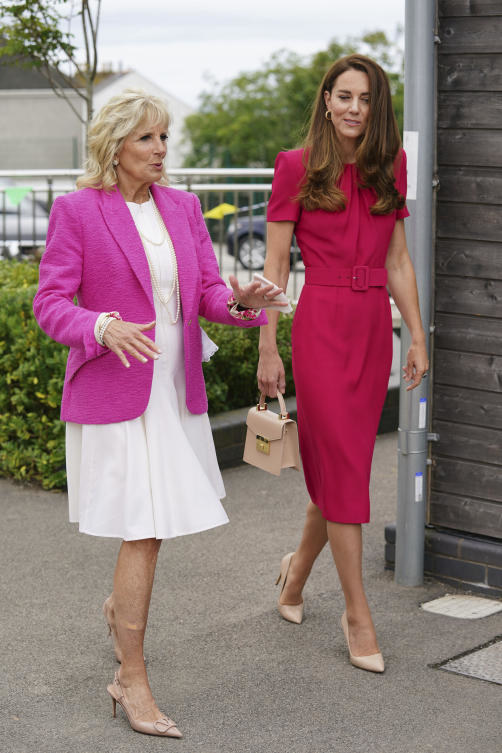
Britain's Kate, Duchess of Cambridge, left, and US First Lady Jill Biden laugh during a visit to Connor Downs Academy in Hayle on Friday, June 11, 2021. (AP)
2 / 4
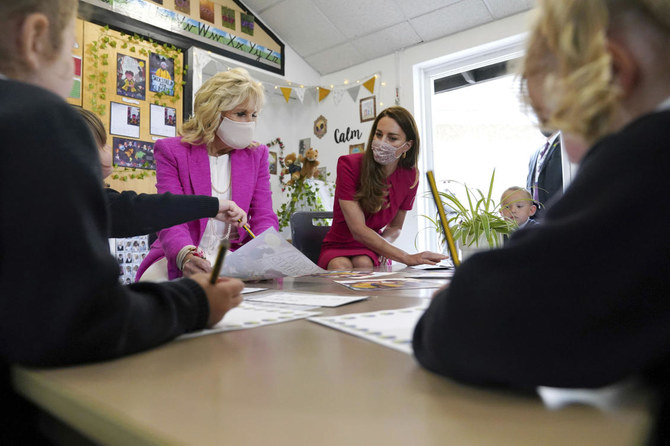
Britain's Kate, Duchess of Cambridge, right, and US First Lady Jill Biden during a visit to Connor Downs Academy in Hayle, West Cornwall, during the G7 summit in England, Friday, June 11, 2021. (AP)
3 / 4
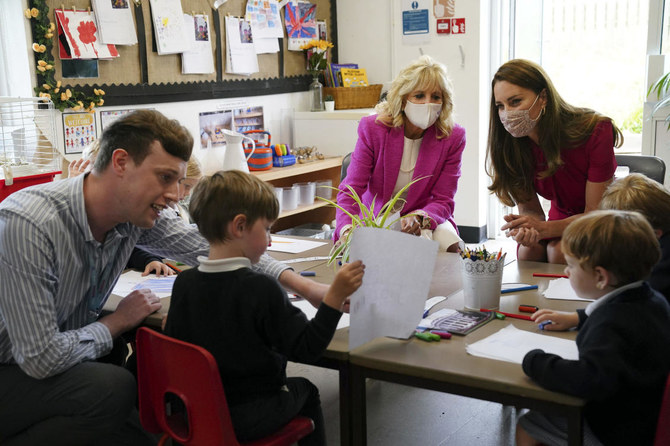
Britain's Kate, Duchess of Cambridge, center right, and US First Lady Jill Biden talk with children in the school's Reception Class during a visit to Connor Downs Academy in Hayle, West Cornwall. (AP)
4 / 4
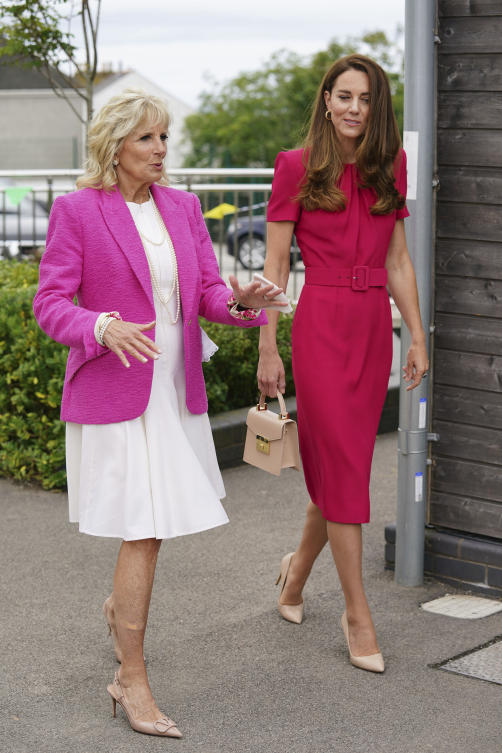
Britain's Kate, Duchess of Cambridge, right, and US First Lady Jill Biden talk with children in the school's Reception Class during a visit to Connor Downs Academy in Hayle, West Cornwall. (AP)
Short Url
Updated 11 June 2021
Follow

Jill Biden, Duchess of Cambridge learn bunny care on tour

  • Biden and the former Kate Middleton visited with 4- and 5-year-olds who attend Connor Downs Academy in Hayle
  • “It’s a huge honor to have you in the United Kingdom,” the duchess said just before the discussion

HAYLE, England: US first lady Jill Biden and Kate, the Duchess of Cambridge, learned about bunny care Friday as they toured a preschool during a joint outing in southwest England.
They also took part in a talk about early childhood education with experts from the UK and some from the United States who joined the discussion via Zoom.
“It’s a huge honor to have you in the United Kingdom,” the duchess said just before the discussion. She thanked Biden — a longtime English teacher — for her interest in early education, also a topic of interest for the duchess, who has three young children with husband Prince William.

Biden, 70, and the former Kate Middleton, 39, visited with 4- and 5-year-olds who attend Connor Downs Academy in Hayle. The school works with children who have experienced trauma. It also has outdoor classrooms where children plant vegetables and flowers and tend to rabbits.
Biden carried a bowl of carrots when the women went outside to see Storm, one of several bunnies housed in pens, and handed the bowl to a group of kids so they could feed him.
Before the indoor roundtable, Biden said she was glad to visit the school.
“I met some wonderful teachers and principals and most of all the children, who were so inspiring and well behaved,” the first lady said. “I couldn’t get over it.”
She is traveling with her husband, President Joe Biden, who is attending a Group of Seven summit of leaders from the world’s largest economies that opened Friday in Carbis Bay.
She thanked the news media for covering the appearance “because early childhood education is so important to lay the foundation for all of our students.”
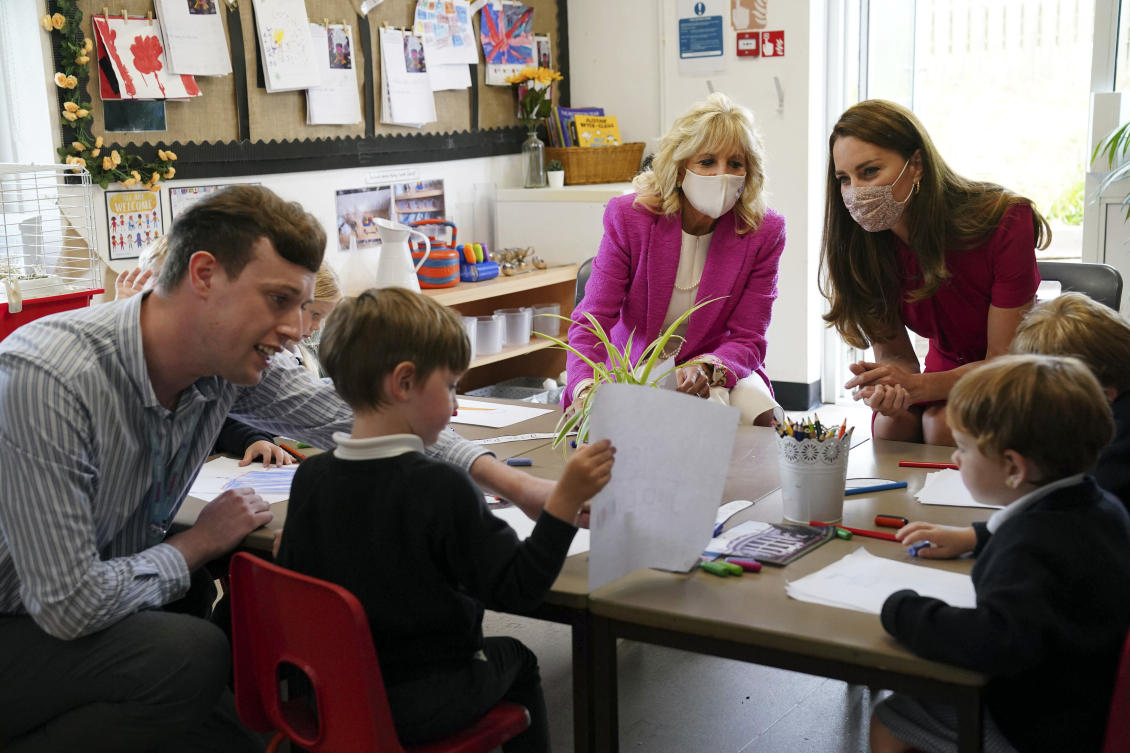

Both women took notes during the discussion, which centered on child mental health and the importance of early education in childhood development.
As they departed, reporters asked Biden if she had sought advice from the duchess on meeting Queen Elizabeth II, which the Bidens are set to do at a summit reception later Friday, followed by tea with the monarch on Sunday at Windsor Castle.
“No, I didn’t,” the first lady replied. “We’ve been busy. Were you not in that room. We were talking education.”
Jill Biden is scheduled to head back to Washington after meeting the queen, while the president continues on to Brussels for a NATO summit and to Switzerland for a highly anticipated one-on-one summit with Russian President Vladimir Putin.


Viral phenomenon in Argentina has young people identifying themselves as animals

Updated 27 February 2026
Follow

Viral phenomenon in Argentina has young people identifying themselves as animals

  • As the movement gains traction, psychologists are stepping in to analyze the phenomenon and its place in public discourse

BUENOS AIRES: On a recent Sunday, a Buenos Aires plaza transformed into a makeshift wilderness for an unusual group of teenagers.
Sofía, wearing a lifelike beagle mask, ran across the grass on all fours. Nearby, 15-year-old Aguara leapt through the air, clearing an obstacle course while imitating the precise movements of a Belgian breed dog. Others dressed as cats and foxes perched in the branches of trees, keeping their distance from curious onlookers.
It was the latest gathering of “therians,” individuals who say they identify mentally, spiritually or psychologically with non-human animals. The trend has taken over Argentine social media over the past few months, gaining traction on platforms like TikTok, where the hashtag #therian has surpassed 2 million posts, with Argentina leading all other Latin American countries in engagement. The surge has drawn the attention of influencers and media outlets alike, sparking reactions that range from laughter and bewilderment to outright anger.
And as the movement gains traction, psychologists are stepping in to analyze the phenomenon and its place in public discourse.
Aguara, who claims to identify as a Belgian Malinois and counts her age as the equivalent of two years and two months in dog years, says she’s a lot like any other teenager.
“I wake up like a normal person and live my life like a normal person,” she said. “I simply have moments when I like being a dog.”
As the leader of what she calls her “pack,” Aguara — the name she identifies with — boasts more than 125,000 followers on TikTok and coordinates regular meetups around the Argentine capital.
Aru, a 16-year-old who wore a seal mask to the park meetup, said she considers herself part of the “otherpaw” branch of therians: individuals who wear masks and tails or move on all fours just for fun. “It’s not necessarily about identifying as an animal,” she said.
She reckons the therian trend took off in Argentina because of the country’s “fairly free” environment. For other young Argentines, the movement has provided a vital community where they can feel truly accepted.
Should parents be worried?
Débora Pedace, a psychologist and director of the Integral Therapeutic Center in Buenos Aires, acknowledged that the phenomenon generates a complex mix of confusion, laughter and even anger.
“From a psychological standpoint, this is a symbolic identification with an animal,” Pedace said. “It becomes pathological or alarming only when it turns into a deeply rooted belief and the person fully assumes the role of an animal, potentially leading to self-harm or hurting others.”