

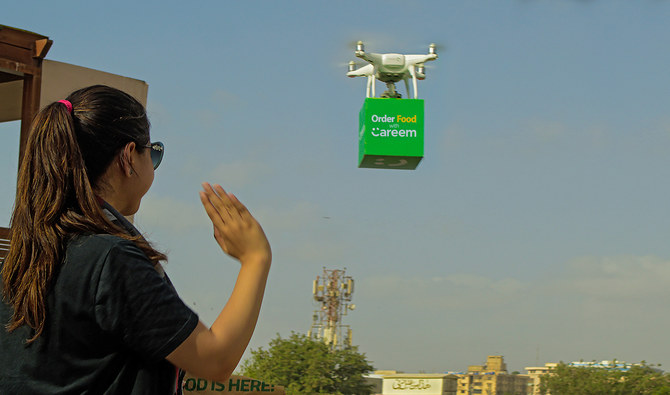

RAWALPINDI: Careem, a ride-hailing company, entered a new domain by launching a drone delivery system in Pakistan on Friday to benefit the country’s growing e-commerce market.
The service was first teased in a video released on the company’s official social media handles showing a white drone buzzing across Karachi.
“Our teams are constantly innovating and experimenting with new ways to inspire and be of service to our customers,” Madiha Javed Qureshi, director communications at Careem, told Arab News. “The drone delivery pilot is one such example.”
The pilot project of ordering food via drone delivery took place for a day on June 10 in Lahore and Karachi with a limited number of customers.
Last February, Food Panda, the food delivery app, also announced its plan to move into drone delivery for food as well.
Badar Khushnood, head of e-commerce at the Pakistan Software Houses Association and member of the National E-commerce Council (NeCC) told Arab News that the move intro drone delivery was a result of “organic growth” in the e-commerce sector, referring to it as “now-commerce.”
“This is what is evolving and emerging now in e-commerce or now-commerce,” he told Arab News over the phone. “It’s exciting that as a developing country we are moving in this direction and experimenting with new technologies. Such initiatives can open new doors of economic progress for Pakistan both internally and globally.”
Khushnood shared his thoughts on the pros and cons of a delivery system employing drones, including the avoidance of traffic congestion and extreme weather, while adding that it could be an “exciting opening to catering to rural areas.”
However, he maintained that scalability of fleet, lack of a comprehensive and practical drone regulation and privacy of customers could pose some of the challenges.
“Are the drones going to be flying over someone’s lawn or pool” he asked. “It’s something they will have to think about, but it is a great step forward.”
Soon after the announcement of the project, Usama Khilji, director of Bolo Bhi, a civil society organization, raised concern over privacy issues associated with the initiative.
“The use of drones for delivery poses several risks to the public,” he told Arab News. “Most drones are equipped with cameras, which poses a risk of surveillance as well as violation of the right to privacy of citizens, especially if these drones are to hover over residential areas for deliveries.”
Khilji also emphasized the idea of transparency, saying that customers should know where the data would be stored and how it would be protected.
“Licensing by the government should also be transparent, as the drone policy drafted in 2020 imposes several restrictions on the use of drones, and it should take the privacy of citizens into account apart from security considerations that it prioritizes,” he said.
Asked about such privacy concerns, the company’s communications director maintained that privacy and protection of Careem customers would continue to be of a high standard as the operation expands.
“Data is a very private thing, and we are very particular about it,” said Qureshi. “Data security and safety is one of the top priorities [at Careem], and from delivery to ride-hailing we will always protect the customer first.”


