

Tunisian cemetery offers living memorial to ‘unknown migrants’

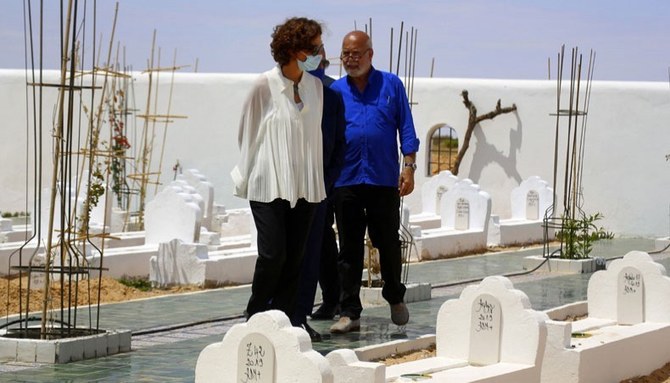
UNESCO Director-General Audrey Azoulay, left, with Algerian artist Rachid Koraichi in the Jardin d’Afrique (Garden of Africa) cemetery for migrants, Zarzis, Tunisia, June 9, 2021. (AFP)
Short Url
Updated 11 June 2021
Follow

Tunisian cemetery offers living memorial to ‘unknown migrants’

  • Garden of Africa graveyard in fishing village of Zarzis holds remains of migrants who died trying to reach Europe
  • Artist Rachid Koraichi, 74, decorated the site in tribute to those ‘condemned by the sea after facing the Sahara’

ROME: A garden cemetery to honor some of the unknown migrants who died while crossing the Mediterranean in an attempt to reach Europe has been inaugurated in Zarzis, a Tunisian fishing village near the border with Libya.

The Jardin d’Afrique (Garden of Africa) cemetery includes a traditional 17th-century door, hand-painted ceramic naves and a prayer hall for all religions made by Algerian artist Rachid Koraichi.

Foreign envoys to Tunisia and a UNESCO representative attending the inaugural ceremony at the site were told that half of its 200 burial places are already full.

More than 21,000 people have died attempting to cross the Mediterranean since 2014, according to the UN.

The cemetery and its garden of olive trees will hold the remains of unknown migrants, and aims to be a symbol as well as a place to remember and pray.

Koraichi, 74, said that the migrants buried there were “condemned by the sea” after facing “the Sahara, bandits and terrorists” and sometimes even torture.

“I wanted to help them go to heaven after the hell they went through,” he told Italian news agency ANSA.

A member of Tijaniyya, an influential Sufi order, launched the burial site project after hearing that Zarzis was running out of space to bury the dozens of dead bodies that washed up in the coastal village each summer.

The remains of more than 1,000 migrants have been buried in the town in the past decade.

In 2018, Koraichi bought land for the cemetery, and began work on decorations and facilities.

“I did this to help families mourn their loved ones, knowing that they have a dignified burial place,” he said.

Koraichi said that he viewed the garden as a symbolic place, similar to the Tomb of the Unknown Soldier, “because we are all responsible for this tragedy.”

The cemetery holds more than 200 white graves, surrounded by five olive trees, which symbolize the five pillars of Islam, and 12 vines representing the Christian apostles.

Gravestone markers have various descriptions, such as “Man, black shirt, Four Seasons Hotel,” or “Woman, black dress, Hachani beach,” which describe the unidentified corpse, where the body was found, and other elements that could help with identification.

An onsite facility where autopsies can be performed is planned in order to help identification.

Currently, autopsies take place in Gabes, 140 km away, which means the authorities have to transport the bodies in difficult conditions.

At the inauguration, UNESCO Director-General Audrey Azoulay paid tribute to Koraichi but also to “the shipwrecked people who died at sea in search of a better life” and to the “universal solidarity of associations, fishermen or individuals who save lives.”

Zarzis Mayor Mekki Lourraidh said: “Many of the young people from Zarzis left for Europe by sea. There were deaths, and we see our children among them.”


Sudan defense minister dismisses ‘intelligence document’ as fabrication after convoy strike

Updated 12 February 2026
Follow

Sudan defense minister dismisses ‘intelligence document’ as fabrication after convoy strike

  • Gen. Hassan Kabroun tells Arab News claims that army hid weapons in aid convoy are “completely false”

RIYADH: Sudan’s defense minister has firmly denied reports attributed to Sudanese intelligence alleging that a convoy targeted in North Kordofan was secretly transporting weapons under the cover of humanitarian aid.

Gen. Hassan Kabroun described the claims as “false” and an attempt to distract from what he called a militia crime.

The controversy erupted after news reports emerged that a document attributed to Sudan’s General Intelligence Service claimed the convoy struck in Al-Rahad on Friday was not a purely humanitarian mission, but was instead carrying “high-quality weapons and ammunition” destined for Sudanese Armed Forces units operating in the state.

The report further alleged that the convoy had been outwardly classified as humanitarian in order to secure safe passage through conflict zones, and that the Rapid Support Forces had destroyed it after gathering intelligence on its route and cargo.

Kabroun categorically rejected the narrative.

“First of all, we would like to stress the fact that this news is false,” he told Arab News. “Even the headline that talks about the security of the regions, such as Al-Dabbah, is not a headline the army would use.”

He described the document as fabricated and politically motivated, saying it was designed to “cover up the heinous crime they committed.”

The minister affirmed that the area targeted by drones is under full control of the Sudanese Armed Forces and does not require any covert military transport.

“Second, we confirm that the region that was targeted by drones is controlled by the army and very safe,” Kabroun said. “It does not require transporting any military equipment using aid convoys as decoys because it is a safe area controlled by the army, which has significant capabilities to transport humanitarian aid.”

According to the minister, the Sudanese military has both the logistical capacity and secure routes necessary to move equipment openly when needed.

“The army is professional and does not need to deliver anything to Kadugli or Dalang on board aid convoys,” he said. “The road between Dalang and Kadugli is open. The Sudanese forces used that road to enter and take control of the region. The road is open and whenever military trucks need to deliver anything, they can do so without resorting to any form of camouflage.”

Kabroun further rejected any suggestion that the military uses humanitarian operations as cover.

“Aid is transported by dedicated relief vehicles to the areas in need of this assistance,” he said. “Aid is not transported by the army. The army and security apparatus do not interfere with relief efforts at all, and do not even accompany the convoys.”

He stressed that the Sudanese Armed Forces maintains a clear institutional separation between military operations and humanitarian work, particularly amid the country’s crisis.

“These are false claims,” he said. “This fake news wanted to cover up the heinous crime they committed.”

Sudan has been gripped by conflict since April 2023, when fighting broke out between the Sudanese Armed Forces and the Rapid Support Forces, plunging the country into what the United Nations has described as one of the world’s worst humanitarian disasters.

The latest dispute over the convoy comes amid intensified fighting in South Kordofan, a strategically sensitive region linking central Sudan with the contested areas of Darfur and Blue Nile.

The false report suggested that intelligence monitoring had enabled the RSF to strike what it described as a military convoy disguised as humanitarian aid. But Kabroun dismissed that version outright.

“The intelligence agency is well aware of its duties,” he said. “The Sudanese Army has enough weapons and equipment to use in the areas of operations. These claims are completely false.”

He argued that the narrative being circulated seeks to shift blame for attacks on civilian infrastructure and humanitarian movements.

“This shows that they are trying to cover up the atrocities,” he added, referring to the militia.

Kabroun maintained that the army has regained momentum on multiple fronts and remains fully capable of sustaining its operations without resorting to deception.

“The region is secure, the roads are open, and the army does not need camouflage,” he said. “We are operating professionally and transparently.”

“These claims are completely false,” Kabroun said. “The Sudanese Army does not use humanitarian convoys for military purposes.”