

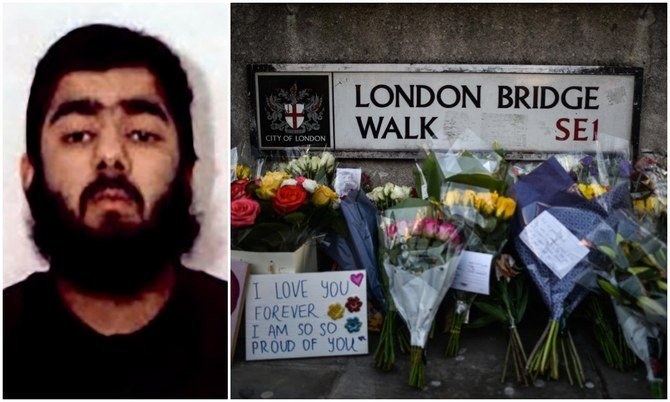

LONDON: A terrorist who killed two people and was subsequently shot dead by police in London was lawfully killed, an inquest into his death has found.
Usman Khan, 28, fatally stabbed Jack Merritt, 25, and Saskia Jones, 23, during a prisoner rehabilitation conference in central London in November 2019.
During the attack he was chased out of the venue, Fishmongers’ Hall, and onto London Bridge where he was later shot dead by police.
The inquest into his death, and that of Merritt and Jones, heard that police feared Khan would detonate a suicide belt he appeared to be wearing.
Six officers shot 20 bullets at Khan, 12 of which hit him. Police were allowed to carry out a “critical shot” because of concerns that he would blow himself up — however, the suicide belt he was wearing turned out to be a fake.
Khan died from gunshot wounds, but a post-mortem also found he was wounded in several other ways, including suffering from a near-fatal stab wound from a narwhal tusk that one bystander had used against him during the attack. That wound passed within a centimeter of his jugular vein in his neck.
An anonymous police officer who attended the scene told of the split-second decision he had to make after realising Khan could have been wearing an explosive belt.
“Literally the first second the shot became available, I took it,” the officer told the inquest, “to save myself and to try and save the people around me.”
Jurors in the inquest ruled that Khan had been lawfully killed by anonymous police officers.
They concluded that killing Khan was necessary to protect themselves and others. Police “believed he was trying to find a trigger” on a suicide vest, and that when they opened fire, they feared Khan was moving to detonate the device.
Coroner Mark Lucraft QC praised the work of Jones and Merritt, both of whom were involved in assisting prisoner rehabilitation programs, and whose lives were “tragically cut short.”
The 2019 attack caused additional controversy in the UK because Khan had recently been released from prison before his sentence had ended. The attack prompted stricter controls for released terrorists in the UK, as well as longer sentences.
Upon his release, Khan was assessed as being more dangerous than when he went into prison, and there was seen to be an imminent risk of him causing serious harm to the public. However, a series of institutional failings appeared to have allowed him to slip through the cracks.
London’s Metropolitan Police Assistant Commissioner Neil Basu praised the “heroic” actions of police officers.
“But my final words are reserved for Jack and Saskia,” he said. “They were two wonderful and talented young people who already achieved so much in their lives, which were tragically cut short.
“My thoughts and the thoughts of everyone in policing are with the friends, families and loved ones of Jack and Saskia, and they are with everyone who was injured, traumatized or affected by this attack.”


