


Islamic insurance market growth to be driven by compulsory health cover – Moody’s

Compulsory health insurance has been introduced in a number of Gulf countries in recent years. (Shutterstock)
Short Url
Updated 09 June 2021
Follow

Islamic insurance market growth to be driven by compulsory health cover – Moody’s

  • Takaful was 29 percent of insurance premiums in largest markets in 2020
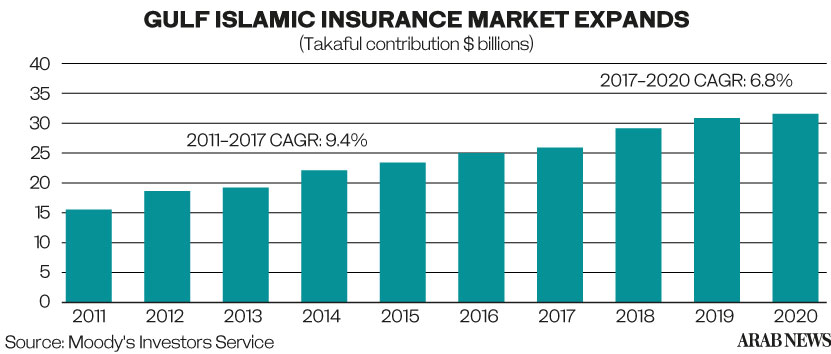
  • Takaful premiums grew at annual 6.8 percent between 2017 and 2020

DUBAI: The Islamic insurance market will continue to grow at current levels in the coming two to three years as more GCC, southeast Asian and African countries introduce mandatory health care, according to Moody’s Investors Service.

Takaful growth will be helped by relatively low levels of insurance penetration and large Muslim populations in these regions, Moody’s said in a report.

Takaful accounted for an average 29 percent of total insurance premiums in its largest markets at the end of last year, up from 27 percent in 2016, while penetration of all insurance products is in the low to mid-single digits compared with 11.2 percent in a mature market, such as North America, Moody’s said.

Islamic insurance premiums grew at a compound annual rate of 6.8 percent between 2017 and 2020, it said.
“The recent adoption of risk-based capital regulation in key takaful markets, and takaful insurers’ continued embrace of digitalization, are further positive factors,” Mohammed Ali Londe, a senior analyst at Moody’s, wrote in the report.

Compulsory medical insurance was introduced over the past four years in Oman, Qatar, Saudi Arabia and Kuwait, while mandatory motor insurance was implemented in Saudi Arabia, the biggest takaful market, this year.

Health premiums in Malaysia grew 25 percent in 2019 after the country’s National Health Protection Scheme was introduced, Moody’s said. Egypt is in the process of phasing in compulsory health cover.


Saudi minister at Davos urges collaboration on minerals

Global collaboration on minerals essential to ease geopolitical tensions and secure supply, WEF hears. (Supplied)
Updated 20 January 2026
Follow

Saudi minister at Davos urges collaboration on minerals

  • The reason of the tension of geopolitics is actually the criticality of the minerals

LONDON: Countries need to collaborate on mining and resources to help avoid geopolitical tensions, Saudi Arabia’s minister of industry and mineral resources told the World Economic Forum on Tuesday.

“The reason of the tension of geopolitics is actually the criticality of the minerals, the concentration in different areas of the world,” Bandar Alkhorayef told a panel discussion on the geopolitics of materials.

“The rational thing to do is to collaborate, and that’s what we are doing,” he added. “We are creating a platform of collaboration in Saudi Arabia.”

Bandar Alkhorayef, Saudi Minister of Industry and Mineral Resources 

The Kingdom last week hosted the Future Minerals Forum in Riyadh. Alkhorayef said the platform was launched by the government in 2022 as a contribution to the global community. “It’s very important to have a global movement, and that’s why we launched the Future Minerals Forum,” he said. “It is the most important platform of global mining leaders.”

The Kingdom has made mining one of the key pillars of its economy, rapidly expanding the sector under the Vision 2030 reform program with an eye on diversification. Saudi Arabia has an estimated $2.5 trillion in mineral wealth and the ramping up of extraction comes at a time of intense global competition for resources to drive technological development in areas like AI and renewables.

“We realized that unlocking the value that we have in our natural resources, of the different minerals that we have, will definitely help our economy to grow to diversify,” Alkhorayef said. The Kingdom has worked to reduce the timelines required to set up mines while also protecting local communities, he added. Obtaining mining permits in Saudi Arabia has been reduced to just 30 to 90 days compared to the many years required in other countries, Alkhorayef said.

“We learned very, very early that permitting is a bottleneck in the system,” he added. “We all know, and we have to be very, very frank about this, that mining doesn’t have a good reputation globally.

“We are trying to change this and cutting down the licensing process doesn’t only solve it. You need also to show the communities the impact of the mining on their lives.”

Saudi Arabia’s new mining investment laws have placed great emphasis on the development of society and local communities, along with protecting the environment and incorporating new technologies, Alkhorayef said. “We want to build the future mines; we don’t want to build old mines.”