

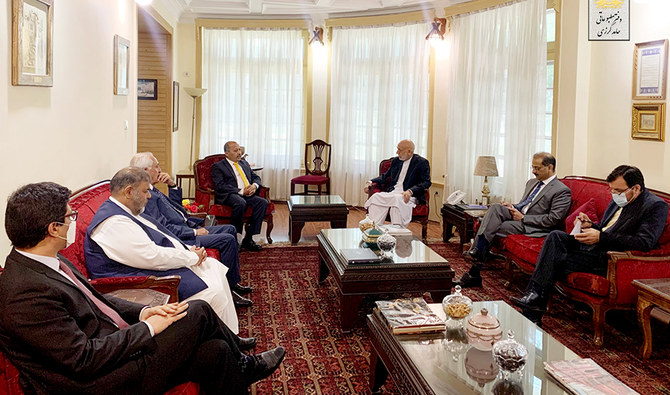

ISLAMABAD: Pakistan’s ambassador to Kabul has held a series of meetings with key Afghan stakeholders this week in a renewed push for peace negotiations between the Afghan government and Taliban insurgents as international forces continue to withdraw from the conflict-torn country.
The envoy’s meetings come as the US and NATO plan to withdraw all their troops from Afghanistan in July, ahead of a Sept. 11 deadline, leading to alarm in neighboring Pakistan which has always pushed for a phased and “orderly” withdrawal to prevent another escalation of conflict.
Last week, Prime Minister Imran Khan said increasing violence in Afghanistan would undermine Pakistan’s security and economic stability.
In the past few days, Pakistan’s envoy to Afghanistan, Mansoor Ahmad Khan, representing various Afghan factions. The meetings started on Sunday, with Abdullah Abdullah, Afghanistan’s chief peace negotiator, whom Khan also met on Wednesday,
“Had great honor to call on Chairman Afghan High Council for National Reconciliation H.E. @DrabdullahCE this afternoon and discuss Afghan peace process and related matters,” Khan said in a tweet.
Had great honour to call on Chairman Afghan High Council for National Reconciliation H.E. @DrabdullahCE this afternoon and discuss Afghan peace process and related matters. @PakistaninAfg @ForeignOfficePk pic.twitter.com/pn24lEOCoF
— Mansoor Ahmad Khan (@ambmansoorkhan) June 9, 2021
Earlier in the day, he met with former President Hamid Karzai, also to discuss peace efforts.
“Great honor to call on former President H.E. @KarzaiH today and have constructive discussions for promoting lasting peace and stability in Afghanistan,” Khan said in a tweet.
Great honour to call on former President H.E. @KarzaiH today and have constructive discussions for promoting lasting peace and stability in Afghanistan and strengthening fraternal relations between the two countries @PakistaninAfg @ForeignOfficePk pic.twitter.com/b5MfkxPHza
— Mansoor Ahmad Khan (@ambmansoorkhan) June 9, 2021
On the same day, Khan also met Afghanistan’s special envoy for Pakistan, Mohammed Umer Daudzai, to discuss Afghan peace and bilateral relations.
Called on Afghan President’s Special Envoy on Pakistan H.E. @Umerdaudzai2 and had important discussions with him on the way forward n Afghan peace process and strengthening bilateral relations @PakistaninAfg @ForeignOfficePk pic.twitter.com/Y4ia8HUBfr
— Mansoor Ahmad Khan (@ambmansoorkhan) June 9, 2021
On Tuesday, Khan met Nazir Ahmadzai, who advises Afghan President Ashraf Ghani on managing ethic divisions in the country that is home to various ethnicities and tribes, many of which are in conflict with one another.
Grateful to Haji Nazir Ahmadzai, Advisor to President on Ethnic Tribes for hosting a dinner for me at his residence this evening. We had frank discussions for strengthening brotherly ties between our two countries @PakistaninAfg pic.twitter.com/0A2eLn9ayA
— Mansoor Ahmad Khan (@ambmansoorkhan) June 8, 2021
On Sunday, Khan met Gulbuddin Hekmatyar, former prime minister and founder of the militia turned political party, Hizb-e-Islami, who has been seeking a role in the peace process, which is also aimed at producing a new power-sharing agreement in the country.
In a tweet, Khan said they had to discussed “ways for achieving lasting peace and stability in Afghanistan through an inclusive political settlement.”
Called on H.E. Gulbuddin Hekmatyar, Leader of Hizb-i-Islami Afghanistan and discussed ways for achieving lasting peace and stability in Afghanistan through an inclusive political settlement @HizbIslami @ForeignOfficePk @PakistaninAfg pic.twitter.com/tl97eFz9vr
— Mansoor Ahmad Khan (@ambmansoorkhan) June 6, 2021
Pakistan was key to bringing the Taliban to the negotiating table with Kabul representatives in past years. Its role in the Afghan peace process has been recognized both by the Afghan government and the US which sponsors intra-Afghan talks.


