

Mongolians voting for president amid biggest virus outbreak

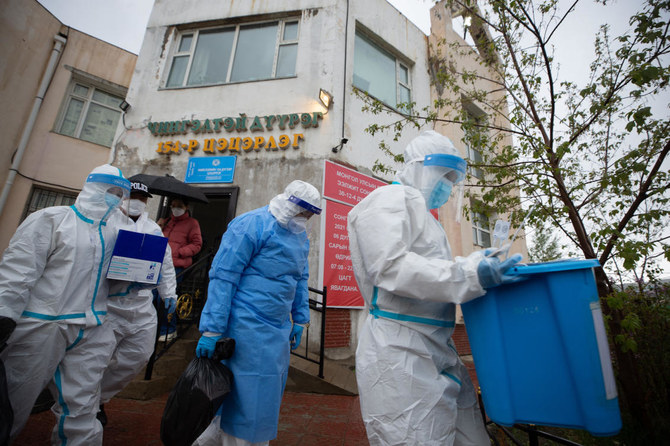
Election workers wearing protective suits against the COVID-19 (coronavirus) deliver ballot boxes to a kindergarten which will be used as a polling station in the presidential election in Ulaanbaatar. (File/AFP)
Short Url
Updated 09 June 2021
Follow

Mongolians voting for president amid biggest virus outbreak

  • The winner will become Mongolia’s sixth president since the transition from communism to democracy in 1992
  • A total of 2,151,329 voters are registered, according to the General Election Commission

ULAANBAATAR: Mongolians began voting Wednesday for a new president amid COVID-19 restrictions and efforts to revive the economy of the vast landlocked nation of just 3 million people.

The winner will become Mongolia’s sixth president since the peaceful transition from communism to democracy in 1992. Incumbent Battulga Khaltmaa of the Democratic Party is barred by the constitution from seeking a second six-year term.

Among the candidates, former Prime Minister Ukhnaagiin Khurelsukh of the Mongolian People’s Party, which exercises a strong majority in parliament, has raised concerns about a possible strengthening of the military’s involvement in public affairs due to his background with the armed forces.

The MPP also controls the Cabinet and Khurelsukh’s biggest rival Sodnomzunduin Erdene, of the much-weakened Democratic Party, has warned that the MPP winning the presidency would threaten Mongolia with dictatorship.

Former tech CEO Dangaasurengiin Enkhbat of the smaller National Labour Party is running as a third-party candidate.

The presidency is a largely ceremonial position, although it does include powers over the military and the right to veto legislation in some cases. Power is mainly vested in the parliament, the Cabinet and the office of the Prime Minister.

A total of 2,151,329 voters are registered, according to the General Election Commission. Polls close at 10 p.m. and it’s not clear when a winner will be announced.

Voters are required to observe social distancing, and restrictions on public gatherings have severely curtailed campaign events, prompting candidates to shift much of their outreach to voters online.

Mongolia’s already ailing economy has been thrown into crisis due to the pandemic, with 69,022 cases and 324 deaths reported and the number of new local infections hitting a daily record last week. That has forced the temporary closure of markets and other enterprises in the capital of Ulaanbaatar, to which many in the traditionally herding population have moved in recent years.

Corruption and pandemic-related disruptions in demand for Mongolia’s chief exports such as coal and copper are also dragging on the economy.

Mongolia has strived to maintain its political and economic independence from both Soviet-era patron Moscow — which supplies virtually all of its energy needs — and rising regional power China, which buys more than 90 percent of Mongolia’s mining exports.


Top Australian writers’ festival canceled after Palestinian author barred

Updated 4 sec ago
Follow

Top Australian writers’ festival canceled after Palestinian author barred

SYDNEY: One of Australia’s top writers’ festivals was canceled on Tuesday, after 180 authors boycotted the event and its director resigned saying she could not ​be party to silencing a Palestinian author and warned moves to ban protests and slogans after the Bondi Beach mass shooting threatened free speech.
Louise Adler, the Jewish daughter of Holocaust survivors, said on Tuesday she was quitting her role at the Adelaide Writers’ Week in February, following a decision by the festival’s board to disinvite a Palestinian-Australian author.
The novelist and academic Randa Abdel-Fattah said the move to bar her was “a blatant and shameless act of anti-Palestinian racism ‌and censorship.”
Prime ‌Minister Anthony Albanese on Tuesday announced a national day ‌of ⁠mourning ​would ‌be held on January 22 to remember the 15 people killed in last month’s shooting at a Jewish Hanukkah celebration on Bondi Beach.
Police say the alleged gunmen were inspired by the Islamic State militant group, and the incident sparked nationwide calls to tackle antisemitism, and prompted state and federal government moves to tighten hate speech laws.
The Adelaide Festival board said on Tuesday its decision last week to disinvite ⁠Abdel-Fattah, on the grounds it would not be culturally sensitive for her to appear at the literary ‌event “so soon after Bondi,” was made “out of respect ‍for a community experiencing the pain ‍from a devastating event.”
“Instead, this decision has created more division and ‍for that we express our sincere apologies,” the board said in a statement.
The event would not go ahead and remaining board members will step down, it added.
Former New Zealand Prime Minister Jacinda Ardern, British author Zadie Smith, Australian author Kathy Lette, Pulitzer Prize-winning American Percival ​Everett and former Greek finance minister Yanis Varoufakis are among the authors who said they would no longer appear at the festival ⁠in South Australia state, Australian media reported.
The festival board on Tuesday apologized to Abdel-Fattah for “how the decision was represented.”
“This is not about identity or dissent but rather a continuing rapid shift in the national discourse around the breadth of freedom of expression in our nation following Australia’s worst terror attack in history,” it added.
Abdel-Fattah wrote on social media that she did not accept the apology, saying she had nothing to do with the Bondi attack, “nor did any Palestinian.”
Adler earlier wrote in The Guardian that the board’s decision to disinvite Abdel-Fattah “weakens freedom of speech and is the harbinger of a less free nation, where lobbying and political ‌pressure determine who gets to speak and who doesn’t.”
The South Australian state government has appointed a new festival board.