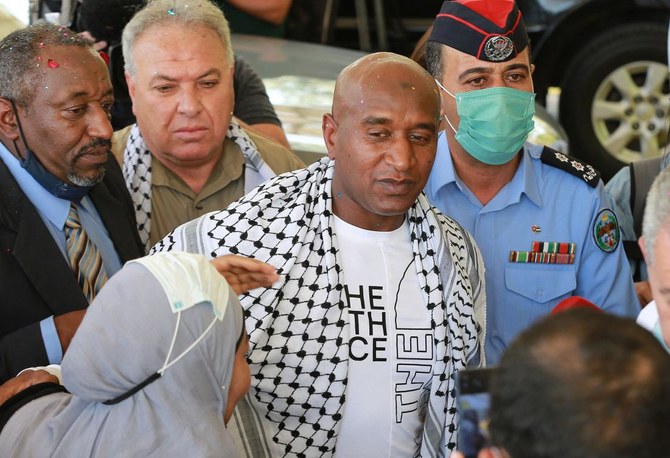
AMMAN: The longest serving Jordanian prisoner in an Israeli jail arrived home on Tuesday, Jordanian officials said.
He completed a 20-year sentence for planting a bomb on an Israeli bus that injured more than a dozen people.
Abdullah Abu Jaber, 44, was arrested after the explosive device went off on the bus in Tel Aviv in December 2000. He was one of thousands of Jordanians who found casual work in Israel after the two countries normalized ties with a peace treaty in 1994.
Abu Jaber, who was among 22 political prisoners held in Israeli jails, headed to his parents’ home in the teeming Baqaa Palestinian refugee camp near the Jordanian capital Amman, witnesses said.
Separately, foreign ministry officials said Israel had dropped charges against two Jordanians who were arrested last month for allegedly crossing the border carrying knives. The authorities had put them on trial shortly after their detention.
Jordan, which has the longest border with Israel, is a close Western ally. Last month it saw large protests against Israel’s military campaign in Gaza and its crackdown on Palestinian worshippers and protesters in Jerusalem’s Al-Aqsa mosque.
Political ties between the two countries have been strained over Israel’s treatment of the Palestinians, and the Jordanian government has faced growing public pressure to scrap the unpopular peace treaty.
Most of Jordan’s 10 million citizens are of Palestinian origin. They or their parents were expelled or fled to Jordan in the fighting that accompanied the creation of Israel in 1948.
They have close family ties with their kin on the other side of the Jordan River in the West Bank and East Jerusalem, both captured by Israel in the 1967 Arab-Israeli war.

Longest serving Jordanian prisoner in Israel arrives home: officials
Short Url
https://arab.news/2pjek
Longest serving Jordanian prisoner in Israel arrives home: officials
- Abdullah Abu Jaber was arrested after the explosive device went off on the bus in Tel Aviv in December 2000
- He was one of thousands of Jordanians who found casual work in Israel
Israeli military says it will pursue every successor of Iran’s Khamenei
- The clerical body that will choose Iran’s next supreme leader has more or less reached a majority consensus
- Minor disagreement over whether their final decision must follow an in-person meeting or instead be issued
The Israeli military warned it would continue pursuing every successor of Iran’s next supreme leader.
In a post on X in Farsi, the Israeli military also warned it would pursue every person who seeks to appoint a successor for Ayatollah Ali Khamenei, referring to the clerical body charged with choosing the Islamic Republic’s supreme leader.
The clerical body that will choose Iran’s next supreme leader, succeeding the slain Ayatollah Ali Khamenei, has more or less reached a majority consensus, Assembly of Experts member Ayatollah Mohammadmehdi Mirbaqeri said on Sunday.
The Mehr news agency quoted him as saying “some obstacles” still needed to be resolved regarding the process.
On Saturday, a senior cleric in the Assembly of Experts said its members would meet “within one day” to choose the leader.
Iranian media said the group had a minor disagreement over whether their final decision must follow an in-person meeting or instead be issued without adhering to this formality.
Ayatollah Mohsen Heidari Alekasir, another member of the Assembly of Experts, said in a video released by Nournews on Sunday that an in-person meeting by the assembly for a final vote was not possible under current conditions.
He said a candidate had been picked, based on the late supreme leader’s advice that Iran’s top leader should “be hated by the enemy” instead of praised by it.
“Even the Great Satan (US) has mentioned his name,” Heidari Alekasir said of the chosen successor, days after US President Donald Trump said that Khamenei’s son, Mojtaba, was an “unacceptable” choice for him.
In a post on X in Farsi, the Israeli military also warned it would pursue every person who seeks to appoint a successor for Ayatollah Ali Khamenei, referring to the clerical body charged with choosing the Islamic Republic’s supreme leader.
The clerical body that will choose Iran’s next supreme leader, succeeding the slain Ayatollah Ali Khamenei, has more or less reached a majority consensus, Assembly of Experts member Ayatollah Mohammadmehdi Mirbaqeri said on Sunday.
The Mehr news agency quoted him as saying “some obstacles” still needed to be resolved regarding the process.
On Saturday, a senior cleric in the Assembly of Experts said its members would meet “within one day” to choose the leader.
Iranian media said the group had a minor disagreement over whether their final decision must follow an in-person meeting or instead be issued without adhering to this formality.
Ayatollah Mohsen Heidari Alekasir, another member of the Assembly of Experts, said in a video released by Nournews on Sunday that an in-person meeting by the assembly for a final vote was not possible under current conditions.
He said a candidate had been picked, based on the late supreme leader’s advice that Iran’s top leader should “be hated by the enemy” instead of praised by it.
“Even the Great Satan (US) has mentioned his name,” Heidari Alekasir said of the chosen successor, days after US President Donald Trump said that Khamenei’s son, Mojtaba, was an “unacceptable” choice for him.
© 2026 SAUDI RESEARCH & PUBLISHING COMPANY, All Rights Reserved And subject to Terms of Use Agreement.


