Ice vests, coconut water as Pakistan Super League feels heat in UAE 

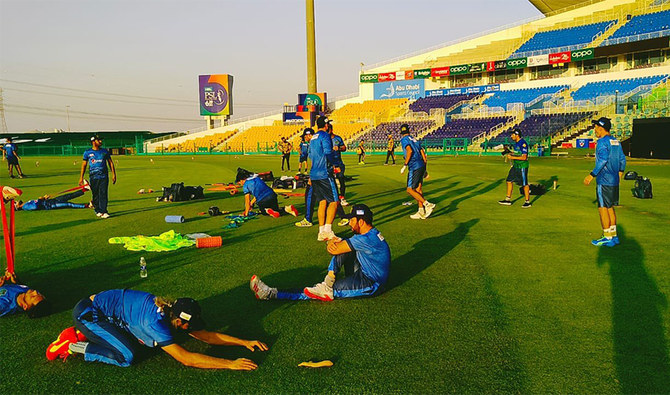
Players of Pakistan Super League (PSL) team Multan Sultans warm up ahead of remaining PSL matches in Sheikh Zayed Cricket Stadium, Abu Dhabi on June 3, 2021. (Photo courtesy: Pakistan Cricket Board)
Short Url
Updated 07 June 2021
Follow

Ice vests, coconut water as Pakistan Super League feels heat in UAE 

  • Twenty20 competition to resume on Wednesday far from home in Abu Dhabi 
  • With day-time temperatures hitting 40 degrees Celsius, some players will wear ice vests on the field 

KARACHI: Pakistan Super League cricketers will have to contend with soaring temperatures and empty stadiums when the Covid-hit Twenty20 competition resumes far from home in Abu Dhabi on Wednesday.
With day-time temperatures hitting 40 degrees Celsius (104 Fahrenheit), some players will wear ice vests on the field, while bowlers have been told to drink coconut water, a natural coolant.
The T20 cricket league was halted in Pakistan in March after seven players and support staff tested positive for Covid-19, and restart efforts stalled as the country was hit by a third wave of the virus.
The PSL will now be completed in the intense heat of the Gulf summer but, with the earliest games starting at 5pm, PCB CEO Wasim Khan said the conditions weren’t “unplayable.”
“There will be ice vests, packs, ice collars, regular drink intervals to make sure that players are kept safe and healthy,” said Khan.
“But it’s not in a position which is unplayable. It’s 38-40 degrees but by five o’clock in the evening it cools down a little bit.”
The United Arab Emirates will also host the remainder of the suspended Indian Premier League in September and October, while India is considering moving the October-November T20 World Cup to the Gulf country.
After exploring the possibility of resuming in the UAE, the Pakistan Cricket Board almost canned the PSL’s sixth edition entirely because of visa problems for players and camera crews traveling from Pakistan, India and South Africa.
All three countries are all on the UAE’s “red list,” with direct scheduled flights banned and compulsory quarantine for passengers arriving on charters.
“It’s tough to organize these matches under Covid... bringing crew and players from around the world and then following the stringent protocols,” said former Pakistan all-rounder Wasim Akram, president of defending champions Karachi Kings.
“Everybody has done a great job, and we are now about to start.”
Still, he added, the compulsory quarantine was draining.
“No matter how good the hotel is, this quarantine is very tough,” he said in a video message.
The PSL is something of a poor relation to the super-rich IPL, but still attracts a host of international stars — even if some are past their prime.
But with a global cricket calendar badly affected by the coronavirus pandemic, several big names will miss the rest of the tournament including big-hitting West Indian Chris Gayle, and South African fast bowler Dale Steyn.
New Zealand’s Martin Guptill, however — whose 147 Twenty20 international sixes are a world record — will be in action, alongside Australian Usman Khawaja and West Indian Andre Russell.
Afghanistan’s Rashid Khan, second in the world Twenty20 rankings, is also taking part.
Pakistanis are used to playing in the UAE, which effectively became a home venue for a decade from 2009 because of security issues after the visiting Sri Lanka team was attacked by Islamist radicals in Lahore.
But they haven’t played there at this time of the year, when the searing heat is accompanied by sapping humidity.
“It will be tough,” said Pakistan captain Babar Azam, who plays for the Kings.
“Players are professionals, and once they enter the field their focus will be on the game,” he added.
The final is scheduled for June 24.


Kazakh president meets Pakistan PM to discuss bilateral trade, regional connectivity

Updated 15 sec ago
Follow

Kazakh president meets Pakistan PM to discuss bilateral trade, regional connectivity

  • Kazakhstan seeks access to Arabian Sea ports as Pakistan pushes role as regional transit hub
  • Commerce ministers discuss connectivity challenges as Pakistan-Kazakhstan trade push grows

KARACHI: Kazakhstan President Kassym-Jomart Tokayev arrived at Prime Minister Shehbaz Sharif’s official residence in Islamabad on Wednesday for talks with Pakistan’s top political leadership on bilateral trade, cooperation and regional connectivity, with both sides expected to sign several memoranda of understanding (MoUs).

Tokayev arrived in Pakistan a day earlier on a two-day official visit as landlocked Kazakhstan seeks access to maritime trade routes through Pakistan’s southern ports on the Arabian Sea. Islamabad, meanwhile, has been positioning itself as a regional transit hub, with an emphasis on improving physical connectivity with Central Asian states.

Pakistan’s Deputy Prime Minister (DPM) and Foreign Minister (FM) Ishaq Dar called on the Kazakh president earlier in the day to welcome him to the country.

“Welcoming him to Pakistan, DPM/FM extended warm greetings from the President, Prime Minister, Government and people of Pakistan,” the foreign office said in a social media post.

It said Dar underscored Pakistan’s appreciation for the growing momentum of high-level political exchanges and reaffirmed a shared commitment to expand bilateral cooperation across political, economic and people-to-people domains, while working together for durable peace, stability and development in the region.

According to the Kazakh government, bilateral trade between the two countries stood at $53.7 million in 2024. Pakistan’s main exports to Kazakhstan include citrus fruits, pharmaceutical products, garments, soap and sports equipment, while imports largely comprise onions and garlic, dried legumes, oats, buckwheat, seeds and fruits.

Pakistan’s foreign office said a day earlier that Tokayev’s visit would offer an important opportunity to explore new avenues for cooperation, with MoUs expected in areas of mutual interest.

Federal Minister for Commerce Jam Kamal Khan separately held talks on Wednesday with Kazakhstan’s Minister of Trade and Integration Arman Shaqqaliev to review bilateral trade and connectivity.

“The meeting focused extensively on addressing connectivity challenges between Pakistan and Central Asia and identifying practical solutions to unlock the full trade potential between the two countries,” the commerce ministry said.

“Both sides agreed that improved rail, road and multimodal connectivity is fundamental to strengthening Pakistan–Kazakhstan trade and enabling sustainable, long-term economic engagement,” it added.

Shaqqaliev highlighted the strategic importance of major infrastructure projects, particularly rail and road corridors, saying such initiatives could generate trade and investment flows of about $5 billion, create jobs and strengthen regional supply chains.

Khan said Pakistan was keen to enhance direct connectivity with Central Asia through Turkmenistan and Afghanistan, while acknowledging regional and geopolitical challenges.

“Improved transit routes would not only benefit Pakistan and Kazakhstan but also open broader opportunities for regional and global trade, including access to African and ASEAN markets through Pakistan’s ports,” he was quoted as saying.

The two sides discussed cooperation in sectors including agriculture and food security, pharmaceuticals, textiles, sports goods, leather, mining, energy and infrastructure development.

Kazakhstan expressed interest in joint ventures in food processing, agriculture value chains and pharmaceuticals, while Pakistan invited Kazakh investment in mining, minerals and agri-based industries under its investment facilitation framework.

Both ministers also stressed the need for structured business-to-business engagement, agreeing that trade promotion bodies should focus on linking firms, sharing market intelligence and facilitating matchmaking without adding regulatory hurdles.

“They reaffirmed their shared commitment to transforming Pakistan–Kazakhstan economic relations from potential to performance, with a strong focus on connectivity, investment-led growth and regional integration,” the commerce ministry said, adding that sustained coordination and private-sector engagement could significantly boost trade and investment in coming years.