

India to ease lockdown rules as coronavirus case numbers decline

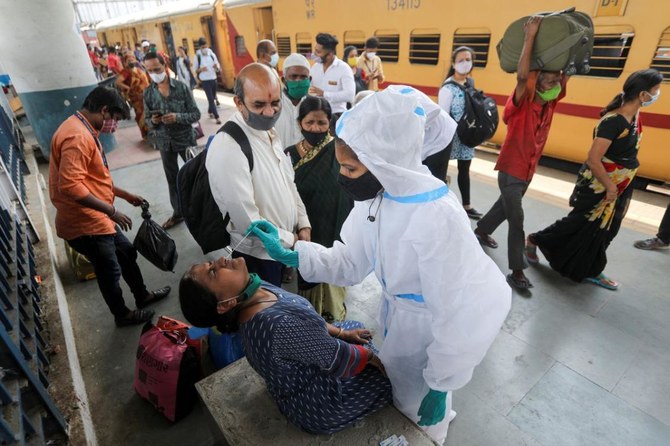
A health worker in personal protective equipment (PPE) collects a swab sample from a woman during a rapid antigen testing campaign for the coronavirus disease (COVID-19) in Mumbai. (File/Reuters)
Short Url
Updated 06 June 2021
Follow

India to ease lockdown rules as coronavirus case numbers decline

  • India has the world’s second-largest number of coronavirus infections after the United States
  • Scientists have warned of a third wave of the coronavirus

NEW DELHI: India reported 114,460 new coronavirus infections on Sunday, the lowest in two months, while the death toll increased by 2,677, as parts of the country prepared to ease movement restrictions.

India has the world’s second-largest number of coronavirus infections after the United States with total cases at 28.8 million, according to health ministry data. The country has suffered 346,759 deaths.

A second wave of the coronavirus that has largely battered the rural interiors of the country is yet to abate but New Delhi and other cities are working toward allowing more businesses to operate and movement rules to be relaxed from Monday onwards.

The western state of Maharashtra, which is India’s richest and has suffered the most infections during the second wave, plans to start this week easing in stages a strict lockdown imposed in April.

Scientists have warned of a third wave of the coronavirus that could hit India later in the year, likely impacting children more.

While the country has ramped up its vaccination drive in the past few weeks after a slow start, a majority of its 1.3 billion people are expected to remain unvaccinated by the time a potential third wave hits.


Bangladesh’s religio-political party open to unity govt

Updated 01 January 2026
Follow

Bangladesh’s religio-political party open to unity govt

  • Opinion polls suggest that Jamaat-e-Islami will finish a close second to the Bangladesh Nationalist Party in the first election it has contested in nearly 17 years

DHAKA: A once-banned Bangladeshi religio-political party, poised for its strongest electoral showing in February’s parliamentary vote, is open to joining a unity government and has held talks with several parties, its chief said.

Opinion polls suggest that Jamaat-e-Islami will finish a close second to the Bangladesh Nationalist Party in the first election it has contested in nearly 17 years as it marks a return to mainstream politics in the predominantly Muslim nation of 175 million.

Jamaat last held power between 2001 and 2006 as a junior coalition partner with the BNP and is open to working with it again.

“We want to see a stable nation for at least five years. If the parties come together, we’ll run the government together,” Jamaat chief Shafiqur Rahman said in an interview at his office in a residential area in Dhaka, ‌days after the ‌party created a buzz by securing a tie-up with a Gen-Z party.

Rahman said anti-corruption must be a shared agenda for any unity government.

The prime minister will come from the party winning the most seats in the Feb. 12 election, he added. If Jamaat wins the most seats, the party will decide whether he himself would be a candidate, Rahman said.

The party’s resurgence follows the ousting of long-time Prime Minister Sheikh Hasina in a youth-led uprising in August 2024. 

Rahman said Hasina’s continued stay in India after fleeing Dhaka was a concern, as ties between the two countries have hit their lowest point in decades since her downfall.

Asked about Jamaat’s historical closeness to Pakistan, Rahman said: “We maintain relations in a balanced way with all.”

He said any government that includes Jamaat would “not feel comfortable” with President Mohammed Shahabuddin, who was elected unopposed with the Awami League’s backing in 2023.