

Pushed out by machine-made Iranian rugs, carpet art disappears from Pakistan

Abdul Samad displays carpets at his shop on Double Road in Quetta, Balochistan, June 2, 2021. (AN photo by Saadullah Akhter)
Short Url
Updated 07 June 2021
Follow

Pushed out by machine-made Iranian rugs, carpet art disappears from Pakistan

  • Carpets from Iran cost less on the market than what carpet business owners pay their staff
  • Weavers say the art is dying as Pakistanis are no longer able to afford hand-knotted qaleen carpets

QUETTA: Famous hand-knotted qaleen carpets are disappearing from southwestern Pakistan as weavers say their craft has been pushed to the brink of extinction by cheap, machine-made rugs from Iran.

The neighborhoods of Hazara Town, Ghosabad and Marriabad in Quetta, the capital of Balochistan province, used to be Pakistan's main qaleen center, with regular exports to the United States and Europe giving employment to thousands of weavers. Now, only a few such workshops are left.

Muhammad Mehdi, who ten years ago inherited his father's qaleen business at Shoukat Stop of Krani Road, remembers how weavers would throng the one hundred khadis (looms) at his family's workshop.

"Hundreds of women, children and young workers used to come for this antique art of weaving, but today we have not a single khadi in our workshop," Mehdi said.

"Now, we only receive three or four orders a year from major carpet companies in Punjab and Sindh. We have hired workers who have their own khadis."

He pays his weavers $42 per square meter. The carpets then go to Lahore and are finished there to be ready for export, with the price per square meter jumping to about $300 and making it unfordable for most Pakistanis.
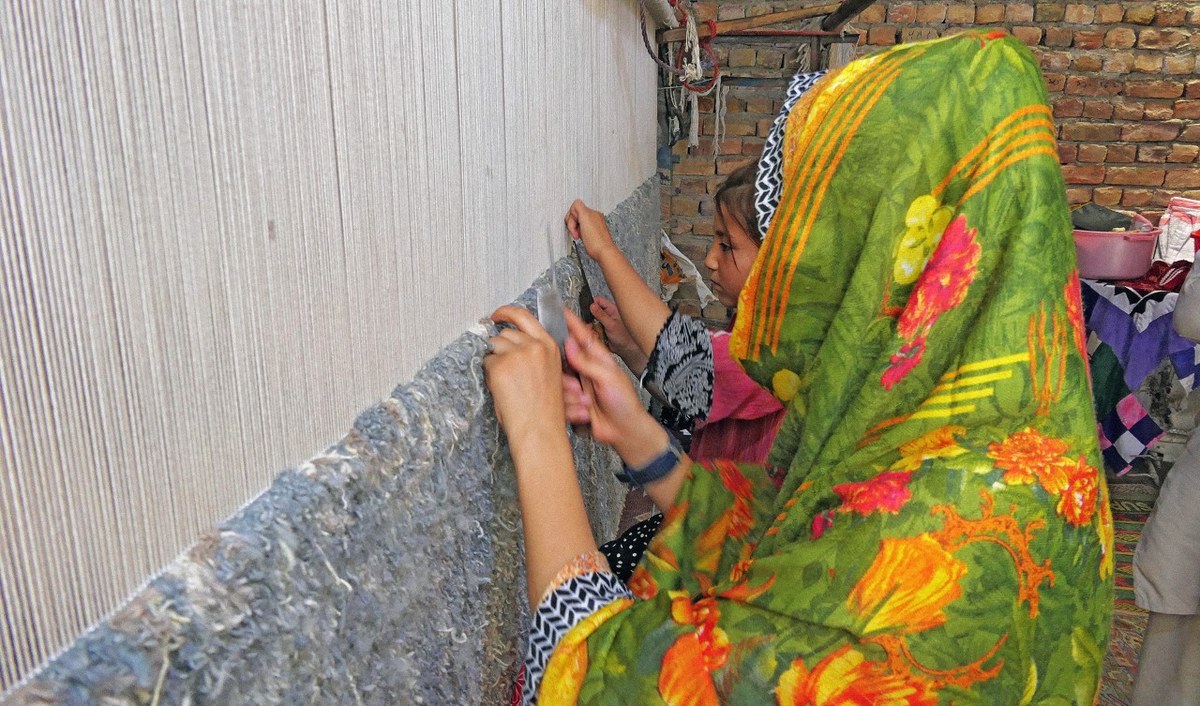


Girls knot a 30-meter rug at their home in Hazara Town, Quetta, Balochistan on June 2, 2021. (AN photo by Saadullah Akhter)

Iranian carpets, meanwhile, cost less than what Mehdi pays his contractors.

Some allege that what makes the Iranian carpets so cheap is not only machine-weaving but also that they enter Pakistan through the porous border without duty. Customs officials say, however, that the scale is not large.

"Indeed, the Iranian rugs are being smuggled to Pakistan but not in large numbers because the smugglers travel through the desert and rugged mountainous routes, which could damage the quality of rugs," a Quetta Customs official told Arab News on condition of anonymity as he is not authorized to talk to the media.

He added that while the Baloch carpets are still exported to the US and Europe, they are no longer sent from Balochistan. Quetta weavers only do the low-paid hard work, which is later sent for finishing to centers such as Lahore. Meanwhile, the local market is flooded by the cheap Iranian rugs.
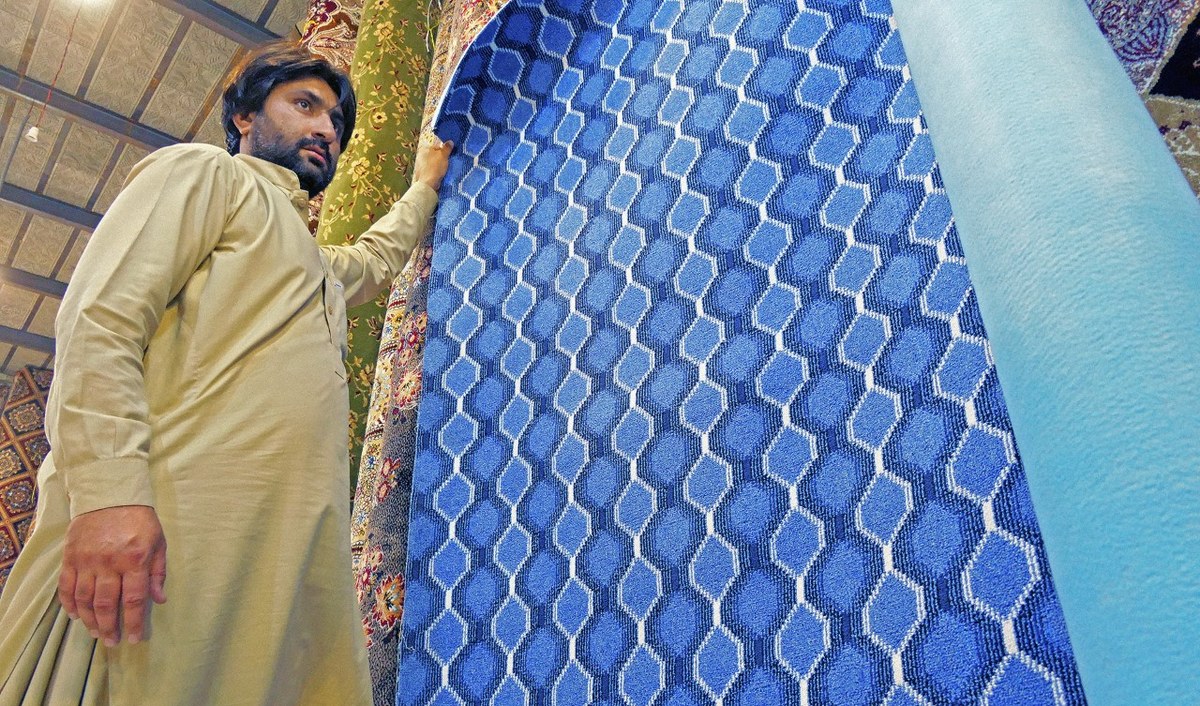


Abdul Samad shows a machine-made Iranian carpet on Double Road in Quetta, Balochistan, June 2, 2021. (AN photo by Saadullah Akhter)
 

"Balochistan didn’t export a single hand-knotted carpet abroad for the last three years," the official said.

Abdul Samad, a Quetta carpet seller who has been in the business for the past 22 years, says the downfall of his craft reflects increasing poverty across the whole country, with people who used to buy hand-made carpets no longer able to afford them.

"The cost of an Iranian rug of 10 to 13 meters is Rs60,000 ($390) while a hand-knotted rug of the same size would cost up to Rs400,000," he said. 

"Pakistani people can't buy them, except for the elites."


Pakistan’s JF-17 fighter jet draws ‘strong interest’ at Riyadh defense exhibition

Updated 29 min 30 sec ago
Follow

Pakistan’s JF-17 fighter jet draws ‘strong interest’ at Riyadh defense exhibition

  • Jets showcased as Pakistan seeks to expand defense exports
  • Interest in JF-17 has heightened after May 2025 conflict with India 

ISLAMABAD: Pakistan’s JF-17 Thunder fighter jet has drawn “strong interest” at the World Defense Exhibition in Riyadh, Pakistan’s state broadcaster said on Sunday, as Islamabad promotes the aircraft to international buyers at one of the region’s largest defense industry events.

The exhibition brings together defense officials, manufacturers and military delegations from dozens of countries, offering a platform for arms exporters to showcase equipment and pursue new contracts amid heightened global and regional security concerns.

Saudi Arabia has sought to position Riyadh as a regional hub for defense and aerospace exhibitions, using such events to foster partnerships and attract international manufacturers as part of broader diversification efforts. 

Last year Islamabad signed a mutual defense pact with Riyadh and is reportedly discussing another defense agreement involving Saudi Arabia and Turkiye, although details have not been made public.

“At the World Defense Exhibition in Riyadh, the Pakistan Air Force’s JF-17 Thunder has attracted strong interest from visitors and defense experts, standing out among fighter jets displayed by the US, Saudi Arabia and other countries,” state broadcaster Pakistan Television reported.

Islamabad is attending the exhibition in the backdrop of talks with at least 13 countries, six to eight of which are in an advanced stage, for deals involving JF-17 jets made jointly with China as well as training aircraft, drones, and weapons systems, according to recent media reports. 

Interest in the JF-17 jets has been bolstered by its operational visibility following the Pakistan-India military confrontation in May 2025, which Pakistani officials and defense analysts have cited as reinforcing the aircraft’s combat credibility.

Islamabad has increasingly positioned the JF-17 as a cost-effective multirole combat aircraft for countries seeking alternatives to high-end Western fighter jets. The aircraft is already in service with several foreign air forces and remains central to Islamabad’s defense export strategy.

Countries engaged in talks include Sudan, Saudi Arabia, Indonesia, Morocco, Ethiopia, and Nigeria as well as the government in eastern Libya led by Khalifa Haftar. Discussions on JF-17s and other weapons with Bangladesh and Iraq have been publicly acknowledged by Pakistan’s military, although more details have not been made public.

Almost all the potential buyers are Muslim-majority nations, like Pakistan. Many are from the predominantly Muslim Middle East, where Pakistan has historically been a security provider.

Separately, Pakistan’s Defense Minister Khawaja Asif met his Saudi counterpart, Khalid bin Salman bin Abdulaziz Al Saud, at the sidelines of the event. 

Asif congratulated the Saudi leadership and the defense minister on the “successful and splendid” organization of the World Defense Show, state broadcaster Radio Pakistan reported. 

“He described this global defense event as an important milestone in promoting defense cooperation in the region,” Radio Pakistan said.