

Asia-Pacific trade ministers mull pandemic, recovery

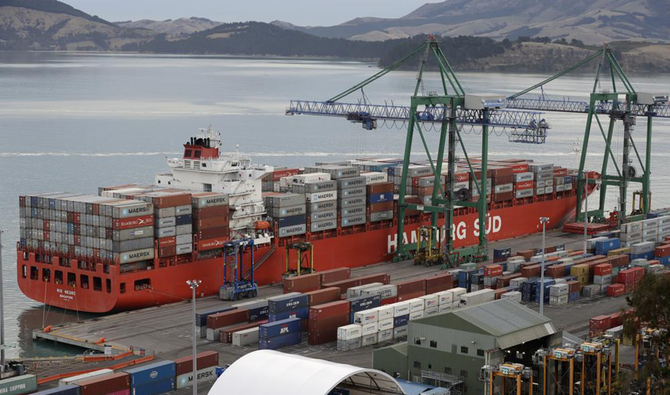
In this June 3, 2020, file photo, containers are loaded onto a ship for export at Lyttelton Port near Christchurch, New Zealand. (AP)
Short Url
Updated 05 June 2021
Follow

Asia-Pacific trade ministers mull pandemic, recovery

  • The trade ministers attending Saturday’s meeting conferred with business leaders on Friday on ways to better manage the health and economic crisis brought on by the pandemic

BANGKOK: Trade ministers from the Pacific Rim were discussing ways to build back better from the pandemic in an online meeting Saturday hosted by New Zealand.

The Asia-Pacific Economic Cooperation forum has long focused on dismantling trade barriers. The meeting of its trade ministers was convened virtually, given the travel restrictions prevailing in the region as coronavirus outbreaks flare in many countries still struggling to obtain and deploy enough COVID-19 vaccines.

On the agenda was a statement on aiding the movement of essential goods needed to fight the pandemic, in line with global trade rules that have been strained in recent years, especially during the administration of President Donald Trump who favored striking trade deals with individual countries.

The trade ministers attending Saturday’s meeting conferred with business leaders on Friday on ways to better manage the health and economic crisis brought on by the pandemic.

“We must ensure that trade plays a role in combatting the worst, continuing effects of COVID-19 through open and unrestricted trade in vaccines, essential medical supplies and associated products,” said Rachel Taulelei, chair of the APEC Business Advisory Council.

In many countries in the Asia-Pacific region, the share of people vaccinated so far is in the low single digits. That includes places like Thailand and Taiwan that initially managed to avoid initial massive outbreaks but now are contending with their worst flare-ups.

APEC members Japan, South Korea and New Zealand are ranked among the worst among all developed nations in vaccinating their people for COVID-19, below many developing countries such as Brazil and India. Australia is also performing comparatively poorly.

This week, President Joe Biden announced the US will swiftly donate an initial allotment of 25 million doses of surplus vaccine overseas through the UN-backed COVAX program, promising infusions for Asia, South and Central America, Africa and others.

That would be a substantial and immediate boost to the lagging COVAX effort, which to date has shared just 76 million doses with needy countries.

While some countries at times have limited exports of vaccines, chemicals needed to make them or of protective equipment such as surgical masks, it’s unclear whether tariffs and other trade barriers have been the main problem since countries like Japan and New Zealand imposed onerous approval requirements that have slowed inoculations.

The average tariff on vaccines is a low 0.8 percent, according to the APEC Secretariat. But duties on some other products can be as high as 30 percent for some countries.

While the average tariff on vaccines is very low within APEC (only 0.8 percent), tariffs are much higher for several goods that are very important in the vaccine supply chain.


Closing Bell: Saudi main market edges up to 10,745 points 

Updated 5 sec ago
Follow

Closing Bell: Saudi main market edges up to 10,745 points 

RIYADH: Saudi equities closed higher on Monday, with the Tadawul All Share Index finishing up 135.69 points, or 1.28 percent, at 10,745.45. 

The MSCI Tadawul 30 Index also advanced, rising 22.21 points, or 1.57 percent, to close at 1,436.31, while the Nomu Parallel Market Index slipped 31.80 points, or 0.13 percent, to 23,586.94. 

Market breadth was positive on the main market, with 216 gainers against 42 decliners, while Nomu saw 42 stocks advancing and 36 declining. 

Trading activity picked up, with 261.7 million shares changing hands, while total turnover reached SR5.10 billion ($1.3 billion). 

Among the top performers, Saudi Fisheries Co. led the gains, closing at SR63.90, up SR5.80, or 9.98 percent. Naseej International Trading Co. rose to SR34.94, gaining SR3.16, or 9.94 percent, while Dar Al Arkan Real Estate Development Co. ended at SR16.74, up SR1.16, or 7.45 percent. 

Zahrat Al Waha for Trading Co. added 6.84 percent to close at SR2.50, and Alamar Foods Co. climbed 5.75 percent to SR42.70.  

On the losing side, Al Masar Al Shamil Education Co. fell 4.36 percent to SR23.90, while Saudi Paper Manufacturing Co. declined 2.82 percent to SR62.05.  

United International Holding Co. slipped 2.36 percent to SR153.40, Saudi Aramco Base Oil Co. dropped 2.09 percent to SR98.60, and United Electronics Co. eased 1.90 percent to SR85.00.  

On the announcement front, Mouwasat Medical Services Co. announced that its board has approved the establishment of a new hospital in Riyadh’s Al-Narjis District, with a planned capacity of 280 beds and a total investment cost of SR900 million.  

The project will be financed through a mix of self-funding and long-term Shariah-compliant bank facilities, with further details on timelines and financial impact to be disclosed at a later stage.  

Shares of Mouwasat Medical Services Co. closed at SR67.95, gaining SR1.40, or 2.10 percent. 

Saudi Arabian Mining Co. reported a net addition of 7.8 million ounces of new gold resources following extensive exploration and drilling activities across multiple sites, alongside the identification of new mineralization opportunities in gold and base metals. 

The company noted that the financial impact of these discoveries has yet to be determined and will be assessed in due course.  

Shares of Saudi Arabian Mining Co. closed at SR67.50, up SR3.05, or 4.73 percent.