

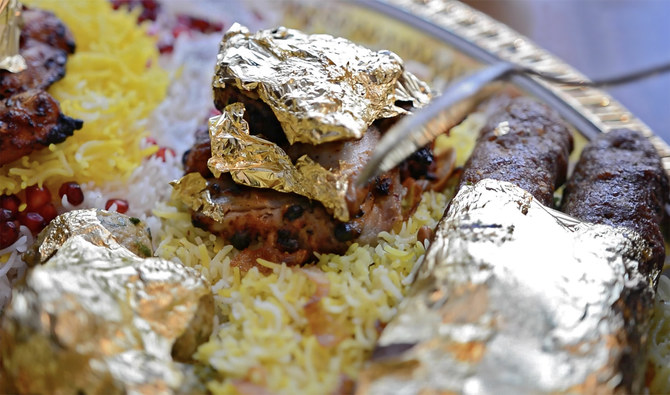
Oh my gold: Dubai restaurant raises biryani to a whole new 23-karat level

Short Url
Updated 05 June 2021
Follow

Oh my gold: Dubai restaurant raises biryani to a whole new 23-karat level

  • The Royal Gold Biryani is garnished with 23-karat edible gold that takes its price to 1,000 dirhams ($270)
  • Restaurant management says most customers do not bother about the price as they don't want to miss the unique experience

DUBAI: Despite political discord, Pakistan and India share more than a few cultural commonalities. One of them is their love for food, which a restaurant Dubai has raised to a whole new level by serving biryani, the most favorite South Asian rice dish, with 23-karat gold.

The fragrant rice delicacy full of spices and sumptuous chunks of meat which are fit for royalty, is served at Bombay Borough in Dubai’s high-end International Financial Center district with edible gold and a price tag so high that even royals will think twice before consuming it.

“We wanted to create something unique and because it is served with love, it is quite popular among expats and we sell at least one to two of these biryani dishes in a day,” Robin Pinto, the restaurant manager, told Arab News earlier this week.

Pinto said most customers do not bother about the 1,000-dirham ($270) price tag since the restaurant’s Royal Golden Biryani is a unique form of the dish and most diners did not want to miss the experience.

Bombay Borough’s signature biryani was launched in February 2020, only a few days before the coronavirus pandemic hit the Gulf country and sealed restaurants for several months.

Garnished with 23-karat gold leaves, the dish takes about 45 minutes to prepare and is served with seekh kabab, chicken malai boti, chicken boti, delicious kofta and boiled eggs.

It is served in a platter with curries and raita that enhance the flavor and can be shared among four to six people.

“We believe that good food tastes better when shared with good friends,” Pinto said.

Despite the high price tag, the restaurant sells at least one to two biryanis a day.

Husain Mansur, a Dubai-based businessman who tried the dish, told Arab News he had heard about it and wanted to know its taste.

“I had read a lot about it and also learnt about it from social media, and so I wanted to try this out for myself,” he said.

“This is one of a kind of experience and people should come and try it.”


Pakistan to launch AI screening in January to target fake visas, agent networks

Updated 05 December 2025
Follow

Pakistan to launch AI screening in January to target fake visas, agent networks

  • New system to flag forged-document travelers before boarding and pre-verify eligibility
  • Move comes amid increasing concern over fake visas, fraudulent agents, forged papers

ISLAMABAD: Pakistan will roll out an AI-based immigration screening system in Islamabad from January to detect forged documents and prevent illegal overseas travel, the government said on Thursday. 

The move comes amid increasing concern over fake visas, fraudulent agents and forged papers, with officials warning that such activity has contributed to deportations, human smuggling and reputational damage abroad. Pakistan has also faced scrutiny over irregular migration flows and labor-market vulnerability, particularly in the Gulf region, prompting calls for more reliable pre-departure checks and digital verification.

The reforms include plans to make the protector-stamp system — the clearance required for Pakistani citizens seeking overseas employment — “foolproof”, tighten labor-visa documentation, and cancel the passports of deportees to prevent them from securing visas again. The government has sought final recommendations within seven days, signalling a rapid enforcement timeline.

“To stop illegal immigration, an AI-based app pilot project is being launched in Islamabad from January,” Interior Minister Mohsin Naqvi said following a high-level meeting chaired by him and Minister for Overseas Pakistanis Chaudhry Salik Hussain.

Naqvi said the new screening technology is intended to determine travelers’ eligibility in advance, reducing airport off-loads and closing loopholes exploited by traffickers and unregistered agents.

The interior minister added that Pakistan remains in contact with foreign governments to improve the global perception and ranking of the green passport, while a uniform international driving license will be issued through the National Police Bureau.

The meeting also approved zero-tolerance measures against fraudulent visa brokers, while the Overseas Pakistanis Ministry pledged full cooperation to streamline the emigration workflow. Minister Hussain said transparency in the protector process has become a “basic requirement,” particularly for labor-migration cases.

Pakistan’s current immigration system has long struggled with document fraud, with repeated cases of passengers grounded at airports due to forged papers or agent-facilitated travel. The launch of an AI screening layer, if implemented effectively, could shift the burden from manual counters to pre-flight verification, allowing authorities to identify risk profiles before departure rather than after arrival abroad.

The reforms also come at a moment when labor mobility is tightening globally. Gulf states have begun demanding greater documentation assurance for imported labor, while European and Asian destinations have increased scrutiny following trafficking arrests and irregular-entry routes from South Asia. For Pakistan, preventing fraudulent departures is increasingly linked to protecting genuine workers, reducing deportation cycles and stabilizing the country’s overseas employment footprint.