KARACHI: An Islamabad-based fintech firm is all set to launch Pakistan’s first financial super app by the end of the month that will help the country’s population open digital accounts and enjoy cross-border payment facility, the company’s top official said on Friday.
“We are planning to launch Pakistan’s first financial super app by the end of June,” Talal Ahmed Gondal, cofounder and chief executive officer of TAG Innovation, said while talking to Arab News. “Our intention is to target women and youth in the first marketing phase who don’t have access to formal bank accounts.”
“In the next stage, TAG plans to launch Pakistan’s first digital bank,” he continued, adding that his organization would operate as an electronic money institution (EMI) for now and offer relevant services to the intended target market.
“The app will enable users to open digital accounts within three minutes,” Gondal explained. “The users will then be able to make peer-to-peer transfers, dispatch money to bank accounts, pay utility bills and recharge their mobile credit. Their phone number will also be their account number.”
The fintech startup has been authorized by the State Bank of Pakistan to operate as an EMI and is launching its pilot phase.
TAG recently closed $5.5 million in a pre-seed round led by venture capitals from the United States, including Quiet Capital Management and Liberty City Ventures. Other participants were Fatima Gobi Ventures, Unpopular Ventures as well as strategic investors like Visa and Angels Investors, the TAG chief informed.
The funding round makes it the largest ever pre-seed in the Middle East, North Africa and Pakistan region. The position was previously held by an Egyptian fintech, Telda, which raised $5 million, according to the data compiled by various venture capital institutions.
Gondal said Pakistan was among the difficult markets for funding since the economic ecosystem was still not mature for the purpose.
“In the US, it would have taken us a maximum of five weeks, but it took us five months here to generate the funding,” he said, though he also recognized that Pakistani market was still untapped with a huge potential.
The TAG chief said his company would utilize the funding for its commercial launch and to expand its outreach in the Middle East to facilitate remittance inflows and cross-border payments.
“We will Initially launch our services in Pakistan but offer them in the Middle East by the end of the year,” he said, adding that TAG wanted to begin the process from Saudi Arabia by hiring a local team since that was where “the highest number of expat Pakistanis live.”
“The funds will be transferred between Saudi and Pakistani TAG accounts within a minute at a very low rate,” he continued while pointing out that the facility would be offered with the help of Saudi banks.
Gondal said that large number of women and youth, particularly students, did not have access to formal banking channels.
“Existing players are mainly targeting lower income segments, but we will offer services to all income groups as the first B2C operator across Pakistan,” he said, adding: “The farming community will also be tapped to receive or make payments for wheats or subsidies.”
According to the World Bank, Pakistan has the third largest unbanked adult population in the world with about 100 million people without their own accounts.
“There are 60 million total bank accounts in Pakistan out of which unique accounts are estimated at 20 million,” Muhammad Sohail, chief executive officer of Topline Securities, said. “About 70 percent of Pakistan’s adult population lacks access to bank accounts.”
According to Pakistan’s central bank, the country has a low volume of electronic transactions due to low banking penetration, lack of trust and awareness related to digital payment methods, limited interoperability and high cost of transactions.


Fintech firm to launch Pakistan's first financial 'super app,' plans expansion to Middle East

https://arab.news/r2c3s
Fintech firm to launch Pakistan's first financial 'super app,' plans expansion to Middle East

- TAG Innovation plans to launch the country’s first digital retail bank after functioning as an electronic money institution for a substantial period
- The company also intends to offer its services to Pakistan’s largest diaspora community in Saudi Arabia by the end of the year to facilitate foreign remittances

Qatar, Pakistan resolve to boost strategic, economic cooperation at Doha talks
- Both countries urge dialogue on Afghanistan amid renewed border tensions between Islamabad and Kabul
- Discussions focus on bilateral trade and investment, energy, defense, manpower and labor and culture
ISLAMABAD: Pakistan and Qatar on Tuesday agreed to deepen their strategic and economic cooperation during high-level talks between Prime Minister Shehbaz Sharif and his Qatari counterpart Sheikh Mohammed bin Abdulrahman bin Jassim Al Thani, Sharif’s office said.
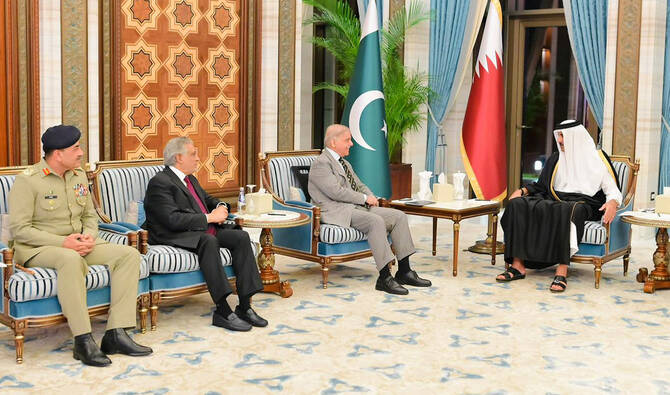
Sharif visited Qatar along with a high-level delegation on the invitation of Qatari emir Sheikh Tamim bin Hamad Al Thani. The Pakistani premier also held meetings with Qatar’s trade and defense ministers to discuss cooperation in various domains.
The visit came at a time when Pakistan is seeking closer economic engagement with Gulf partners amid its broader push to stabilize the economy and attract investment, while maintaining security and defense cooperation with key regional states.
During their meeting in Doha, PM Sharif and Qatar’s Sheikh Mohammed discussed bilateral relations and exchanged views on regional and international developments, according to the Pakistan prime minister’s office.
“They reaffirmed the strong brotherly relations between Pakistan and Qatar and expressed satisfaction at the growing momentum in political, economic and institutional ties,” Sharif’s office said.
“Discussions focused on enhancing cooperation in the fields of trade and investment, energy, defense, manpower and labor and culture, with both sides stressing the importance of their task force to accelerate cooperation in all these areas.”
Pakistan and Qatar maintain strong trade and investment ties. In 2022, the office of Qatar’s emir said the Qatar Investment Authority planned to invest $3 billion in Pakistan, targeting sectors including transport, aviation, education, health, media, technology and labor.
Nearly 300,000 Pakistanis live and work in Qatar, according to Pakistan’s foreign office, with many employed in health, education, engineering and public services, as well as construction and transport. The two countries engage through forums such as the Bilateral Political Consultations and the Joint Ministerial Commission.
Sharif said he had productive discussions with Qatar’s emir, Sheikh Tamim bin Hamad Al Thani, on how the two sides could transform their brotherly ties into mutually beneficial economic relationships.
“We also took stock of the regional situation,” he said on X. “Pakistan and Qatar will continue to work together for peace and stability in the region and beyond.”
DIALOGUE WITH AFGHANISTAN
Earlier, Sharif and Qatar’s Deputy PM Sheikh Saoud Al-Thani discussed the situation in Afghanistan and called for dialogue to support regional stability.
The meeting took place amid renewed tensions after Islamabad carried out airstrikes last week on what it described as Tehreek-e-Taliban Pakistan (TTP) targets inside Afghanistan. Kabul said the strikes killed civilians and vowed to respond to what it called a violation of its sovereignty.
“Regional developments were also discussed, in particular the situation in Iran and Afghanistan,” Sharif’s office said in a statement. “Both sides emphasized the importance of dialogue, de-escalation and collective efforts to promote peace and stability in the region.”
This was the second time in less than six months that Pakistan conducted airstrikes in Afghanistan. The last strikes triggered heavy, weeklong clashes between the neighbors along their border before Qatar and Turkiye mediated a ceasefire between them in Oct. last year.
Separately, Sharif held meetings with Qatar’s State Minister for Trade Dr. Ahmed bin Mohammed Al-Sayed and a delegation of the Qatar Businessmen Association (QBA), highlighting Pakistan’s investment-friendly reforms.
He invited QBA members to explore opportunities in infrastructure, logistics, energy, agriculture, technology and export-oriented manufacturing, his office said.