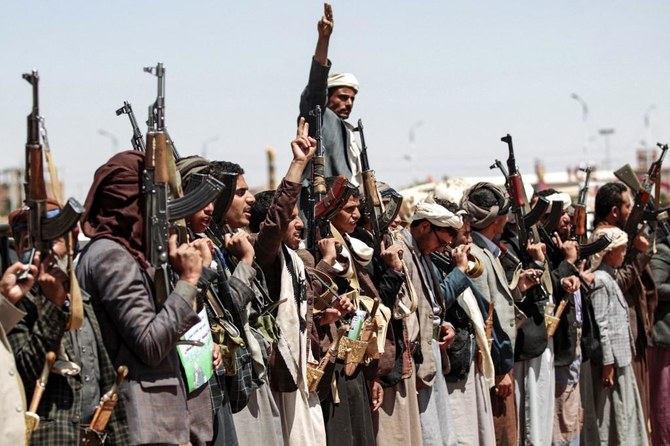

JEDDAH: The US on Friday blamed Iran-aligned Houthis for the failure of a ceasefire to take hold in Yemen on Friday and accused them of not taking other steps toward ending the brutal conflict.
“While there are numerous problematic actors inside of Yemen, the Houthis bear major responsibility for refusing to engage meaningfully on a ceasefire and to take steps to resolve a nearly seven-year conflict that has brought unimaginable suffering to the Yemeni people,” the State Department said.
The US special envoy for Yemen, Tim Lenderking, returned on Thursday from a trip to Saudi Arabia, Oman, the UAE and Jordan, where he discussed the humanitarian and economic crisis in Yemen with government officials, Yemenis and international partners, the department said in a statement.
Last week, the Arab coalition’s air defenses intercepted an explosives-laden drone launched by the Houthis toward Saudi Arabia. The weaponized UAV was aimed at the southern Saudi city of Khamis Mushait along the border with Yemen.
Since taking office in January, US President Joe Biden has made Yemen a priority and appointed Lenderking to help revive stalled UN peace efforts. After Lenderking returned from a visit last month, the State Department accused the Houthis of worsening Yemen’s humanitarian crisis by attacking Mario, the last northern stronghold of the legitimate government.
The situation has not changed.
“The Houthis continue a devastating offensive on Marib that is condemned by the international community and leaves the Houthis increasingly isolated,” the State Department said.
Lenderking had talked to Yemenis about strengthening “inclusive processes” that could help citizens discuss the country’s future and increase efforts toward peace, it said.
The UN Security Council called on the Houthis to quickly allow UN experts to examine an oil tanker moored off the war-torn country’s coast loaded with more than 1 million barrels of crude oil, warning there is a growing risk it could rupture or explode “causing an environmental, economic, maritime and humanitarian catastrophe for Yemen and the region.”
The UN’s most powerful body reiterated that the Houthis are responsible for delaying a technical assessment of the tanker, the FSO Safer, that the UN had hoped to deploy in March.
Moammer Al-Eryani, Yemen’s information minister, said the failure of negotiations between the UN and the Houthis over the tanker was “not surprising,” in light of the militia’s continued procrastination and elusiveness over the issue.
He said the militia is it as a bargaining chip, tool for blackmail, and an attempt to achieve political gains without heeding warnings of a disaster.