UN Security Council to discuss Yemen oil tanker impasse

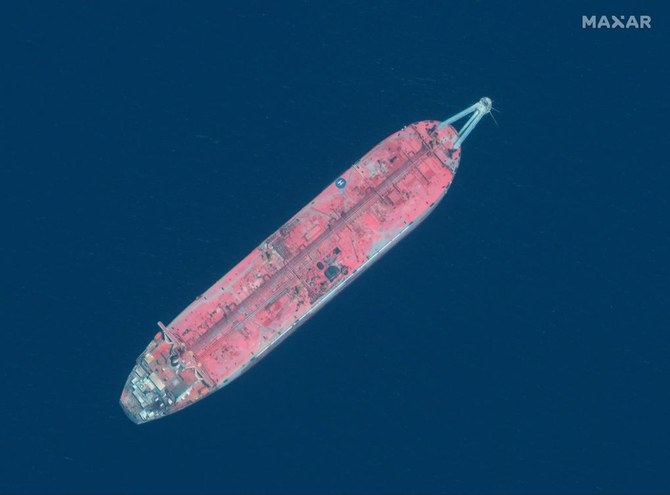
A close up view of the FSO Safer oil tanker on June 19, 2020, off the port of Ras Isa. (File/AFP)
Short Url
Updated 02 June 2021
Follow

UN Security Council to discuss Yemen oil tanker impasse

  • FSO Safer has 1.1 million barrels of crude on board and has been abandoned near Yemen’s port of Hodeida since 2015
  • Dujarric: Militia’s comments seem to confirm that the Houthis aren’t ready to provide the assurances we need

UNITED NATIONS: The UN Security Council will meet this week to discuss a long-abandoned fuel tanker off Yemen amid growing fears of a catastrophic oil spill, diplomats said Wednesday.
Thursday’s meeting, requested by Britain, comes after the Houthi militia said an agreement to allow a UN mission to inspect the tanker had “reached a dead end.”
The 45-year-old fuel vessel FSO Safer has 1.1 million barrels of crude on board and has been abandoned near Yemen’s western port of Hodeida since 2015.
UN inspectors were initially meant to assess the tanker last year but the mission has been repeatedly delayed over disagreements with the militia.
A spokesperson for Britain at the UN said there was a “grave risk” of an oil spill “which would be catastrophic for Yemen and the region.”
“The responsibility for the tanker lies with the Houthis and they must cooperate with the UN. We are bringing this issue to the UN Security Council tomorrow to discuss next steps,” he added.
The Houthis said Tuesday that negotiations with the UN had reached an impasse after several days of talks, according to their Al-Masira channel.
They said they “deeply regret the UN’s backing out of conducting maintenance work (in a deal) that was signed last November.”
Stephane Dujarric, spokesman for UN Secretary General Antonio Guterres, reiterated that maintenance work can’t be undertaken without an impartial assessment first.
He said the militia's comments “seem to confirm that the Houthis aren’t ready to provide the assurances we need to deploy the UN mission to the Safer.”
“The Safer is a dangerous site, and we need to understand exactly what we’re dealing with before undertaking any major works,” Dujarric said.
The UN has said an oil spill would destroy Red Sea ecosystems, shut down the fishing industry and close Yemen’s lifeline Hodeida port for six months.
Apart from corrosion to the aging vessel, essential work to curb explosive gases in its storage tanks has been neglected.


Fledgling radio station aims to be ‘voice of the people’ in Gaza

Updated 15 February 2026
Follow

Fledgling radio station aims to be ‘voice of the people’ in Gaza

  • The electricity crisis is one of the most serious and difficult problems in the Gaza Strip, says Shereen Khalifa Broadcaster

DEIR EL-BALAH: From a small studio in the central city of Deir El-Balah, Sylvia Hassan’s voice echoes across the Gaza Strip, broadcast on one of the Palestinian territory’s first radio stations to hit the airwaves after two years of war.

Hassan, a radio host on fledgling station “Here Gaza,” delivers her broadcast from a well-lit room, as members of the technical team check levels and mix backing tracks on a sound deck. “This radio station was a dream we worked to achieve for many long months and sometimes without sleep,” Hassan said.

“It was a challenge for us, and a story of resilience.”

Hassan said the station would focus on social issues and the humanitarian situation in Gaza, which remains grave in the territory despite a US-brokered ceasefire between Israel and Hamas since October.

“The radio station’s goal is to be the voice of the people in the Gaza Strip and to express their problems and suffering, especially after the war,” said Shereen Khalifa, part of the broadcasting team.

“There are many issues that people need to voice.” Most of Gaza’s population of more than 2 million people were displaced at least once during the gruelling war.

Many still live in tents with little or no sanitation.

The war also decimated Gaza’s telecommunications and electricity infrastructure, compounding the challenges in reviving the territory’s local media landscape. “The electricity problem is one of the most serious and difficult problems in the Gaza Strip,” said Khalifa.

“We have solar power, but sometimes it doesn’t work well, so we have to rely on an external generator,” she added.

The station’s launch is funded by the EU and overseen by Filastiniyat, an organization that supports Palestinian women journalists, and the media center at the An-Najah National University in Nablus, in the occupied West Bank.

The station plans to broadcast for two hours per day from Gaza and for longer from Nablus. It is available on FM and online.

Khalifa said that stable internet access had been one of the biggest obstacles in setting up the station, but that it was now broadcasting uninterrupted audio.

The Gaza Strip, a tiny territory surrounded by Israel, Egypt, and the Mediterranean Sea, has been under Israeli blockade even before the attack on Oct. 7, 2023, which sparked the war. Despite the ceasefire, Israel continues to strictly control the entry of all goods and people to the territory.

“Under the siege, it is natural that modern equipment necessary for radio broadcasting cannot enter, so we have made the most of what is available,” she said.