Oil rises toward $72 on demand prospects

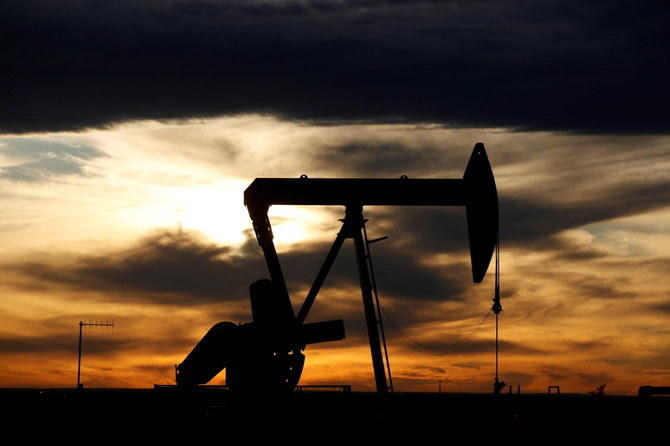
The fast pace of vaccinations in countries such as the U.S. has boosted demand for oil. (Reuters)
Short Url
Updated 04 June 2021
Follow

Oil rises toward $72 on demand prospects

  • Brent hit $71.99 on Thursday for highest since May 2019

LONDON: Oil rose toward $72 a barrel on Friday, trading close to a two-year high as OPEC+ supply discipline and recovering demand countered concerns about patchy COVID-19 vaccination rollout around the globe.
The Organization of the Petroleum Exporting Countries (OPEC) and allies on Tuesday said they would stick to agreed supply restraints. A weekly supply report on Thursday showed US crude inventories dropped more than expected last week.
Brent crude rose 33 cents, or 0.5 percent, to $71.64 a barrel by 08:12 a.m. GMT. It reached an intra-day high of $71.99 on Thursday for its highest since May 2019. US West Texas Intermediate crude was up 22 cents, or 0.3 percent, at $69.03.
“After much dilly-dallying, Brent appears to have found a new home above $70,” said Stephen Brennock of oil broker PVM.
“Summer and the reopening of the global economy is bullish for oil demand in the second half of the year.”
For the week, Brent is on track for a gain of more than 2.8 percent and US crude is heading for a 4 percent rise.
Also boosting oil this week was a slowdown in talks between the United States and Iran over Tehran’s nuclear program, which reduced expectations for a rapid increase in supply of Iranian oil to the market.
In focus later on Friday will be US jobs figures for May. The consensus forecast for non-farm payrolls, due at 12:30 p.m. GMT, is that about 650,000 jobs were added in May.
While rising demand and the fast pace of COVID-19 vaccinations in countries such as the United States has boosted oil, a slower inoculation rollout and high infections in the likes of Brazil and India are hitting demand in high-growth oil markets.
India, the world’s second most populous country, has vaccinated only 4.7 percent of the adult population and is reeling from a second wave of infections.


Qatar CPI falls in January, annual inflation rises 2.28% 

Updated 5 sec ago
Follow

Qatar CPI falls in January, annual inflation rises 2.28% 

JEDDAH: Qatar’s consumer price index climbed 2.28 percent in January from a year earlier, official data showed, while registering a 2.22 percent drop from the previous month.

The decline from December was led by an 11.97 percent drop in recreation and culture prices, alongside decreases in miscellaneous goods and services, restaurants and hotels, clothing, food and housing-related costs, Qatar News Agency reported, citing data from the National Planning Council. 

This was followed by miscellaneous goods and services at 3.46 percent, restaurants and hotels at 1.90 percent, clothing and footwear at 1.15 percent, food and beverages at 0.59 percent, and housing, water, electricity, gas, and other fuels at 0.17 percent. 

Qatar’s inflation remains relatively contained compared with wider global price swings, helped by stable housing costs and government subsidies. Across the region, trends are mixed, with Saudi inflation easing to 1.8 percent in January while Egypt’s annual rate slowed to 10.1 percent even as monthly prices jumped. 

“The annual increase, comparing January 2026 with the same month in 2025, was driven by rises in eight groups,” QNA reported, noting that the largest year-on-year increases were seen in miscellaneous goods and services, which rose 12.40 percent. 

Price increases were observed in the transport group at 0.54 percent, followed by communication at 0.32 percent and health at 0.27 percent. Furniture and household equipment rose 0.20 percent and education edged up 0.06 percent, while tobacco recorded no change. 

This was followed by recreation and culture at 4.90 percent and clothing and footwear at 3.25 percent. Food and beverages rose 2.87 percent, furniture and household equipment 2.37 percent, education 2.08 percent, housing and utilities 1.21 percent, and communication 0.40 percent. 

In contrast, QNA further reported, three groups saw annual declines: restaurants and hotels, down 2 percent; health, down 1.38 percent; and transport, down 0.48 percent, while the tobacco group remained unchanged. 

“When calculating the CPI for January 2026 excluding the housing, water, electricity, gas, and other fuels group, the index reached 114.57 points, down by 2.65 percent compared with December 2025, and up by 2.51 percent compared with January 2025,” the QNA report added. 

The index — which tracks inflation across 12 main expenditure groups covering 737 goods and services — is based on 2018 as the reference year, drawing on the Household Income and Expenditure Survey conducted in 2017–2018.