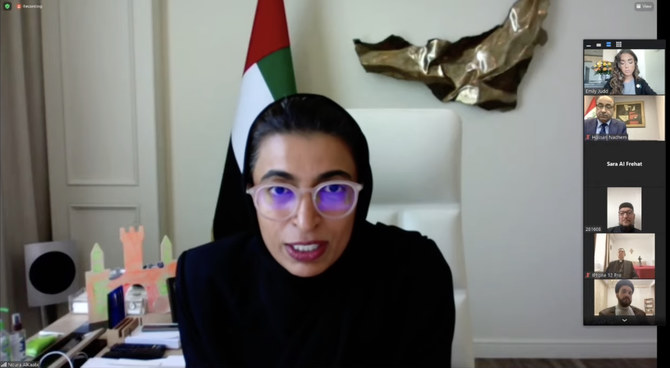

RIYADH: The Higher Committee of Human Fraternity (HCHF) held a webinar on Thursday, called “Pope Francis in Iraq: A Moment of Human Fraternity,” to discuss concrete steps that can be taken to ensure that the seed of harmony in Iraq continues to grow, with partnerships across all religious and ethnic divides.
“We, the people of Iraq, are working to sustain the momentum of Pope Francis’s visit,” Hassan Nadhem, Iraq’s minister of culture, said. “We’ve created a high commission in the general secretariat of the council of ministers dedicated to this mission, and have many upcoming projects.”
A department for cultural diversity also has been set up, he added.
Three months ago, Pope Francis went on a “pilgrimage” to Iraq, becoming the first Catholic pope in history to visit the country. He traveled to the cities including Mosul, Baghdad and Irbil with a message of peace.
“You are all brothers,” he said.
Mohammed Abdel Salam, secretary-general of the HCHF and former adviser to the grand imam of Al-Azhar, reaffirmed the pontiff’s message in his opening statement, saying: “We are all brothers, and Iraq is in all our hearts.”
He said: “Today, I sit among a diverse group of people who represent hope in their hard work and determination for the cause of human fraternity. Today we sit together for the sake of Iraq and to discuss how we can build on Pope Francis’ historic visit.
“Iraq is a country with people from all walks of life,” he added.
Iraq, the “cradle of civilization” known for its history of coexistence under Mesopotamian rule, has been plagued by wars, economic crises and, more recently, the COVID-19 (coronavirus) health crisis.
Mosul, in particular, has been devastated by militant extremists in the past few years. Its mosques and churches have been destroyed, its city library set aflame and antiquities trafficked, all at the hands of Daesh.
In February 2018, UNESCO launched the “Revival of the Spirit of Mosul” initiative at the International Conference for the Reconstruction of Iraq in Kuwait.
The $100 million program aims to link international efforts to help reconstruct the devastated city and restore its heritage.
Noura Al-Kaabi, UAE's minister of culture and youth, praised the joint effort, in partnership with UNESCO, toward rebuilding Mosul.
“We took the leap to commit to the ‘Revival of the Spirit of Mosul’ because we wanted to stand by our brothers and sisters in Mosul and Iraq, to support them in reviving the identity of the city and rebuilding their future, instilling hope and demonstrating the power of solidarity.
“The UAE hopes this is a project that is sustainable; this is very important to us,” she said. “The project has already employed 600 people and is set to target 1,000 employment and training opportunities by 2023.”
The initiative includes the creation of educational institutes, a museum with the remnants of Al-Nouri mosque — destroyed by Daesh in 2017 — among other restorations of monumental landmarks, all of which will contribute toward the increase in tourism and economic recovery, according to Al-Kaabi.
Ernesto Ottone, assistant general director of UNESCO, said that the second phase of the initiative provides more than 2,800 job opportunities for Iraqi women and men.
“Young Iraqis have many talents and are really willing to grab all the opportunities,” Olivier Poquillon, Dominican order representative to UNESCO and the UAE’s restoration project in Mosul, said.
Louis Raphael I Sako, patriarch of Babylon of the Chaldeans and head of the Chaldean Catholic Church, called on the people of Iraq to stand as one and work to renew interreligious dialogue.
The Iraqi culture minister announced the completion of an official booklet that informs and acknowledges people’s different religions — the completion of which came with the help and support of Sayyed Jawad Al-Khoei, Shiite religious leader in Najaf and founder of the Iraqi Council for Interfaith Dialogue.
“We must also play our role to shape the family home, criminalize offensive speech and prevent the killing of one another,” Abdul Wahab Taha Al-Sammerai, imam of Abu Hanifa Mosque in Baghdad, said.
“And we must be unified in legislating these issues. Only then will we reach a civil state in which everyone is equal.”
All panelists expressed their joy at the pending visit of the grand imam of Al-Azhar to Iraq to build on Pope Francis’ mission of human fraternity.