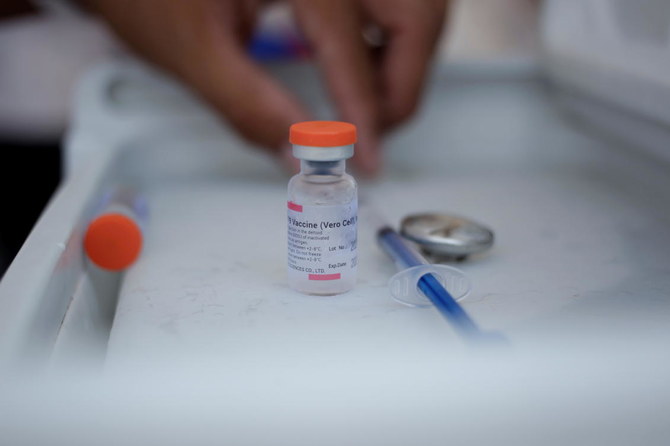
CAIRO: Egypt’s local production of the first batch of the Chinese Sinovac coronavirus vaccine will start by the end of June, according to Health Minister Hala Zayed.
Khaled Mujahid, the Ministry of Health and Population’s spokesman, said once the production of the first batch is completed, it will be sent to the Egyptian Drug Authority for analysis.
Mujahid said Chinese experts were currently in Egypt to supervise the manufacturing process and transfer expertise to both the Egyptian Holding Co. for Biological Products and Vaccines (VACSERA) and the Egyptian Drug Authority.
He said Egypt is one of the first countries in the world to manufacture the Sinovac vaccine following an agreement reached in April, and stressed clinical trials had been conducted on the jab and that competitive prices were fixed in the agreement.
Sinovac’s efficacy, he added, was 91 percent based on clinical studies conducted in Brazil, Chile, Turkey, Indonesia, China, Hong Kong and the Philippines. Second doses, he said, will be administered 21 days after first doses.
The ministry has allocated more than 400 centers nationwide and urged citizens — especially the elderly and those with chronic diseases — to register to get the jabs.
The government has also approved 179 new facilities to provide doses for those who work abroad and have filed requests for vaccination.
More details about their locations will be shared on the ministry’s website to ease the process. Requests for vaccine certificates for travel are also being addressed.
The ministry announced that mobile medical clinics will be stationed in front of post offices in all governorates to vaccinate pensioners from the first until the 10th of each month.
These clinics are equipped with two data entry points to electronically register pensioners, and devices to check blood pressure and blood sugar before administering the vaccine.

Egypt’s local production of Sinovac vaccine to begin by end of June
Short Url
https://arab.news/rtky6
Egypt’s local production of Sinovac vaccine to begin by end of June
- Centers to provide jabs to Egyptians working abroad
- Egypt is one of the first countries in the world to manufacture the Sinovac vaccine
Aid trucks resume crossing Egypt-Gaza border after closure
- More than 100 aid trucks crossed the Egyptian side of Gaza’s Rafah border crossing on Tuesday, two sources told AFP
RAFAH: More than 100 aid trucks crossed the Egyptian side of Gaza’s Rafah border crossing on Tuesday, two sources told AFP.
Israel closed all crossings into the Gaza Strip on Saturday, after it launched a joint attack on Iran with the United States.
It agreed to reopen the Kerem Shalom crossing, where trucks from Egypt are inspected, for the “gradual entry of humanitarian aid.”
“More than 100 United Nations aid trucks, including UNICEF’s, entered the Rafah border crossing” on Tuesday, a source at the border told AFP on Wednesday on condition of anonymity.
An official with the Egyptian Red Crescent, which coordinates aid deliveries, said the trucks “went through Rafah to the Kerem Shalom crossing,” where Israeli authorities did not send any back to Egypt — their procedure when aid shipments are rejected.
Both sources said no Palestinians were allowed through the crossing on Tuesday.
The Rafah crossing, the only gateway for Gazans to the outside world that does not pass through Israel, had reopened for a trickle of people on February 2, nearly two years after Israeli forces seized it.
A statement from the Red Crescent on Tuesday said the convoy included hundreds of tons of food, relief supplies and “fuel products to operate hospitals and vital facilities.”
The UN had warned its partners were “forced to ration fuel, prioritize life-saving operations” in the devastated Palestinian territory.
The Red Crescent official said another aid convoy was sent on Wednesday and was waiting to be allowed in.
The October peace deal between Israel and Palestinian militant group Hamas stipulates that 600 aid trucks should be allowed in per day.
Israel closed all crossings into the Gaza Strip on Saturday, after it launched a joint attack on Iran with the United States.
It agreed to reopen the Kerem Shalom crossing, where trucks from Egypt are inspected, for the “gradual entry of humanitarian aid.”
“More than 100 United Nations aid trucks, including UNICEF’s, entered the Rafah border crossing” on Tuesday, a source at the border told AFP on Wednesday on condition of anonymity.
An official with the Egyptian Red Crescent, which coordinates aid deliveries, said the trucks “went through Rafah to the Kerem Shalom crossing,” where Israeli authorities did not send any back to Egypt — their procedure when aid shipments are rejected.
Both sources said no Palestinians were allowed through the crossing on Tuesday.
The Rafah crossing, the only gateway for Gazans to the outside world that does not pass through Israel, had reopened for a trickle of people on February 2, nearly two years after Israeli forces seized it.
A statement from the Red Crescent on Tuesday said the convoy included hundreds of tons of food, relief supplies and “fuel products to operate hospitals and vital facilities.”
The UN had warned its partners were “forced to ration fuel, prioritize life-saving operations” in the devastated Palestinian territory.
The Red Crescent official said another aid convoy was sent on Wednesday and was waiting to be allowed in.
The October peace deal between Israel and Palestinian militant group Hamas stipulates that 600 aid trucks should be allowed in per day.
© 2026 SAUDI RESEARCH & PUBLISHING COMPANY, All Rights Reserved And subject to Terms of Use Agreement.


