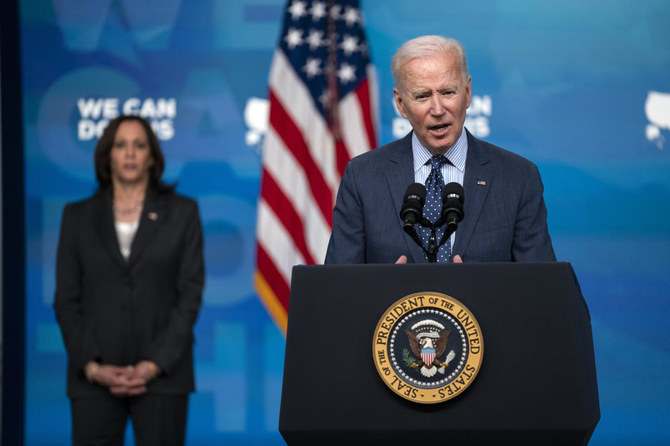
WASHINGTON: President Joe Biden announced Thursday the US will donate 75 percent of its unused COVID-19 vaccines to the UN-backed COVAX global vaccine sharing program, acting as more Americans have been vaccinated and global inequities have become more glaring.
Of the first tranche of 25 million doses, the White House said about 19 million will go to COVAX, with approximately 6 million for South and Central America, 7 million for Asia and 5 million for Africa. The doses mark a substantial — and immediate — boost to the lagging COVAX effort, which to date has shared just 76 million doses with needy countries.
Overall, the White House aims to share 80 million doses globally by the end of June, most through COVAX. But 25 percent of the nation’s excess will be kept in reserve for emergencies and for the US to share directly with allies and partners.
“As long as this pandemic is raging anywhere in the world, the American people will still be vulnerable,” Biden said in a statement. “And the United States is committed to bringing the same urgency to international vaccination efforts that we have demonstrated at home.”
US National Security Adviser Jake Sullivan said the US “will retain the say” on where the doses distributed through COVAX ultimately go.
“We’re not seeking to extract concessions, we’re not extorting, we’re not imposing conditions the way that other countries who are providing doses are doing; we’re doing none of those things,” said Sullivan. “These are doses that are being given, donated free and clear to these countries, for the sole purpose of improving the public health situation and helping end the pandemic.”
The remaining 6 million in the initial tranche of 25 million will be directed by the White House to US allies and partners, including Mexico, Canada, South Korea, West Bank and Gaza, India, Ukraine, Kosovo, Haiti, Georgia, Egypt, Jordan, Iraq, and Yemen, as well as for United Nations frontline workers.
Vice President Kamala Harris informed some US partners they will begin receiving doses, in separate calls with Mexican President Andres Manuel López Obrador, President Alejandro Giammattei of Guatemala, Indian Prime Minister Narendra Modi, and Prime Minister Keith Rowley of Trinidad and Tobago. Harris is to visit Guatemala and Mexico in the coming week.
The long-awaited vaccine sharing plan comes as demand for shots in the US has dropped significantly — more than 63 percent of adults have received at least one dose — and as global inequities in supply have become more glaring.
Scores of countries have requested doses from the United States, but to date only Mexico and Canada have received a combined 4.5 million doses. The US also has announced plans to share enough shots with South Korea to vaccinate its 550,000 troops who serve alongside American service members on the peninsula. White House COVID-19 coordinator Jeff Zients said that 1 million Johnson & Johnson doses were being shipped to South Korea Thursday.
The growing US stockpile of COVID-19 vaccines is seen by many overseas and at home not only as a testament to America’s achievement but also its global privilege.
Tom Hart the, acting CEO of The ONE Campaign, called the Thursday announcement a “welcome step” but said the Biden administration needs to commit to sharing more doses. “The world is looking to the US for global leadership and more ambition is needed.”
Biden has committed to providing other nations with all 60 million domestically produced doses of the AstraZeneca vaccine, which has yet to be authorized for use in the US but is widely approved around the world. The US-produced doses have been held up for export by an ongoing safety review by the Food and Drug Administration, said Zients.
The White House says the initial 25 million doses will be shipped from existing federal stockpiles of Pfizer, Moderna and Johnson & Johnson vaccines. More doses are expected to be made available to share in the months ahead.
As part of its purchase agreements with drug manufacturers, the US controlled the initial production by its domestic manufacturers. Pfizer and Moderna are only now starting to export vaccines produced in the US to overseas customers. The US has hundreds of millions more doses on order, both of authorized and in-development vaccines.
The White House also announced Thursday that it is lifting restrictions on sharing vaccines produced by AstraZeneca, as well as Sanofi and Novavax, which are also not authorized in the US, allowing the companies to determine for themselves where to share their doses.


![]()

Biden announces international COVID-19 vaccine sharing plan
Short Url
https://arab.news/wnw7e
Biden announces international COVID-19 vaccine sharing plan
- 6 million in the initial 25 million will be directed by the White House to US allies and partners, including the West Bank and Gaza, Egypt, Jordan, Iraq, and Yemen
- The initial 25 million doses will be shipped from existing federal stockpiles of Pfizer, Moderna and Johnson & Johnson vaccines


Latest updates


© 2026 SAUDI RESEARCH & PUBLISHING COMPANY, All Rights Reserved And subject to Terms of Use Agreement.