

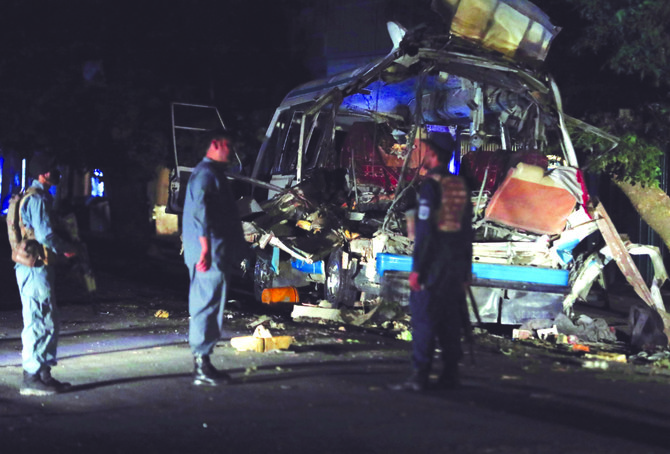
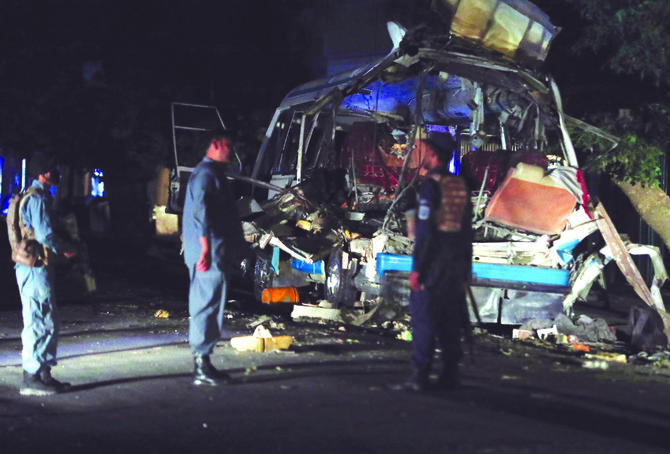
KABUL: At least 10 civilians lost their lives in back-to-back explosions in a Shiite-dominated area of Afghanistan’s capital, Kabul, while other parts of the country suffered a power outage after electricity towers were blown up in a separate incident, officials said on Wednesday.
The first blast, which took place on Tuesday evening, targeted a minibus in southwestern Kabul, near the residence of Mohammed Mohaqiq, an adviser to President Ashraf Ghani, killing six people on board.
“It was followed by a second explosion in another area of the capital, this time on a vehicle carrying civilians, resulting in the loss of four lives,” Tariq Arian, a spokesman for the interior ministry, told Arab News.
Both blasts were conducted using sticky bombs, a standard device deployed in most strikes across Kabul and the eastern city of Jalalabad for more than a year in the latest sign of rising insecurity amid an ongoing withdrawal of US-led foreign troops from the country.
In a statement on Wednesday, Zabihullah Mujahid, a spokesman for the Taliban, categorically denied the Taliban’s link to the attacks.
No group has claimed responsibility for Tuesday’s blasts yet, which came less than a month after nearly 100 people, mostly female students, were killed in multiple explosions outside their school in the same Shiite-dominated neighborhood of Dasht-e-Barchi.
The area where the blasts occurred is home to a large community of Shiites from the Hazara ethnic minority, which Daesh has targeted in the past.
The militant group has also claimed responsibility for conducting attacks on Shiites in other parts of Afghanistan, including Kabul, in recent years.
As officials analyzed the aftermath of Tuesday’s blasts, unknown attackers blew up a tower in a government-controlled area of northern Kabul, cutting off the power supply to several parts of the country.
FASTFACT
Attacks occurred less than a month after nearly 100 people killed in the same Shiite neighborhood of Dasht-e-Barchi.
“We do not know when we will be able to repair the pylon and restore the power supply again,” Sangar Niazai, a spokesman for Afghanistan’s power department, told Arab News.
There have been at least seven such attacks on electricity towers in the past month, particularly in the north of Kabul, ramping up pressure on the embattled government as it struggles to contain military gains by the Taliban.
The group has seized strategic districts in several provinces, including near Kabul, since May 1, when Washington began withdrawing its remaining troops from Afghanistan.
The Taliban claim to have overrun military sites as hundreds of soldiers have reportedly defected to join the group in critical areas, including the provinces of Maidan Wardak, eastern Laghman, northern Baghlan, Ghazni, and Helmand.
“Those who have come over with their weapons belong to the army, police and local militants. We have welcomed them,” Mujahid told Arab News.
However, the interior ministry’s spokesman said while “government forces had made some tactical retreats from some districts, we have a presence in those areas, and the Taliban have suffered heavy losses.”
Arian, along with officials from the defense ministry, refused to share the number of districts that had been overtaken by the Taliban or how many Afghan forces had joined the movement.
“The focus of the Taliban’s attacks has been on roads leading to Kabul, cutting government supply lines, and building pressure while the government faces challenges with demoralization, defections and a shortage of resources,” a senior army general, requesting anonymity as he is not authorized to speak to the media, told Arab News.
Experts, however, said that the departure of foreign forces was “depriving Kabul of crucial aerial support to attack Taliban positions” and would, therefore, allow the militants to lay siege on more cities soon.
“While government leaders are locked in a power struggle, the Taliban’s strategy is to cut roads that serve as economic artery lines, build pressure on government forces, especially near Kabul, and wait for more defections that would eventually lead them to either total victory or to have the upper hand during future peace negotiations,” Taj Mohammed, a Kabul-based analyst, told Arab News.
“It’s the same tactic used by Mujahideen forces against the former government after the withdrawal of Soviet Union forces from here in the 1990s,” he added.


