

Yemeni government continues to provide exceptional permits for ships to deliver fuel: foreign minister

1 / 4
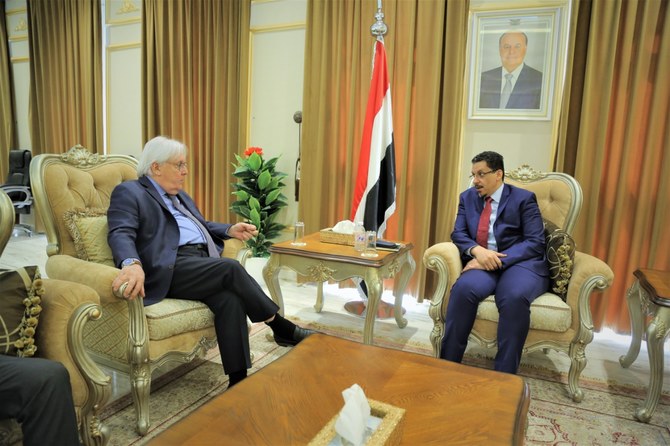
Yemen’s Foreign Minister Ahmed Awad bin Mubarak meets UN envoy to Yemen Martin Griffiths. (Saba)
2 / 4
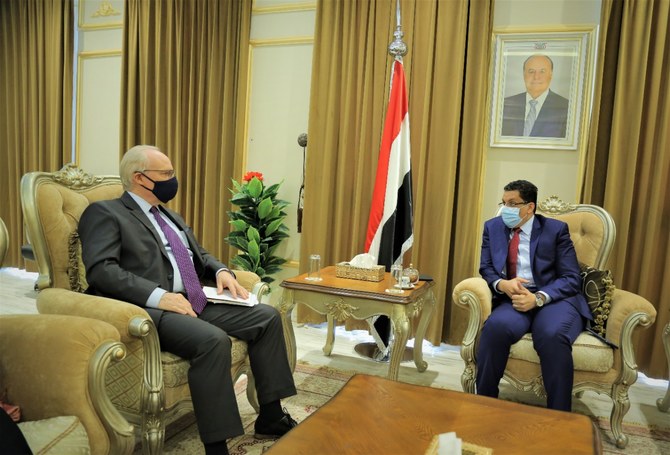
Yemen’s Foreign Minister Ahmed Awad bin Mubarak meets US envoy to Yemen Tim Lenderking. (Saba)
3 / 4
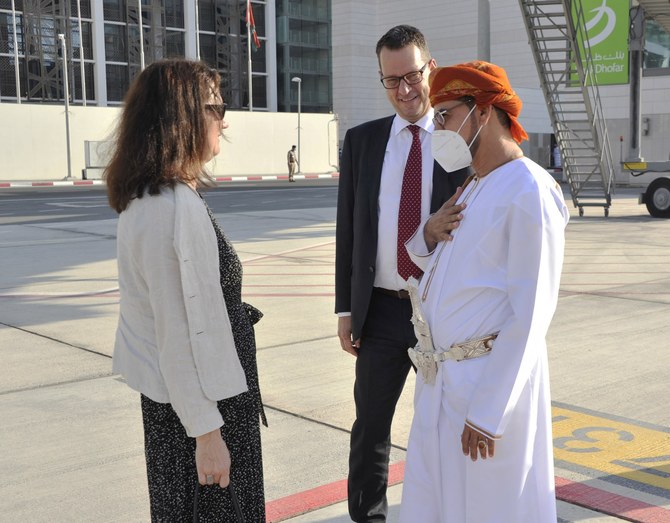
Oman’s Foreign Minister Sayyed Badr Al-Busaidi held talks on Yemen with his Swedish counterpart Ann Linde
4 / 4
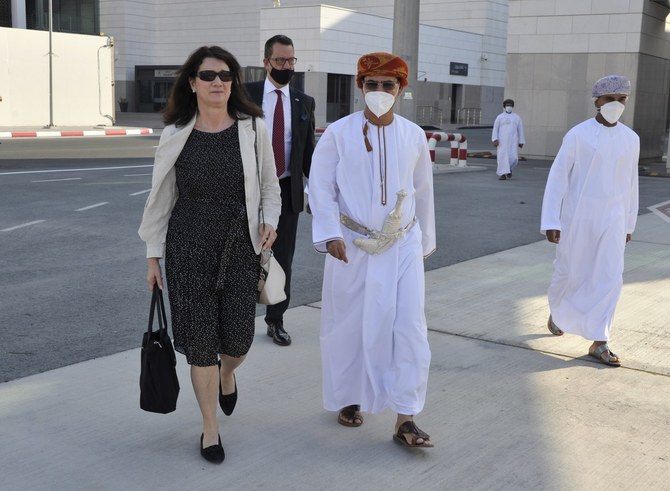
Oman’s Foreign Minister Sayyed Badr Al-Busaidi held talks on Yemen with his Swedish counterpart Ann Linde
Short Url
Updated 02 June 2021
Follow

Yemeni government continues to provide exceptional permits for ships to deliver fuel: foreign minister

  • Bin Mubarak highlighted the seriousness of the situation of the Safer oil tanker
  • Yemeni information minister warns of genocide against children in Houthi-controlled areas

RIYADH: The Yemeni government said on Wednesday it is continuing to provide exceptional permits for ships to deliver fuel for civilian use in Houthi controlled areas.
During a meeting with US envoy to Yemen Tim Lenderking, Foreign Minister Ahmed Awad bin Mubarak said his government is issuing the permits “despite the Houthi militia looting the official revenues of fuel shipments to finance its war efforts instead of paying the salaries of employees.”
Bin Mubarak also highlighted the seriousness of the situation of the Safer oil tanker, which is at risk of breaking up and causing an ecological disaster in the Red Sea, Yemen’s Saba news agency reported.
“This is because the Houthi militia rejected all solutions and proposals and have not allowed a UN technical team to access the tanker to assess its condition and maintenance,” he said.
Bin Mubarak and Lenderking discussed efforts to end the six year war.

Bin Mubarak told Lenderking it was important to continue to support the Yemeni government and complete the implementation of the Riyadh Agreement, especially with regard to security and the military.
The US envoy called on the Houthis to stop all military operations in Marib, where the militia launched an offensive in February.
Lenderking said the US will continue to support the legitimate government and the unity, stability and security of Yemen.
Bin Mubarak also met with UN envoy to Yemen Martin Griffiths to discuss international efforts aimed at stopping the war, where he said  the "international community must send clear messages and exert maximum pressure on the Houthi militia to force it to comply with the peace requirements, to stop shedding Yemeni blood and destabilizing the region."
They also talked about the military and humanitarian situation in the Marib.

Meanwhile, Yemeni Minister of Information Moammar Al-Eryani said there had been a high death toll of child soldiers recruited by the Iran-backed Houthis in recent battles in Marib.
“The field reports and the Houthi militia’s confessions through its media outlets confirm the significant increase in the number of children killed, who were thrust into suicide attacks by the militia on various fronts in the Yemeni province of Marib, since it established camps to lure and recruit them under the guise of ‘summer centers’,” Al-Eryani said.
He warned of “a genocide perpetrated by the Houthi militia against thousands of children aged between 10 and 16, after luring them from their homes and schools and brainwashing them with extremist ideas.
Elsewhere, Oman’s Foreign Minister Sayyed Badr Al-Busaidi held talks on Yemen with his Swedish counterpart Ann Linde, during her visit to the sultanate.


Hamas to hold leadership elections in coming months: sources

Updated 4 sec ago
Follow

Hamas to hold leadership elections in coming months: sources

  • A Hamas member in Gaza said Hayya is a strong contender due to his relations with other Palestinian factions, including rival Fatah, which dominates the Palestinian Authority, as well as his regional standing

GAZA CITY, Palestinian Territories: Hamas is preparing to hold internal elections to rebuild its leadership following Israel’s killing of several of the group’s top figures during the war in Gaza, sources in the movement said on Monday.
“Internal preparations are still ongoing in order to hold the elections at the appropriate time in areas where conditions on the ground allow it,” a Hamas leader told AFP.
The vote is expected to take place “in the first months of 2026.”
Much of the group’s top leadership has been decimated during the war, which was sparked by Hamas’s unprecedented attack on Israel in October 2023.
The war has also devastated the Gaza Strip, leaving its more than two million residents in dire humanitarian conditions.
The leadership renewal process includes the formation of a new 50-member Shoura Council, a consultative body dominated by religious figures.
Its members are selected every four years by Hamas’ three branches: the Gaza Strip, the occupied West Bank and the movement’s external leadership.
Hamas prisoners in Israeli prisons are also eligible to vote.
During previous elections, held before the war, members across Gaza and the West Bank used to gather at different locations including mosques to choose the Shoura Council.
That council is responsible, every four years, for electing the 18-member political bureau and its chief, who serves as Hamas’s overall leader.
Another Hamas source close to the process said the timing of the political bureau elections remains uncertain “given the circumstances our people are going through.”
After Israel killed former Hamas chief Ismail Haniyeh in Tehran in July 2024, the group chose its then-Gaza chief Yahya Sinwar as his successor.
Israel accused Sinwar of masterminding the October 7 attack.
He too was killed by Israeli forces in the southern Gaza city of Rafah, three months after Haniyeh’s assassination.
Hamas then opted for an interim five-member leadership committee based in Qatar, postponing the appointment of a single leader until elections are held and given the risk of being targeted by Israel.
According to sources, two figures have now emerged as frontrunners to be the head of the political bureau: Khalil Al-Hayya and Khaled Meshaal.
Hayya, 65, a Gaza native and Hamas’s chief negotiator in ceasefire talks, has held senior roles since at least 2006, according to the US-based NGO the Counter-Extremism Project (CEP).
Meshaal, who led the Political Bureau from 2004 to 2017, has never lived in Gaza. He was born in the West Bank in 1956.
He joined Hamas in Kuwait and later lived in Jordan, Syria and Qatar. The CEP says he oversaw Hamas’s evolution into a political-military hybrid.
He currently heads the movement’s diaspora office.
A Hamas member in Gaza said Hayya is a strong contender due to his relations with other Palestinian factions, including rival Fatah, which dominates the Palestinian Authority, as well as his regional standing.
Hayya also enjoys backing from both the Shoura Council and Hamas’s military wing, the Ezzedine Al-Qassam Brigades.
Another source said other potential candidates include West Bank Hamas leader Zaher Jabarin and Shoura Council head Nizar Awadallah.