

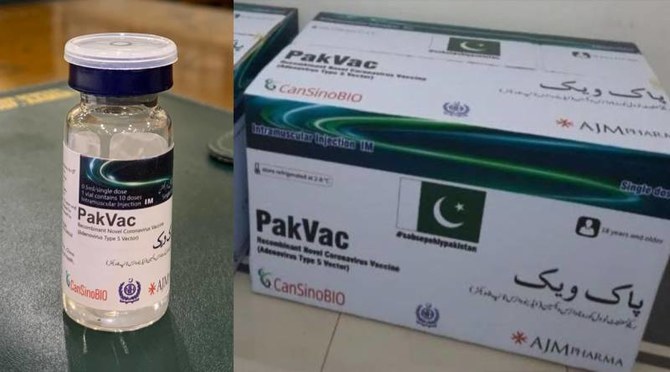
Pakistan launches locally developed coronavirus vaccine PakVac

Pakistan's locally developed coronavirus vaccine, in collaboration with China’s Cansino Bio, PakVac. (Photo courtesy: Social Media)
Short Url
Updated 02 August 2021
Follow

Pakistan launches locally developed coronavirus vaccine PakVac

  • Country has so far administered over 7.3 million doses using mostly Chinese vaccines 
  • Pakistan has in the past three weeks seen a dip in infection transmission 

ISLAMABAD: Pakistan in collaboration with China’s Cansino Bio on Tuesday launched a locally developed coronavirus vaccine called the PakVac, planning minister Asad Umar, who also heads a federal body overseeing Pakistan’s pandemic response, said.

Pakistan last week opened up its coronavirus vaccination campaign to everyone aged 19 or older as it scrambles to protect more of its 220 million people during a third wave of the pandemic. Infection rates have gone down significantly in the last three weeks. 

Pakistan initially had to deal with vaccination hesitancy and a shortage of vaccine supplies and had limited shots to people aged 30 or over.

But with purchases and donations from China and allocations from the World Health Organization and the GAVI Vaccine Alliance, it has now secured more than 18 million doses and is keen to get them out into the population. So far 7.3 million people have been vaccinated. 

“This is a proud moment for the team at NIH [National Institute of Health],” Umar said at the launching ceremony for PakVac. “Chinese [Sinopharm] vaccine is the single most preferred vaccine for Pakistanis … now we have to promote this PakVac.”

“It is really, really heartwarming, the way China has supported us,” Umar said.

Pakistani health chief Dr. Faisal Sultan also appreciated state-run National Institute of Health for its contribution to the fight against COVID-19.

“NIH facility inaugurated today for the formulation, fill and finish of the CanSino-Bio vaccine,” Sultan said. “Dr. Aamer Ikram and his team have done a great job! This is a milestone in the journey to achieve self-reliance.”

In March, Pakistan said it would import Chinese Cansino Biologics COVID-19 vaccines in bulk to package three million doses locally.

“We will be getting the bulk vaccine by mid-April from Cansino, from which 3 million doses can be made,” planning minister Umar had said. “The bulk vaccine received will be formulated, sterilized and packed in Pakistan.”


World Bank president in Pakistan to discuss development projects, policy issues

Updated 01 February 2026
Follow

World Bank president in Pakistan to discuss development projects, policy issues

  • Pakistan, World Bank are currently gearing up to implement a 10-year partnership framework to grant $20 billion loans to the cash-strapped nation
  • World Bank President Ajay Banga will hold meetings with Pakistan Prime Minister Shehbaz Sharif and other senior officials during the high-level visit

ISLAMABAD: World Bank President Ajay Banga has arrived in Pakistan to hold talks with senior government officials on development projects and key policy issues, Pakistani state media reported on Sunday, as Islamabad seeks multilateral support to stabilize economy and accelerate growth.

The visit comes at a time when Pakistan and the World Bank are gearing up to implement a 10-year Country Partnership Framework (CPF) to grant $20 billion in loans to the cash-strapped nation.

The World Bank’s lending for Pakistan, due to start this year, will focus on education quality, child stunting, climate resilience, energy efficiency, inclusive development and private investment.

"World Bank President Ajay Banga arrives in Pakistan for a high-level visit," the state-run Pakistan TV Digital reported on Sunday. "During his stay, he will meet Prime Minister Shehbaz Sharif and other senior officials to discuss economic reforms, development projects, and key policy issues."

Pakistan, which nearly defaulted on its foreign debt obligations in 2023, is currently making efforts to stabilize its economy under a $7 billion International Monetary Fund (IMF) program.

Besides efforts to boost trade and foreign investment, Islamabad has been seeking support from multilateral financial institutions to ensure economic recovery.

“This partnership fosters a unified and focused vision for your county around six outcomes with clear, tangible and ambitious 10-year targets,” Martin Raiser, the World Bank vice president for South Asia, had said at the launch of the CPF in Jan. last year.

“We hope that the CPF will serve as an anchor for this engagement to keep us on the right track. Partnerships will equally be critical. More resources will be needed to have the impact at the scale that we wish to achieve and this will require close collaboration with all the development partners.”

In Dec., the World Bank said it had approved $700 million in ​financing for Pakistan under a multi-year initiative aimed at supporting the country's macroeconomic stability and service delivery.

It ‍followed a $47.9 ‍million World Bank grant ‍in August last year to improve primary education in Pakistan's most populous Punjab province.