Pakistan says plans to vaccinate 70 million people by end of year 

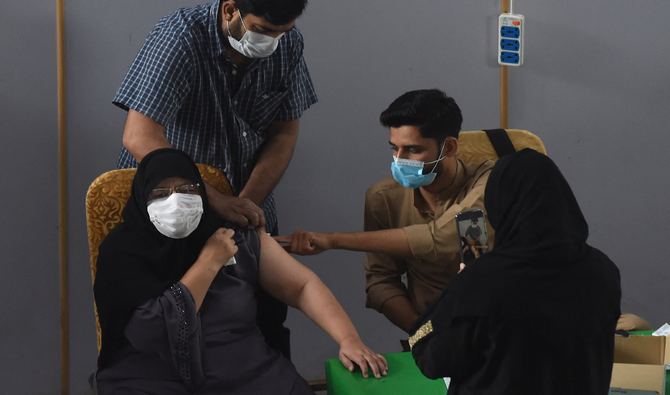
A health worker inoculates a woman with a dose of the Covishield AstraZeneca-Oxford's Covid-19 coronavirus vaccine at a vaccination centre in Lahore on May 23, 2021. (AFP)
Short Url
Updated 01 June 2021
Follow

Pakistan says plans to vaccinate 70 million people by end of year 

  • Asad Umar says government plans to achieve high vaccination rates in June and July so strict restrictions would not be required on Eid Al-Adha 
  • Islamabad reopens amusement, water parks after virus positivity rate at less than 5 percent for sixth consecutive day across Pakistan

ISLAMABAD: Planning minister Asad Umar, who also oversees the country’s pandemic response, said on Monday the government aimed to administer coronavirus vaccines to 70 million people by the end of the year, with as many people as possible inoculated by July so restrictions would not have to be imposed for the Eid Al-Adha in late July. 

Pakistan last week opened up its vaccination campaign to everyone aged 19 or older as it scrambles to protect more of its 220 million people.

Pakistan initially had to deal with vaccination hesitancy and a shortage of vaccine supplies and had limited shots to people aged 30 or over. But with purchases and donations from China and allocations from the World Health Organization and the GAVI Vaccine Alliance, it has now secured more than 18 million doses and is keen to get them out into the population.

“According to our figures, more than 7 million vaccine doses have been administered,” Umar said, adding that the government’s target was to vaccine 70 million people across Pakistan by the end of the year, with a particular emphasis on achieving high vaccination rates in June and July so that strict restrictions would not have to be imposed before and during the Eid Al-Adha holiday, as had happened for the Eid Al-Fitr break. 

Umar said the strict but “timely decision” by the government to impose a lockdown in the last week of Ramadan and before and during Eid Al-Fitr had produced results and stemmed the spread of the disease. However, he stressed the need for the public to keep exercising caution and following standard operating procedures. 

Meanwhile, Islamabad reopened its water and amusement parks on Monday, nearly a week after registering a nationwide drop in new COVID-19 cases, while the positivity rate stood at less than 5 percent for the sixth consecutive day across the country, official data showed.

Islamabad’s district administration said the decision was taken “amid low disease transmission and in light of global practices.”

“It is subject to the strict adherence of following protocols,” it said in a notification issued on Monday, adding: “Fifty percent capacity will be ensured at all entertainment facilities.”

Starting from May 16, Pakistan began relaxing its COVID-19 restrictions – which had been imposed ahead of the Eid Al-Fitr holidays – before resuming public transport services in all provinces and cities and re-opening markets under strict health protocols across the country.

According to the National Command and Operation Center (NCOC), the federal body dealing with the country’s COVID-19 response, Pakistan on Monday reported a 4.05 percent positivity rate for COVID-19, with 2,117 new cases and 43 deaths.


Islamic military coalition, Pakistan to deepen cooperation to combat ‘terrorism’ — Pakistani military

Updated 02 February 2026
Follow

Islamic military coalition, Pakistan to deepen cooperation to combat ‘terrorism’ — Pakistani military

  • Islamic Military Counter Terrorism Coalition is a 43-member alliance that includes Pakistan, Saudi Arabia, Egypt, Jordan, UAE and other nations
  • The Pakistani military statement comes after a meeting between IMCTC secretary-general and the chief of Pakistani defense forces in Rawalpindi

ISLAMABAD: Pakistan and the Islamic Military Counter Terrorism Coalition (IMCTC) have reaffirmed their commitment to deepening cooperation, including intelligence sharing and capacity building, to jointly combat “terrorism” and “extremism,” the Pakistani military said on Monday.

The IMCTC is a 43-member military alliance that was formed on Saudi Arabia’s initiative in Dec. 2015 to consolidate Muslim countries’ efforts in countering “terrorism.”

A 17-member IMCTC delegation is visiting Pakistan from Feb. 2-6 to conduct a training at National University of Sciences and Technology on “Re-integration and Rehabilitation of Extremist Elements,” according to the Pakistani military.

On Monday, IMCTC Secretary-General Maj. Gen. Mohammed bin Saeed Al-Moghedi held a meeting with Chief of Pakistani Defense Forces Field Marshal Asim Munir to discuss cooperation among IMCTC member states.

“During the meeting, matters of mutual interest were discussed, with particular emphasis on regional security dynamics and enhanced cooperation in counter-terrorism efforts,” the Inter-Services Public Relations (ISPR), the Pakistani military’s media wing, said in a statement.

“Both sides reaffirmed their shared commitment to combating terrorism and extremism through collaborative strategies, intelligence sharing, and capacity building among member states.”

The IMCTC features Pakistan, Saudi Arabia, Türkiye, Afghanistan, Egypt, Jordan, Qatar, Palestine, UAE, Bangladesh and other nations. In 2017, Pakistan’s former army chief Gen. (retd) Raheel Sharif was appointed as the IMCTC commander-in-chief.

During discussions with Major General Al-Moghedi, Field Marshal Munir appreciated the role of IMCTC in fostering stability and promoting coordinated counterterrorism initiatives across the Islamic world, according to the ISPR.

The IMCTC secretary-general acknowledged Pakistan’s significant contributions and sacrifices in the fight against militancy and lauded the professionalism of Pakistan’s armed forces.

“The meeting underscored the resolve of both sides to further strengthen institutional collaboration for peace, stability, and security in the region,” the ISPR added.

Pakistan enjoys cordial ties with most Muslim countries around the world, particularly Gulf Cooperation Council countries. In Sept. 2025, Pakistan signed a landmark defense pact with Saudi Arabia according to which an act of aggression against one country will be treated as an act of aggression against both.