

Dubai’s Majid Al Futtaim to break ground on Mall of Saudi in Q4

1 / 4
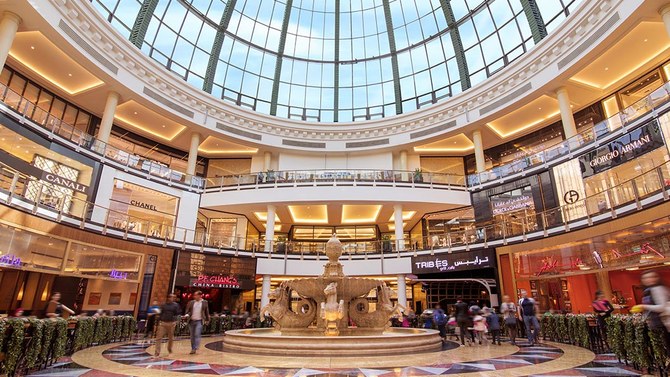
Mall of Saudi will include around 600 stores across 300,000 square meters of gross leasable area. Pictured is Mall of Emirates in Dubai. (Supplied)
2 / 4
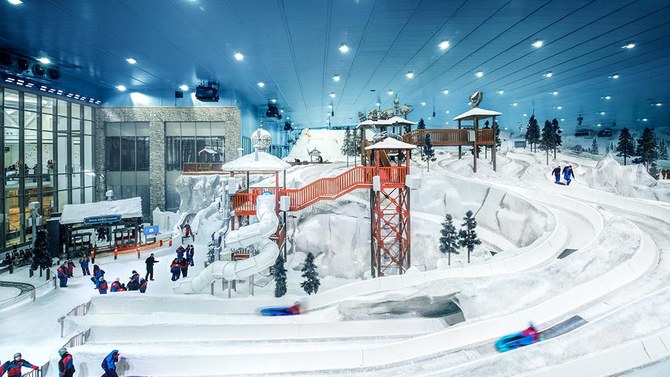
Mall of Saudi will also include the largest ski slope and snow park in the Middle East, luxury hotels and branded residences covering approximately 2,000 keys and on a 214,000 square meter area. Image is of ski slope at Mall of Egypt. (Supplied)
3 / 4
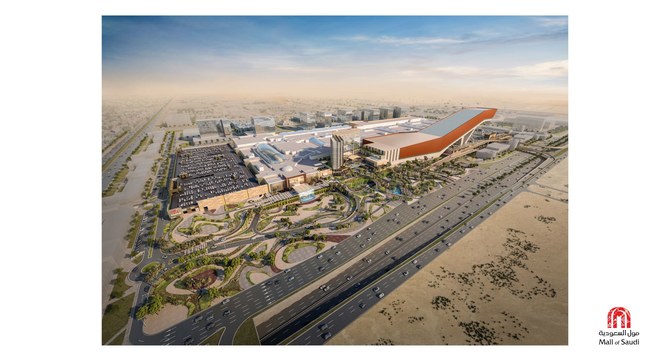
Mall of Saudi will include around 600 stores across 300,000 square meters of gross leasable area. (Supplied)
4 / 4
Mall of Saudi will include around 600 stores across 300,000 square meters of gross leasable area. (Supplied)
Short Url
Updated 31 May 2021
Follow

Dubai’s Majid Al Futtaim to break ground on Mall of Saudi in Q4

  • Flagship project will include the largest ski slope and snow park in the Middle East

DUBAI: Dubai’s Majid Al Futtaim has signed an agreement with global infrastructure consulting firm AECOM to help mastermind the development of the retailer’s Mall of Saudi, its flagship project in the Kingdom.

The mall is set to break ground in the fourth quarter of this year in Riyadh, as part of a mixed-use development in the north of the capital city.

AECOM will be the lead design consultancy on the project and supervise construction of the mall, which is expected to consist of about 600 stores across 300,000 square meters of gross leasable area. At present, half of the space has been reserved by retailers.

Mall of Saudi will also include the largest ski slope and snow park in the Middle East, luxury hotels and branded residences covering about 2,000 keys and on a 214,000 square meter area.

The mall will also include a Carrefour hypermarket and 31 VOX Cinema screens, including the world’s largest IMAX, and a Magic Planet.

Majid Al Futtaim, which employs 43,000 people in 17 markets and owns and operates 27 shopping malls, 13 hotels and four mixed-use communities, reported a 7 percent year-on-year fall in revenues to AED32.6 billion ($8.88 billion) in 2020, resulting in a net loss of AD2.7 billion, compared to a loss of AED1.9 billion in 2019.

Majid Al Futtaim CEO Alain Bejjani said in a statement in February: “The pandemic has not only been a financial crisis, but an even bigger crisis of trust. We have built our organization to withstand adverse economic conditions, so our primary focus was on acting swiftly to protect our customers and employees, as we worked diligently to restore trust and maintain non-negotiable commitments to our sustainable business practices.”

Across its operations, revenue in its mall division was down 24 percent to AED3.5 billion and its hotels recorded a 60 percent drop in occupancy rates, while the biggest impact was felt in the Majid Al Futtaim — Ventures division, which manages its leisure, entertainment and cinema assets, where revenue fell 49 percent to AED1.4 billion.

In 2021, Majid Al Futtaim continued its expansion, with the opening of City Center Al Zahia in Sharjah in March, while the Mall of Oman is due to open later this year. Its retail operation is pushing ahead with expansion into Kenya, Uganda, and Uzbekistan and has plans to scale up its e-commerce operation in Saudi Arabia. Majid Al Futtaim — Cinemas also plans to open 30 VOX Cinemas in Saudi Arabia this year.

“The fact that we have experienced growth in some of our businesses during a year of unprecedented disruption is a testament to the importance that should always be placed on people, the planet and our collective progress. For me, this is stakeholder capitalism in action, and it makes me optimistic about our future,” Bejjani said.

“Every country has had their own set of challenges to deal with. The reality is the fastest recovery is the UAE . . . and we expect very fast recoveries in other markets like Saudi Arabia,” Bejjani told the AP news agency in April. “We have also seen Egypt being very resilient.”


Saudi stocks rebalance after Kingdom opens market to global investors

Updated 7 sec ago
Follow

Saudi stocks rebalance after Kingdom opens market to global investors

  • Foreign access reforms trigger short-term volatility while underlying market fundamentals hold

RIYADH: Saudi Arabia’s stock market experienced a volatile first week following a landmark decision to fully open the market to foreign investors—a move analysts view as essential to funding the Kingdom’s sweeping economic transformation plans.

The Tadawul All Share Index began the week with a sharp decline, falling 1.89 percent on Feb. 1, the same day new regulations eliminating key restrictions on international investment officially came into force. The index rebounded the following session and remained in positive territory for three consecutive days before slipping once more, ultimately ending the week down 1.34 percent.

Ownership data from Tadawul as of Feb. 1 indicated that foreign non-strategic investors reduced their holdings in nearly half of the companies listed on the TASI. An analysis conducted by Al-Eqtisadiah’s Financial Analysis Unit showed that foreign ownership declined in 120 firms, increased in 97 others, and remained unchanged across the remainder. Despite these shifts, the total number of shares held by foreign investors showed no overall change.

Speaking to Arab News, economist Talat Hafiz addressed the initial volatility in the TASI, explaining: “Stock markets in the Kingdom and globally naturally experience fluctuations driven by profit-taking and price corrections.”

He added that the index’s decline and subsequent recovery “appears to be primarily the result of technical and sentiment-related factors rather than a direct reaction to the opening of the market to foreign investors.”

Hafiz emphasized that this was particularly evident given that foreign participation in the Saudi market is not entirely new, having previously existed under alternative regulatory structures.

The market turbulence coincided with sweeping reforms enacted by the Capital Market Authority and announced in January. These measures included the removal of the restrictive Qualified Foreign Investor framework, which had imposed a $500 million minimum asset requirement, as well as the elimination of swap agreements. The reforms aim to attract billions of dollars in fresh investment while improving overall market liquidity.

Hafiz noted that an initial surge of foreign capital was widely expected to generate short-term volatility as portfolios were rebalanced and liquidity dynamics adjusted. However, the rapid recovery of the index suggests that the market’s underlying fundamentals remained strong and that investor confidence was not significantly undermined.

Earlier in January, experts had told Arab News that the reforms could unlock as much as $10 billion in new foreign inflows. Tony Hallside, CEO of STP Partners, described the move as a pivotal evolution, signaling that the Kingdom is committed to building the most accessible, liquid, and globally integrated financial markets in the region.

Hafiz reinforced this optimistic outlook, stating that broader market access is likely to yield positive effects by boosting liquidity, widening participation, and supporting overall market recovery—ultimately contributing to greater long-term stability once near-term adjustments ease.

He said: “TASI’s swift rebound reflects the market’s constructive response to increased openness and deeper investor participation.”

Hafiz said he does not believe the market opening is primarily intended to function as a conventional financing channel. Instead, he argued that its broader objective lies in the internationalization of the Saudi market, a goal underscored by its inclusion in major global indices.

He explained that attracting foreign capital should be understood less as a short-term funding solution and more as a structural reform aimed at strengthening market depth, efficiency, transparency, and global integration.

The Saudi economist added that while increased foreign participation can indirectly support Vision 2030 by enhancing liquidity and reducing the cost of capital, the opening of the market is “not designed as a direct mechanism to revive or fast-track projects that may have faced funding constraints.”

Rather, it creates a more resilient, globally connected financial ecosystem that can sustainably support long-term development ambitions, according to Hafiz.

As the market continues to stabilize, investors and observers are monitoring which sectors are expected to attract the largest share of investment in the coming weeks and months.

Hafiz told Arab News that foreign investment is expected to initially focus on companies operating in strategically significant, high-growth sectors such as healthcare, transportation, and technology, in addition to mining, energy, and telecommunications.

He added that experienced foreign investors are likely to gravitate toward firms demonstrating strong financial disclosure practices, sound corporate governance, adherence to environmental, social and governance standards, and a track record of consistent dividend payouts.