Indonesia deports seized Iranian crew, tanker after four months

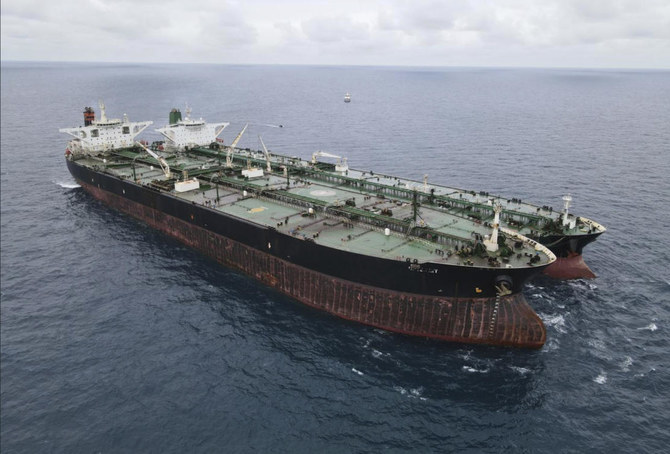
Panamanian-flagged MT Frea, left, and Iranian-flagged MT Horse tankers are seen anchored together in Pontianak waters off Borneo island, Indonesia. (File/AP)
Short Url
Updated 30 May 2021
Follow

Indonesia deports seized Iranian crew, tanker after four months

  • Captains of the tanker and another Panama vessel were found guilty on Tuesday for entering Indonesian territory without a permit

JAKARTA: Indonesia has deported the captains of two oil tankers belonging to Iran and Panama and escorted their vessels out of its waters over the weekend after a court ruling earlier in the week found the two men guilty of violating the country’s navigational rules, Indonesian authorities said on Sunday.
Indonesia’s Maritime Security Agency (Bakamla) Spokesman Col. Wisnu Pramandita told Arab News that the tankers were freed on Friday after the immigration department issued a deportation order for the two captains following their convictions.
Pramandita said the department handed each man his passport onboard a Bakamla vessel, which then took them to their respective ships.
“Bakamla ship KN Pulau Dana-323 monitored the whole process and was escorting MT Horse and MT Freya as they began sailing out of Indonesia to make sure they left Indonesian waters,” he said.
“We escorted them for about three hours until they reached international waters on the Malacca Straits,” Pramandita added.
On Tuesday, a district court in Batam, in the province of Riau Islands, south of Singapore, where the tankers had been impounded for four months, sentenced Mehdi Monghasemjahromi, captain of the Iran-flagged MT Horse and Chen Yo Qun, captain of the Panama-flagged MT Freya, with a suspended one-year prison term subject to probation for two years. The sentence means that the two captains do not have to immediately serve the prison term unless they repeat the same offense during the probation.
The two were found guilty of unauthorized entry into Indonesian waters by sailing out of the designated sea lanes for the innocent passage of foreign vessels within the Indonesian archipelago.
The court did not find Monghasemjahromi guilty of weapon possession and ordered that the firearms and ammunition found inside the Iranian tanker, which had been held as evidence during the trial, be returned to the tanker’s chief security guard.
However, Pramandita said the court ordered MT Freya’s captain to pay a fine of 2 billion rupiahs ($139,798) for causing environmental damage by spilling oil in Indonesia’s waters when the two tankers were conducting an unauthorized ship-to-ship oil transfer in the waters off Pontianak, the capital of the West Kalimantan province.
On Jan. 24, the two tankers were caught in the act with their hoses connected when a Bakamla ship, KN Marore-322, detected on its radar an idle signal, which indicated that a vessel’s automatic identification system had been turned off.
The ship proceeded to the location and found the two tankers illegally transferring oil from MT Horse to MT Freya. The tankers had also concealed their identities by covering their hulls and not flying their respective national flags.
Bakamla then impounded the two supertankers before they were anchored off Bakamla base in Riau Islands’ Batu Ampar port, while the 25 Chinese nationals on MT Freya and 36 Iranian nationals on MT Horse were detained onboard their tankers.
In February, Bakamla’s Vice Adm. Aan Kurnia told reporters that the two tankers had trespassed 25 nautical miles into Indonesia’s territorial waters when the agency caught them.
Iranian news agency IRNA reported that the MT Horse, which belongs to the National Iranian Tanker Company, has resumed its mission after 125 days of impoundment and “successfully passed legal procedures with the support of Iranian officials and consular assistance by the Foreign Ministry.”
“The devoted staff of the tanker tolerated separation from their families during the long period to defend their national duty resolutely,” the agency reported.
On April 19, Iranian Foreign Minister Mohammed Javad Zarif visited Indonesia and met with his Indonesian counterpart, Retno Marsudi, before paying a courtesy visit to President Joko Widodo.
A statement from Indonesia’s foreign ministry said that both foreign ministers discussed bilateral cooperation, including efforts to combat the pandemic and achieve post-pandemic economic recoveries, with no mention of the tanker.


Australia bans a citizen with alleged links to militant Daesh group from returning from Syria

Updated 5 sec ago
Follow

Australia bans a citizen with alleged links to militant Daesh group from returning from Syria

  • The woman was planning to join another 33 Australians and fly on Monday from Damascus to Australia, Burke said
  • “These are horrific situations that have been brought on those children by actions of their parents”

MELBOURNE: Australia’s government banned an Australian citizen with alleged ties to the militant Daesh group from returning home from a detention camp in Syria, the latest development in the case of fraught repatriation of families of Daesh fighters.
The woman was planning to join another 33 Australians — 10 women and 23 children — and fly on Monday from Damascus, Syria, to Australia, Home Affairs Minister Tony Burke said Wednesday.
But the group was turned back by Syrian authorities to the Roj detention camp, due to unspecified procedural problems.
The Australian government had acted on news that the group planned to leave Syria, Burke said. He said the woman, whom he did not identify, had been issued with a temporary exclusion order on Monday and her lawyers had been provided with the paperwork on Wednesday.
She was an immigrant who left Australia for Syria sometime between 2013 and 2015, Burke said, declining to elaborate on whether she had children — though he generally blamed the parents for the predicaments of their offspring stranded in Syria.
“These are horrific situations that have been brought on those children by actions of their parents. They are terrible situations. But they have been brought on entirely by horrific decisions that their parents made,” Burke told Australian Broadcasting Corp.
Burke has the power to use temporary exclusion orders to prevent high-risk citizens from returning to Australia for up to two years.
The laws were were introduced to in 2019 to prevent defeated Daesh fighters from returning to Australia. There are no public reports of an order being issued before.
Burke said security agencies had not advised that any of the other Australians in the group warranted an exclusion order. Such orders can’t be made against children younger than 14.
Confusing messages at a cramped camp
At the Roj camp, tucked in Syria’s northeastern corner near the border with Iraq, the Australian women who had expected to travel home refused to speak to The Associated Press on Wednesday.
One of the women, Zeinab Ahmad, said they had been advised by an attorney not to talk to journalists.
A security official at the camp, Chavrê Rojava, said that family members of the detainees — who she said were Australians of Lebanese origin — had traveled to Syria to arrange their return. They brought temporary passports that had been issued for the would-be returnees, Rojava said.
“We have no contact with the Australian government regarding this matter, as we are not part of the process,” she said. “We have left it to the families to resolve.”
Rojava said that after the group had departed the camp to travel to Damascus, they were contacted by a Syrian government official and warned to turn back. The families were “very disappointed” upon returning to the camp, she said.
“We recently requested that all countries and families come and take back their citizens,” Rojava said.
She added that Syrian authorities do not want to see a “repeat of what happened in Al-Hol camp” — a much larger camp, also in northeastern Syria that once housed tens of thousands of people, mostly women and children, with alleged ties to Daesh.
Last month, during fighting between Syrian government forces and the Kurdish-led Syrian Democratic Forces, which had controlled Al-Hol, guards abandoned their posts and many of the camp’s residents fled.
That raised concerns that Daesh members would regroup and stage new attacks in Syria.
The Syrian government then established control of Al-Hol and has begun moving its remaining residents to another camp in Aleppo province. The Kurdish-led force remains in control of Roj camp and a ceasefire is now in place.
The thorny issue of repatriating Daesh-linked foreign citizens
Former Daesh fighters from multiple countries, their wives and children have been detained in camps since the militant group lost control of its territory in Syria in 2019. Though defeated, the group still has sleeper cells that carry out deadly attacks in both Syria and Iraq.
Australian governments have repatriated Australian women and children from Syrian detention camps on two occasions. Other Australians have also returned without government assistance.
Australia’s Prime Minister Anthony Albanese on Wednesday reiterated his position announced a day earlier that his government would not help repatriate the latest group.
“These are people who chose to go overseas to align themselves with an ideology which is the caliphate, which is a brutal, reactionary ideology and that seeks to undermine and destroy our way of life,” Albanese told reporters.
He was referring to the militants’ capture of wide swaths of land more than a decade ago that stretched across Syria and Iraq, territory where Daesh established its so-called caliphate. Militant from foreign countries traveled to Syria at the time to join the Daesh. Over the years, they had families and raised children there.
“We are doing nothing to repatriate or to assist these people. I think it’s unfortunate that children are caught up in this, that’s not their decision, but it’s the decision of their parents or their mother,” Albanese added.