

Egypt hosts Israeli minister in diplomatic drive to secure permanent Gaza peace

1 / 2
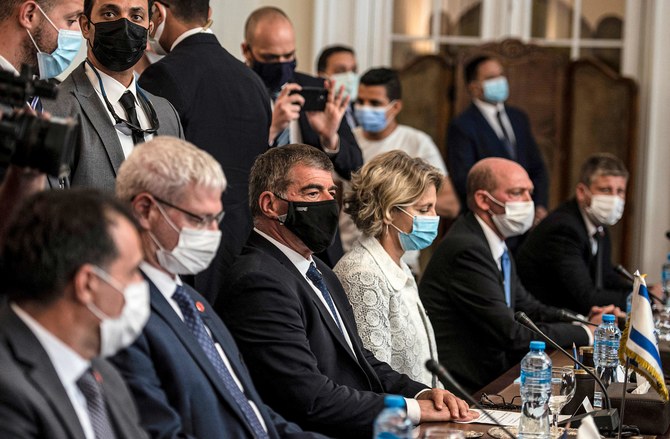
Israel's Foreign Minister Gabi Ashkenazi (C) looks on during his meeting with his Egyptian counterpart at Tahrir Palace in Cairo. (AFP)
2 / 2
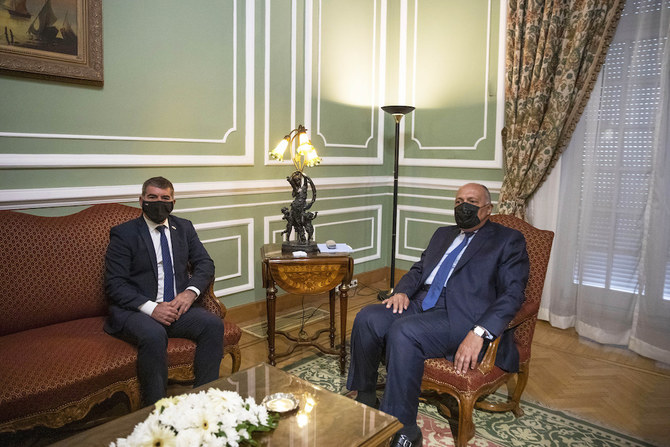
Egyptian Foreign Minister Sameh Shoukry (R) meets with Israeli Foreign Minister Gabi Ashkenazi at the Tahrir Palace in Cairo, Egypt, Sunday, May 30, 2021. (AP)
Short Url
Updated 30 May 2021
Follow

Egypt hosts Israeli minister in diplomatic drive to secure permanent Gaza peace

  • Israeli Foreign Minister Gabi Ashkenazi in first Cairo visit for 13 years
  • Egypt’s intelligence chief in security talks with Netanyahu

CAIRO: A senior Israeli government minister took part in talks in Cairo on Sunday for the first time in 13 years, amid a high-level diplomatic push to bring permanent peace to Gaza.

Foreign Minister Gabi Ashkenazi met Egyptian Foreign Minister Sameh Shukry as part of Egypt’s efforts to revive the Middle East peace process and “build on the ceasefire in Gaza,” the Egyptian Foreign Ministry said.

At the same time, Egypt’s intelligence chief Abbas Kamel met Israeli Prime Minister Benjamin Netanyahu in Jerusalem. Netanyahu said they discussed regional security issues and how to prevent Hamas from siphoning off civilian aid to Gaza.

Opinion

This section contains relevant reference points, placed in (Opinion field)

Kamel also met Palestinian President Mahmoud Abbas in Ramallah and handed him a message of support to Paletinians from Egyptian President Abdel Fattah El-Sisi.

The flurry of diplomatic activity follows an Egypt-brokered ceasefire on May 21 that ended an 11-day onslaught on Gaza that killed 248 Palestinians, 66 of them children.

In Cairo, Shoukry told Ashkenazi there was a “need to take into account the special sensitivity associated with East Jerusalem, Al-Aqsa Mosque and all Islamic and Christian holy sites", the Egyptian Foreign Ministry said. Attacks by Israeli security forces on worshippers in the mosque during Ramadan helped trigger the Gaza conflict.
Egypt restated its call for the creation of an appropriate atmosphere to revive talks between Israelis and Palestinians with the aim of reaching a two-state solution. Among the terms of the Egyptian initiative for a long-term truce was the immediate improvement of the humanitarian and economic situation in Gaza.

The initiative also stipulates a plan for the reconstruction of Gaza, and a prisoner exchange deal between Hamas and Israel.

Ashkenazi called on the Egyptian side to work toward reaching a permanent ceasefire with Hamas, with a focus on the need to reach an agreement that obliged Hamas to return Israeli soldiers and citizens captured since 2014.

The minister said Egypt was an important regional ally committed to peace in the region. He said: “We all need to act to prevent strengthening extremist elements that threaten regional stability, and to ensure the return home of the missing persons and prisoners held by Hamas.”

In Jerusalem, Netanyahu also repeated “the Israeli demand to return the soldiers and civilians detained in the Gaza Strip as soon as possible,” his office said.

Israel seeks the return of the remains of Hadar Goldin and Oron Shaul, two soldiers missing since the 2014 war on Gaza, and two Israeli civilians, Hisham Al-Sayed and Avera Mengistu.

Hamas says it has captured four Israeli soldiers, and has said more than once that all four were alive. Egypt has invited Israel, Hamas and the Palestinian Authority for talks on a deal to exchange prisoners.

Meanwhile, Palestinian Prime Minister Mohammed Shtayyeh met with European Union envoy for the Middle East peace process Sven Koopmans where he called on Europe to solidify an initiative to revive the political process.

Shtayyeh said it was important to have international guarantees to avoid a repeat of Israel’s aggression in Gaza and the destruction of what has been reconstructed.

The premier also said the Palestinian leadership was determined on holding elections, calling on the international community — especially European countries — to seriously pressure Israel to allow them to hold candidacy, elections and campaigning in Jerusalem.


Refugees, migrants in Lebanon find rare sanctuary from Israeli strikes in Beirut church 

Updated 07 March 2026
Follow

Refugees, migrants in Lebanon find rare sanctuary from Israeli strikes in Beirut church 

  • Beirut church offers safe haven for displaced migrants, refugees
  • Many refugees lived through 2024 war, but are now more vulnerable

BEIRUT: When Israeli strikes began pummelling Beirut’s southern suburbs early on Monday, Sudanese refugee Ridina Muhammad and her family ​had no choice but to flee home on foot, eventually reaching the only shelter that would accept them: a church.
Eight months pregnant, Muhammad, 32, walked with her husband and three children for hours in the dark streets until they found a car to take them to the St. Joseph Tabaris Parish, which has opened its doors to refugees and migrants.
They are among 300,000 people displaced across Lebanon this week by heavy Israeli strikes, launched in response to a rocket and drone attackinto Israel by the Lebanese armed group Hezbollah.
Just 100,000 of the displaced are in government shelters. Others are staying ‌with relatives ‌or sleeping in the streets. But migrants and refugees say government ​shelters ‌were ⁠never an option ​for ⁠them, saying they were turned away during the last war between Hezbollah and Israel.
Muhammad’s oldest daughter, now seven, stopped speaking after the 2024 war.
This time, they are even more vulnerable: their home was destroyed in this week’s strikes and Muhammad is due to give birth at the end of the month.
“I don’t know if there’s a doctor or not, but I’m really scared about it because I haven’t prepared any clothes for the baby, nor arranged a hospital, and I don’t know where to go,” she told ⁠Reuters as her younger daughter leaned against her pregnant belly.
Muhammad ‌said she was registered with the United Nations’ refugee agency (UNHCR) ‌but had not received support.
“Us, as refugees, why did we ​register with the UN, if they are not ‌helping us in the most difficult times?” she said.
Dalal Harb, a spokesperson for UNHCR ‌Lebanon, said the agency had mobilized but reaching everyone immediately was extremely challenging given the scale and speed of displacement. The UNHCR operation in Lebanon is currently only around 14 percent funded, she said.
The Jesuit Refugee Service (JRS), which helped the church host displaced in 2024, is doing so again.
Michael Petro, JRS’ Emergency Shelter Director, said the church was ‌full within the first day of strikes, with 140 people from South Sudan, Ethiopia, Bangladesh, and other countries sheltering there.
“There are many, many more ⁠people coming than there ⁠were in 2024, and we have fewer and fewer places to put them,” he said.
Petro said he was told weeks ago that government shelters would be open to migrants if war erupted.
But when the strikes began and even Lebanese struggled to find shelter, the policy seemed to change, he said.
“We’re hearing from hotlines up to government officials and ministries that migrants are not welcome,” Petro said.
Lebanon’s Minister for Social Affairs Haneen Sayyed did not respond to a request for comment. On Thursday, Sayyed said Beirut shelters were full.
When Israeli strikes began, Othman Yahyeh Dawood, a 41-year-old Sudanese man, put his two young sons on his motorcycle.
They drove 75 kilometers (46 miles) from the southern Lebanese town of Nabatieh to St. Joseph’s, where they had sheltered in 2024.
“I know the area ​is safe and there are people who ​will welcome us,” he said.
“We don’t know where to go; there’s war there (in the south), war here (in Beirut), war in Sudan, and nowhere else to go,” he said.