

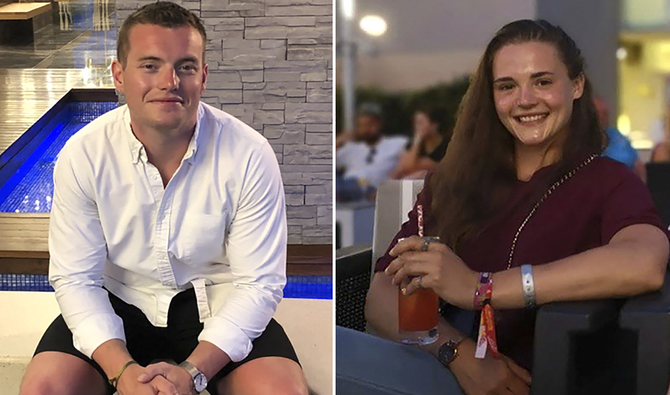

LONDON: The family of the man murdered in the 2019 London Bridge attack have criticized the monitoring system used to track potential terrorists as “badly run” and “totally dysfunctional.”
Jack Merritt, 25, and Saskia Jones, 23, were stabbed to death by Usman Khan at an event held by Cambridge University’s Learning Together program at London’s Fishmongers’ Hall.
Learning Together pairs students and prisoners together as part of a rehabilitation and learning experience.
Khan had taken part in the program as a “peer mentor” alongside the students while serving a prison sentence for attempting to establish a terror training camp.
On Friday, an inquest jury warned that Khan’s high-profile status within the Cambridge rehabilitation scheme had “blinded authorities” to the threat he posed, and “omissions and failures” also played a role in allowing the attack to take place.
The inquest also noted “serious deficiencies” in how Khan was managed following his release from prison in 2018, as well as failures by security services to guide the staff who were assigned with monitoring him.
There had been “unacceptable management, a lack of accountability and deficiencies in management by MAPPA,” a mechanism that allows police and prison authorities to cooperate and oversee the release of high-risk offenders, the inquest said.
Khan’s attempts to prepare for the attack were unknown by authorities despite police and MI5 surveillance and strict probation monitoring.
In the lead up to the attack, he bought knives and materials to make a fake suicide vest. He was also permitted to travel to London from the West Midlands without being escorted.
Following Friday’s inquest, Merritt’s mother told the Daily Mail: “The whole MAPPA process was totally dysfunctional. It’s life or death that they get these things right. It’s catastrophic if that goes wrong. It’s unforgivable.”
His father said: “Everybody seems to have been walking around with their eyes closed and not seeing what they didn’t want to see. MAPPA was a shambles. It was badly run. They didn’t know what they were dealing with.”
MI5 and West Midlands Counter-Terrorism Police “were complacent and passive in the face of Khan’s extreme and continuing threat,” he warned.
While serving his prison sentence, Khan was listed as a “high-risk” category A prisoner, which placed him among the 70 most dangerous inmates in the UK. He had also been implicated in prison violence and attempts to radicalize fellow inmates.
Just before his release, MI5 received information that Khan “wanted to commit an attack,” but the intelligence was not shared with his probation officer. MAPPA was also unaware that he was under MI5 investigation.
Merritt said there “remains troubling questions” over why the intelligence was not shared with the authorities tasked with overseeing Khan’s release.
The two slain students were described by the inquest as “wonderful young people” who “touched the lives of so many” through their prisoner rehabilitation work.
“Jack’s family believe that the Learning Together program must be properly safeguarded, and this did not happen in the present case,” the Merritt family said in a statement.
“But such activities must continue. To do otherwise would be to allow Khan’s attack on liberal democracy, and the values which underpin it, to have won.”


