LONDON: Injuries inflicted during Israeli attacks on the Gaza Strip have become an “endemic disease,” a high-profile British-Palestinian surgeon has warned.
Ghassan Abu-Sittah, a reconstructive surgeon, has made regular trips to Gaza since the 1980s to treat wounded Palestinians.
He returned to the war-torn territory last week amid renewed Israeli-Palestinian fighting. The 11-day conflict left more than 250 people dead in Gaza and 13 in Israel.
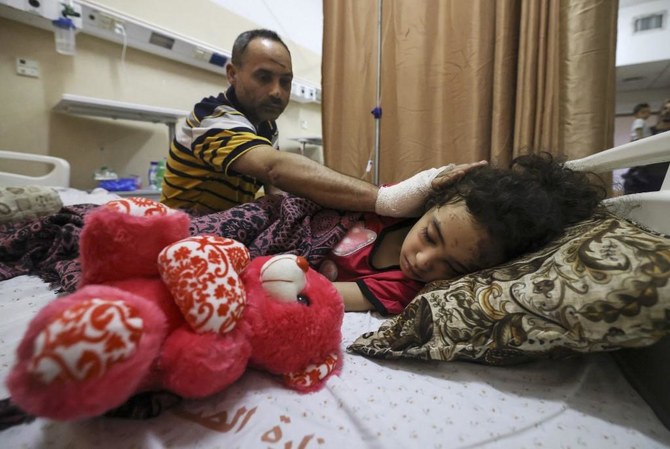
But the real toll is reflected in survivors who must live with life-changing injuries, Abu-Sittah warned. “War injuries are now something akin to an endemic disease in Gaza,” he told the Daily Telegraph.
The UN Office for the Coordination of Humanitarian Affairs said almost 2,000 Palestinians were injured in the conflict, including more than 600 children and 400 women.
It added that about 10 percent of those injured could suffer from long-term disabilities that require extensive rehabilitation.
Previous flare-ups in Gaza have inflicted war-related disabilities on 5-10 percent of the entire population.
Abu-Sittah said he now commonly treats people who have been injured in multiple wars, and his current trip mostly involved treating crush injuries.
In past rounds of violence, the most common injuries were gunshot and shrapnel wounds, and the same surnames “keep appearing in operating rooms,” he said.
“Most people were injured in their homes. We have whole families in different rooms in the hospital,” he added.
“Most of the areas targeted (by Israeli airstrikes) were urban areas in the center of Gaza. They weren’t rural peripheral communities.”
Gaza requires highly skilled specialist surgeons who are not found in typical health systems, due to the complex injuries inflicted in the latest violence.
“It has turned the public health pyramid on its head,” said Abu-Sittah. “You need surgeons in a number disproportionate to the 2 million people who live in Gaza.”
The 51-year-old surgeon has volunteered in conflict zones since the 1980s, visiting Syria, Iraq, Lebanon and Gaza.
His expertise in blast-related injuries led him to author several books on the subject and conduct research for Imperial College London.
Abu-Sittah’s family originally hail from Gaza, where they were refugees. He grew up in Kuwait before moving to the UK.
Treating wounded children is the most difficult part of his job, he said, and it “is what keeps me coming back to Gaza.”
Referring to his three children, he added: “Dealing with wounded children becomes much more taxing once you’ve had your own. With kids (in Gaza), you patch them up now so they’ll be injured in the next war.”


British-Palestinian surgeon: Gaza war injuries an ‘endemic disease’
https://arab.news/jybqf
British-Palestinian surgeon: Gaza war injuries an ‘endemic disease’

- Ghassan Abu-Sittah commonly treats people who have been injured in multiple conflicts
- “You need surgeons in a number disproportionate to the 2 million people who live in Gaza”


GCC states ‘face reliance on Saudi Arabia for food imports’
- With 70 percent of food coming through Strait of Hormuz, analysts warn of inevitable shortages
Some Gulf states may have to rely on overland food deliveries from Saudi Arabia if the US-Israel-Iran war continues to disrupt shipping through the Strait of Hormuz and restrict regional airspace, analysts warned on Thursday.
The region is up to 90 percent dependent on food imports, and price surges and scarcity of some goods are expected.
“With over 70 percent of GCC foodstuffs being imported through the Strait of Hormuz, Gulf states face shortages if the war persists,” said Neil Quilliam of the Chatham House think tank.
“While GCC countries have taken steps to diversify suppliers and ensure sufficient stores to withstand disruption, this can only last several months. At this point, price increases and longer lead times will start to hit the markets.”
Commodities analyst Ishan Bhanu said: “The biggest immediate effect will be due to the blockade of Jebel Ali in Dubai, serving about 50 million people. Qatar, Kuwait, Bahrain and Iraq effectively become landlocked and will depend on overland routes through Saudi Arabia.”
Bottlenecks are yet to show and the UAE has said its strategic reserves of vital goods cover four to six months of needs. It urged residents to report unjustified price increases through a dedicated hotline.
Supermarket staff throughout the Gulf said shelves remain largely stocked, though suppliers are taking longer to replenish certain products. Iran’s strikes on the Gulf since Saturday prompted panic buying in supermarkets, a dry run for what could come.
“Perception of risk matters, and even if stocks are sufficient now, public runs on supermarkets can spook the public,” Quilliam said.


