

Turkey facing ‘sea snot’ invasion on popular shorelines 

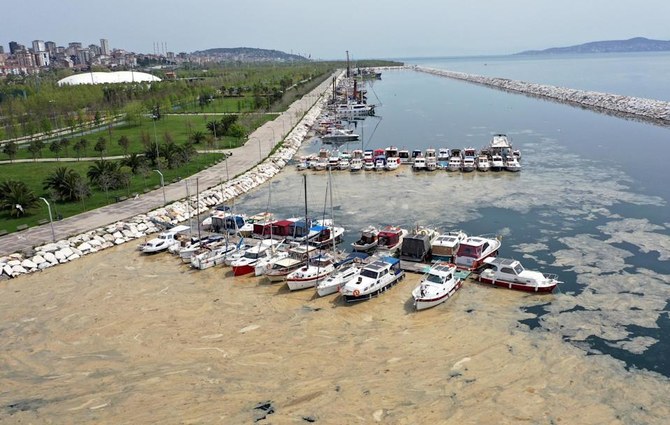
A section of Istanbul waterfront showing sea snot infestation, which has exacerbated over the last six months. (Getty Images)
Short Url
Updated 26 May 2021
Follow

Turkey facing ‘sea snot’ invasion on popular shorelines 

  • Scientists: ‘Mucus-like’ substance linked to untreated sewage flowing into sea
  • Local diver: Amount contained underwater ‘10-15 times higher’ than on surface

LONDON: Some of Turkey’s most popular shorelines have been struck by a mucus-like substance known as “sea snot,” which scientists have warned is spreading due to climate change. 

Turkey’s sea snot has grown in size over the last six months and could pose a problem to fish and eventually humans, scientists have said.

Its origins lie in phytoplankton that can grow out of control when nutrients such as nitrogen and phosphorus permeate throughout seawater. The reaction occurs most commonly when nutrient-rich untreated sewage flows into the sea.

“The increase in the number of elements such as nitrogen and phosphorus in the sea is largely related to domestic waste such as sewage,” said Mustafa Sari, maritime faculty dean of Bandirma Onyedi Eylul University.

“Domestic waste released into the sea without treatment increases the nitrogen and phosphorus load of the seawater.” 

Sea snot from the phytoplankton could create hazards for humans because it prevents people from fishing or swimming in affected waters.

“I have been traveling here for 15 years and there used to be snot at some times, but it is worse this year. It is such a dirty sight, and it stinks,” said ship worker Burak Yenilmez.

“Our work has reduced by up to 70 percent,” said local diver Hakan Kara, adding that the amount of the substance contained underwater is “10-15 times higher” than on the surface.

“It is in pieces, but everywhere. The bottom of the sea is completely covered with snot,” he said. “Sea horses, crabs, small fish and any marine creatures living there die because it clogs their gills. We need an urgent solution to this situation.”

Experts say climate change will continue to make the problem worse. “The main trigger is warming related to climate change, as phytoplankton grow during higher temperatures,” said Dr. Neslihan Ozdelice, a marine biologist at Istanbul University.

Countering climate change will require a global effort, she added, warning that Turkey needs to focus on issues such as overfishing and wastewater discharge.

“We are experiencing the visible effects of climate change, and adaptation requires an overhaul of our habitual practices,” said Ozdelice. “We must initiate a full-scale effort to adapt.”


Hundreds flee to government-held areas in north Syria ahead of possible offensive

Updated 56 min 18 sec ago
Follow

Hundreds flee to government-held areas in north Syria ahead of possible offensive

  • Many of the civilians who fled used side roads to reach government-held areas
  • Men, women and children arrived in cars and pickup trucks that were packed with bags of clothes

DEIR HAFER, Syria: Scores of people carrying their belongings arrived in government-held areas in northern Syria on Friday ahead a possible attack by Syrian troops on territory held by Kurdish-led fighters east of the city of Aleppo.
Many of the civilians who fled used side roads to reach government-held areas because the main highway was blocked with barriers at a checkpoint that previously was controlled by the Kurdish-led and US-backed Syrian Democratic Forces, Associated Press journalists observed.
The Syrian army said late Wednesday that civilians would be able to evacuate through the “humanitarian corridor” from 9 a.m. to 5 p.m. Thursday. The announcement appeared to signal plans for an offensive against the SDF in the area east of Aleppo.
There were limited exchanges of fire between the two sides.
Men, women and children arrived in cars and pickup trucks that were packed with bags of clothes, mattresses and other belongings. They were met by local officials who directed them to shelters.
In other areas, people crossed canals on small boats and crossed a heavily damaged pedestrian bridge to reach the side held by government forces.
The SDF closed the main highway but about 4,000 people were still able to reach government-held areas on other roads, Syrian state TV reported.
A US military convoy arrived in Deir Hafer in the early afternoon but it was not immediately clear whether those personnel will remain. The US has good relations with both sides and has urged calm.
Inside Deir Hafer, many shops were closed and people stayed home.
“When I saw people leaving I came here,” said Umm Talal, who arrived in the government-held area with her husband and children. She added that the road appeared safe and her husband plans to return to their home.
Abu Mohammed said he came from the town of Maskana after hearing the government had opened a safe corridor, “only to be surprised when we arrived at Deir Hafer and found it closed.”
SDF fighters were preventing people from crossing through Syria’s main east-west highway and forcing them to take a side road, he said.
The tensions in the Deir Hafer area come after several days of intense clashes last week in Aleppo, previously Syria’s largest city and commercial center, that ended with the evacuation of Kurdish fighters from three neighborhoods north of the city that were then taken over by government forces.
The fighting broke out as negotiations stalled between Damascus and the SDF over an agreement reached in March to integrate their forces and for the central government to take control of institutions including border crossings and oil fields in the northeast.
The US special envoy to Syria, Tom Barrack, posted on X Friday that Washington remains in close contact with all parties in Syria, “working around the clock to lower the temperature, prevent escalation, and return to integration talks between the Syrian government and the SDF.”
The SDF for years has been the main US partner in Syria in fighting against the Daesh group, but Turkiye considers the SDF a terrorist organization because of its association with Kurdish separatist insurgents in Turkiye.