

Iran's Rouhani urges greater 'competition' in presidential poll

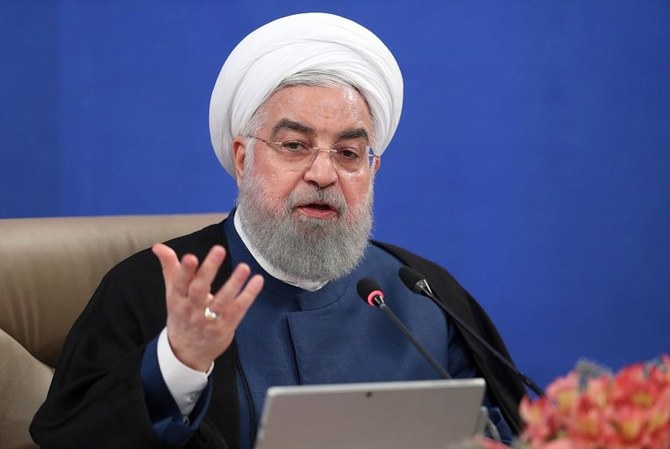
Rouhani in a weekly Cabinet meeting said he wished Iran’s Guardian Council would give more would-be candidates the opportunity to run. (File/AFP)
Short Url
Updated 26 May 2021
Follow

Iran's Rouhani urges greater 'competition' in presidential poll

  • Rouhani said he wished Iran’s Guardian Council would give more would-be candidates the opportunity to run
  • “I am holding consultations to make the election scene more competitive and participatory”: Raisi

TEHRAN: Iran's President Hassan Rouhani on Wednesday called for greater "competition" in an election for his successor next month after several hopefuls were barred from running against ultraconservative candidates.
Rouhani said he had asked the Islamic republic's supreme leader Ayatollah Ali Khamenei to intervene and warned that "the heart of elections is competition. If you take that away it becomes a corpse."
Iran's ultraconservative judiciary chief Ebrahim Raisi is now widely seen as the frontrunner to replace Rouhani, a moderate, after the powerful Guardian Council prevented several prominent figures from standing for election.

Raisi appeared to object to the large number of disqualifications on Tuesday.
"Since yesterday evening, when I was informed of the results, ... I have made contacts and I am holding consultations to make the election scene more competitive and participatory," Raisi said on Twitter.
Seven candidates, five of them ultraconservatives, were approved for the June 18 poll, which comes at a time Iran is in talks with world powers to revive the tattered nuclear deal that former US president Donald Trump withdrew from in 2018.
The Guardian Council disqualified several well-known figures, including long-time parliament speaker Ali Larijani, a moderate-conservative ally of Rouhani who had been seen as the main challenger to Raisi.
The president, speaking at a televised cabinet meeting, also warned of the risk of low voter turnout and said the system's "continued legitimacy" was at stake.
Rouhani, an advocate of detente with the West and of ending Iran's international isolation, won office through an alliance with reformist and moderate forces but must step down this year after serving two consecutive terms.
Iran was plunged into a deep recession after Trump torpedoed Rouhani's signature achievement, the 2015 nuclear deal which offered sanctions relief in return for Iran's pledge never to acquire an atomic weapon.
Negotiations are now underway in Vienna aiming to bring Washington back into the accord, lift punishing sanctions on Iran and get Tehran to reverse the nuclear steps it took in retaliation to the US withdrawal.
The election comes amid a climate of general discontent amid Iran's deep economic and social crisis, and after the violent repression of waves of protests in the winter of 2017-2018 and in November 2019.
For the reformers and moderates who have governed with Rouhani since 2013, the solution to the country's problems lies in the discussions underway in Vienna.
Ultraconservatives and many conservatives meanwhile accuse Rouhani of shirking responsibility by blaming Iran's woes solely on the United States, and on the Europeans for failing to help Tehran counter the devastating effects of US sanctions.
Iran's candidate disqualifications caused dismay in the reformist press.
"Goodbye reformism?" read the front-page headline of a Shargh daily article that said "not even the most sceptical" had imagined the latest development.
It argued that reformists' woes partly stem from the economic crisis hurting their middle class base, which it said now lacks "any energy" to push forward their agenda.
The ultraconservative Kayhan daily meanwhile strongly defended the council's decision on candidates, arguing it was in line with the constitution and "not based on personal preference".
It also said a possible low turnout would be the fault of Rouhani's administration over its handling of the economy.
A record 57 percent of Iranians stayed away from legislative elections in February last year after thousands of candidates, many of them moderates and reformists, were disqualified.
The Guardian Council, the unelected body responsible for overseeing elections, this time selected the seven candidates from a field of about 600 hopefuls.
Rouhani said that, in his request for a revision of the list, "I sent a letter to the supreme leader yesterday on what I had in mind and if he can help with this".
According to Rouhani, the supreme leader has "seldom intervened" during previous elections, but "there have been times when he added someone back in with an order".
This happened in 2005, when he reversed the Guardian Council's decision to bar two reformist figures - Mostafa Moein and Mohsen Mehralizadeh, the latter of whom is also an approved candidate this year.
Larijani, however, has already conceded his disqualification, writing on Twitter that "I am content with God's will".


Gaza health officials say strikes kill 21 after Israel says shots wounded officer

Updated 4 sec ago
Follow

Gaza health officials say strikes kill 21 after Israel says shots wounded officer

GAZA CITY: Gazan health officials said Israeli air strikes on Wednesday killed 21 people in the Palestinian territory, with Israel’s military saying it struck after gunfire targeting its troops wounded an officer.
Despite a US-brokered truce entering its second phase last month, violence has continued in the Gaza Strip, with Israel and Hamas accusing each other of breaching the agreement.
The latest bloodshed came days after Israel partly reopened the Rafah crossing between Gaza and Egypt, the only exit for Gazans that does not pass through Israel.
The health ministry, which operates under Hamas authority, said that 21 people were killed in a series of strikes, with at least 38 others wounded, updating an earlier figure given by the territory’s civil defense agency.
Among the dead were three children, said the agency, which operates as a rescue force under the Hamas authority.
“We were sleeping when suddenly shells and gunfire rained down on us,” said Abu Mohammed Haboush, whose son was killed.
“Young children were martyred, my son and my nephew were among the dead. We lost many young men,” he said, adding that he and his family were living far away from the so-called “Yellow Line,” where Israeli forces are stationed.
AFP images showed mourners offering prayers in the compound of Al-Shifa hospital in Gaza City, where several bodies wrapped in white shrouds were laid out.
An AFP photograph showed a relative holding a body of a child wrapped in a shroud at the hospital as relatives gathered around him.
Shortage of medical aid
Three bodies were brought to Nasser Hospital after Israeli strikes hit homes and tents housing displaced Palestinians in the southern Khan Yunis area, the civil defense agency said.
Fourteen more bodies were taken to Al-Shifa Hospital, its director Mohamed Abu Salmiya said in a statement.
“We also received dozens of wounded. The situation is extremely difficult in the hospitals of the Gaza Strip due to the severe shortage of medicines and medical supplies,” Abu Salmiya said.
Israel scrutinizes all aid into besieged Gaza, a tiny coastal territory surrounded by fences, walls and the Mediterranean Sea.
The Israeli military said it had launched strikes after “terrorists opened fire on troops” Wednesday, seriously wounding an officer, adding that it considers the incident a violation of the ceasefire.
It said the troops came under attack near the “Yellow Line,” without specifying which side of the line the troops were on.
The ceasefire took effect after two years of war in Gaza, sparked by Hamas’s October 2023 attack on Israel.
Following what was reportedly US pressure, Israel allowed the opening of the Rafah crossing, but limited passage to patients and their travel companions.
Sick and wounded Gazans have begun crossing into Egypt to seek medical treatment since Monday.
On Tuesday, 45 people crossed into Egypt and 42 entered the territory, a source at the Palestinian Red Crescent Society told AFP.
Shortly after midnight Wednesday, those meant to enter during the day on Tuesday arrived in Gaza through Rafah in a large bus, an AFP journalist reported.
‘My homeland’
Relatives of those returning from Egypt screamed in joy, hugging and crying.
“I am so happy to be back with my husband, my children, my family, my loved ones, and of course, my homeland,” Fariza Barabakh, who returned that day, told AFP.
“It’s an indescribable feeling, thank God. What can I say? My two young children didn’t recognize me, but thank God. I hope it will be alright,” Yusef Abu Fahma, another returnee, told AFP.
Gaza’s health ministry says at least 556 people have been killed in Israeli strikes since the ceasefire took effect on October 10, while the Israeli military says four of its soldiers have been killed over the same period.
Saturday was among the deadliest days, with the civil defense agency reporting at least 32 people killed in Israeli attacks, which the military said were in response to a Hamas ceasefire violation.
Media restrictions and limited access in Gaza have prevented AFP from independently verifying casualty figures or freely covering the fighting.