

Pakistan says will solve ‘tough problem’ of vaccinating over 3 million stateless people

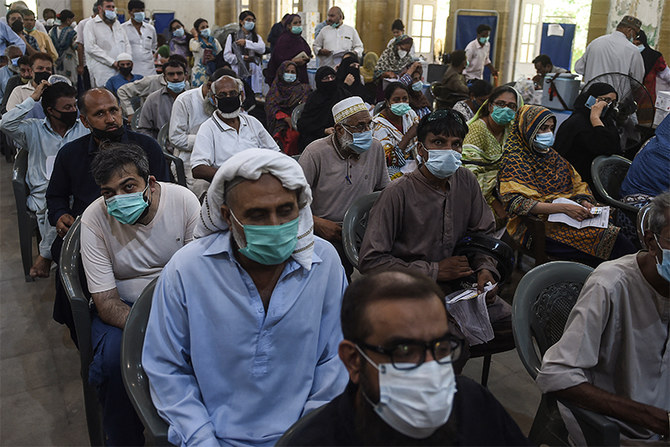
People wait for their trun to get a dose of the Covid-19 coronavirus Sinopharm vaccine at a vaccination camp in Karachi on May 25, 2021. (AFP)
Short Url
Updated 26 May 2021
Follow

Pakistan says will solve ‘tough problem’ of vaccinating over 3 million stateless people

  • Stateless people lack 16-digit national identity card number required to register for government vaccine program
  • Senior health official say all non-Pakistani residents eligible for COVID-19 jabs after proving identity using relevant documents

ISLAMABAD: Pakistan’s health chief Dr. Faisal Sultan said on Wednesday the government would solve the “tough problem” of vaccinating its more than three million stateless people living in different parts of the country.

In a story published in Arab News on Tuesday, several refugees in Pakistan described being unable to get citizenship despite decades of living in the country. Now they fear being left out of a national vaccination drive as registering for a free government-run immunization drive requires that citizens send a 16-digit computerized national identity card number to a 1166 number.
“Slightly tough problem but will be solved,” Dr. Faisal Sultan, who advises Prime Minister Imran Khan on public health, told Arab News.
According to Article 15 of the Universal Declaration of Human Rights, “everyone has the right to a nationality.” Nevertheless, statelessness remains a reality across the world.
While the exact numbers are not known, Pakistan’s leading association of doctors recently wrote a letter to the government about the plight of stateless people in Pakistan, saying they were no fewer than three million in number.
In September 2018, Prime Minister Imran Khan pledged citizenship for Bengali and Afghan refugees, a decision widely hailed by the United Nations High Commissioner for Refugees agency, civil society groups and human rights organizations. However, that promise is yet to be fulfilled.
Pakistan’s Ministry of National Health Services and Regulations says “every person currently in Pakistan” would get the COVID-19 vaccine by waiting for the immunization process to begin for people in their respective age brackets.
Rana Muhammad Safdar, director-general health at the ministry, told Arab News refugees or any other persons in Pakistan would have to prove their identity to be eligible to get a vaccine.
“This can be done using any document from the UNHCR or any other organization that proves their identity as non-Pakistani residents of the country,” he said in an interview on Tuesday.
Safdar, however, declined to comment when asked how individuals could register themselves through the official helpline when it only recognized 16-digit computerized national identity card numbers issued to Pakistani citizens, or why some people were being turned away even when they directly approached vaccination centers with relevant documents.


Pakistan, China call for more ‘visible, verifiable’ actions to dismantle ‘terrorist’ groups in Afghanistan 

Updated 5 sec ago
Follow

Pakistan, China call for more ‘visible, verifiable’ actions to dismantle ‘terrorist’ groups in Afghanistan 

  • Foreign ministers of China, Pakistan co-chair seventh round of strategic dialogue in Beijing to review bilateral cooperation, regional situation
  • Pakistan accuses Kabul of facilitating attacks launched by militant outfits from Afghanistan’s soil, a charge Kabul has repeatedly denied

ISLAMABAD: Pakistan and China on Monday urged Afghanistan to take more visible actions to dismantle “terrorist organizations” based in its country, vowing to work with world powers to encourage Kabul to adopt moderate policies and integrate into the international community. 

Ties between Pakistan and Afghanistan remain strained as Islamabad alleges militant outfits, mainly the Tehreek-e-Taliban Pakistan (TTP) group, uses Afghan soil to launch attacks against Pakistan. Islamabad accuses the Afghan Taliban government of facilitating these attacks against Pakistan, charges Kabul have repeatedly denied. 

The joint statement by China and Pakistan was released after a meeting of both countries’ foreign ministers, Ishaq Dar and Wang Yi, in Beijing. Dar and his Chinese counterpart co-chaired the Seventh Round of China-Pakistan Foreign Ministers’ Strategic Dialogue in Beijing on Jan. 4 where they reviewed cooperation in trade, investment, economic sectors, counterterrorism, defense and regional matters. 

“The two sides called for more visible and verifiable actions to dismantle and eliminate all terrorist organizations based in Afghanistan which continue to pose serious threats to regional and global security, and prevent terrorist organizations from using the Afghan territory for terrorism against any other country and to endanger any other country,” the statement read. 

The joint statement said the two countries will work with world powers to encourage Kabul to adopt an inclusive political framework, moderate policies, and pursue good neighborliness. 

On bilateral cooperation, China and Pakistan said they had agreed to focus on industry, agriculture and mining, and also promote the building and operation of the Gwadar Port in southwestern Pakistan. 

“The two sides will deepen cooperation in areas such as trade and investment, information technology, science and technology, cybersecurity, technical and vocational training and education, and people-to-people and cultural exchanges,” the statement said. 

“The two sides agreed to further strengthen cooperation in the financial and banking sectors, including extending mutual support at regional and international multilateral financial forums. Pakistan appreciated China for providing support for its fiscal and financial sectors.”

The joint statement said China commended Pakistan’s “comprehensive measures” to combat “terrorism” and protect Chinese personnel, projects and institutions in the country.

“The two sides reiterated their commitment to combating terrorism in all its forms and manifestations with zero tolerance, and agreed to further deepen all-round cooperation on counter-terrorism and security, and make concerted efforts to ensure that the China-Pakistan Belt and Road cooperation advance in a secure and smooth manner,” the statement said. 

Pakistan and China expressed their willingness to conduct a transboundary water resources cooperation, stressing the importance of fulfilling international legal obligations. The statement comes as Pakistan frequently accuses India of violating a water-sharing agreement between the two neighbors, claiming New Delhi purposefully diverts the flow of water away from its territory. 

Islamabad has warned that any move by New Delhi to stop or divert the flow of Indus rivers to Pakistan will be considered an “act of war.”

Pakistan and China also demanded an unconditional, comprehensive and permanent ceasefire in Gaza in their joint statement, reaffirming their support for the Palestinian people’s right to self-determination and for the implementation of a two-state solution in the Middle East. 

“The two sides also expressed their concern at the situation in the occupied West Bank, and urged the need for urgently addressing it,” the statement said.