

Malian army detains leaders, triggering condemnation, coup fears

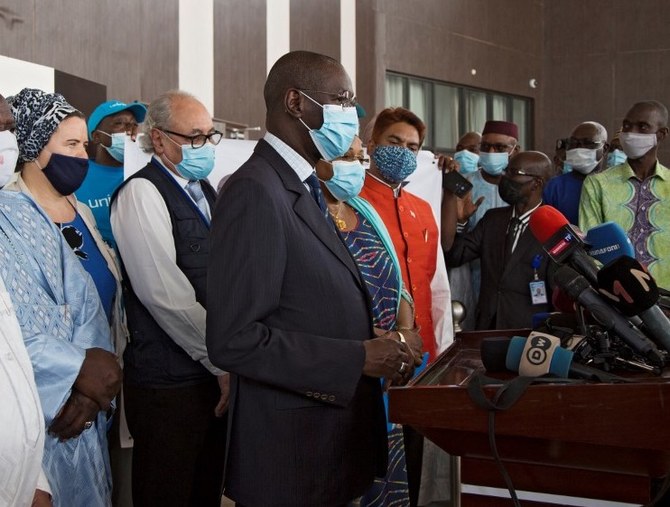
Malian Prime Minister Moctar Ouane was conducting a reshuffle when he was led away. (AFP/File)
Short Url
Updated 25 May 2021
Follow

Malian army detains leaders, triggering condemnation, coup fears

BAMAKO: Malian officers upset with a government reshuffle have detained the president and prime minister at an army camp outside the capital, triggering broad international condemnation and demands for their immediate release.
President Bah Ndaw and Prime Minister Moctar Ouane lead an interim government that was installed under the threat of regional sanctions following a putsch in August, and the detentions on Monday raised fears of a second coup.
Two senior officials, who declined to be named, told AFP that soldiers had taken Ndaw and Ouane to the Kati military camp on the outskirts of the capital Bamako.
Their detentions followed a sensitive government reshuffle earlier on Monday that was designed to respond to growing criticism of the interim government.
The military kept the strategic portfolios it controlled during the previous administration in the reshuffle.
But two coup leaders — ex-defense minister Sadio Camara and ex-security minister Col. Modibo Kone — were replaced.
Coup leaders and army officers have wielded significant influence over the government, casting doubts on a pledge to hold elections by early next year.
The reshuffle came at a time of growing political challenges in the capital Bamako and pressure to stick to the deadline for promised reforms.
Speculation of a coup swirled around Bamako late on Monday, but the city remained relatively calm.
Briefly reached by phone before the line cut, Prime Minister Ouane told AFP that soldiers “came to get him.”
EU leaders condemned what they called the “kidnapping” of Mali’s civilian leadership, said council president Charles Michel.
“What happened was grave and serious and we are ready to consider necessary measures,” he told reporters after a summit of the bloc’s 27 leaders, describing events as “the kidnapping of the president and the prime minister.”
Earlier, a joint statement by the United Nations, African Union, Economic Community of West African States, the European Union and the United States condemned the arrests and called for their “immediate and unconditional liberty.”

Young military officers ousted Keita on August 18 after weeks of protests over perceived government corruption and his handling of Mali’s jihadist insurgency.
After the 15-nation West Africa bloc ECOWAS threatened sanctions, the military junta handed power to a caretaker government that pledged to reform the constitution and stage elections within 18 months.
Coup leader Assimi Goita was appointed as vice president of the caretaker administration, and the interim president, Bah Ndaw, is a retired army officer.
Many have doubted whether the military-dominated government has the will, or the ability, to stage reforms on a short timescale.
Among other problems, the vast nation faces a major logistical and security challenge, as swathes of territory are in the hands of jihadists.
Doubts remained despite the interim government last month pledging to hold a constitutional referendum on October 31, with elections to follow in February next year.
On May 14, amid growing anger, the government then said it would appoint a new “broad-based” cabinet.
An official at Mali’s interim presidency, who requested anonymity, said the reshuffle was designed to send a message that “respect for the transition deadline remains the priority.”
He also underscored the necessity of replacing the defense and security ministers.
“They are not emblematic figures of the junta,” the official said, referring to the newly appointed ministers.
In an example of mounting unease, the opposition M5 movement — which spearheaded protests against Keita in 2020 — this month urged dissolving the interim government and demanded a “more legitimate” body.
But the M5 is divided. Two members of the Union for the Republic and Democracy party — part of the M5 — were appointed interim ministers Monday.
Civil disputes in Mali are also adding to the pressure created by political feuding.
The country’s largest union, UNTM, called a second week of strikes Monday after pay negotiations with the interim government collapsed.


Philippine President Marcos hit with impeachment complaint

Updated 3 sec ago
Follow

Philippine President Marcos hit with impeachment complaint

  • Rage over so-called ghost infrastructure projects has been building for months in the archipelago country of 116 million
  • President accused of systematically bilking taxpayers out of billions of dollars for bogus flood control projects
MANILA: Members of Philippine civil society groups filed an impeachment complaint against President Ferdinand Marcos, Jr. on Thursday, accusing him of systematically bilking taxpayers out of billions of dollars for bogus flood control projects.
Rage over so-called ghost infrastructure projects has been building for months in the archipelago country of 116 million, where entire towns were buried in floodwaters driven by powerful typhoons in the past year.
The filing, endorsed by the Makabayan bloc, a coalition of left-wing political parties, accuses Marcos of betraying the public trust by packing the national budget with projects aimed at redirecting funds to allies.
Under the Philippine Constitution, passage of articles of impeachment in the House of Representatives triggers a Senate trial, where a guilty verdict would mean removal from office and disqualification from future public posts.
A copy of the complaint was filed at the House’s Office of the Secretary General “in accordance with House rules,” petitioners said Thursday, though it was not marked as received as the top official was not present.
“The President institutionalized a mechanism to siphon over ?545.6 billion ($9.2 billion) in flood control funds, directing them into the hands of favored cronies and contractors and converting public coffers into a private war chest for the 2025 (mid-term) elections,” a summary of the filing seen by AFP says.
It also accuses the president of directly soliciting kickbacks, a charge that relies heavily on unproven allegations made by a former congressman who fled the country while under investigation.
Presidential spokeswoman Claire Castro, who told reporters on Thursday that Marcos was recovering after spending the night under medical observation for an undisclosed illness, declined to discuss the filing.
“Let’s wait (to see) its contents, we cannot address that as of now if we don’t have the details of their complaints,” she said.
Marcos has consistently noted that he was the one who put the issue of ghost projects center stage and taken credit for pushing investigations that have seen scores of construction firm owners, government officials and lawmakers implicated.
But complainant Liza Maza told reporters on Thursday she believed the moves were only intended to deflect blame.
“We think the investigation he initiated is just a cover-up,” she said. “Because the truth is, he is the head of this corruption.”
Hours later, a group with ties to former president Rodrigo Duterte showed up at the House of Representatives with their own corruption-based impeachment complaint against the president, only to depart without leaving a copy.
‘Slim chance’
Thursday’s complaint was not the first filed against Marcos this week.
Under the constitution, any citizen can file an impeachment complaint provided it is endorsed by one of the more than 300 members of Congress.
On Monday, a local lawyer brought a case citing Rodrigo Duterte’s arrest and transfer to the International Criminal Court, as well as unproven allegations of drug abuse.
Dennis Coronacion, chair of the political science department at Manila’s University of Santo Tomas, said at the time that the document relied largely on “rehashed or recycled allegations” and lacked “sufficient evidence.”
On Thursday, Coronacion said the new complaint was also unlikely to go far in a Congress packed with Marcos allies.
“(It) has a very slim chance of getting the approval of the House Committee on Justice and (even less) so, in the plenary, because the president still enjoys the support of the members of the House of Representatives,” Coronacion said.