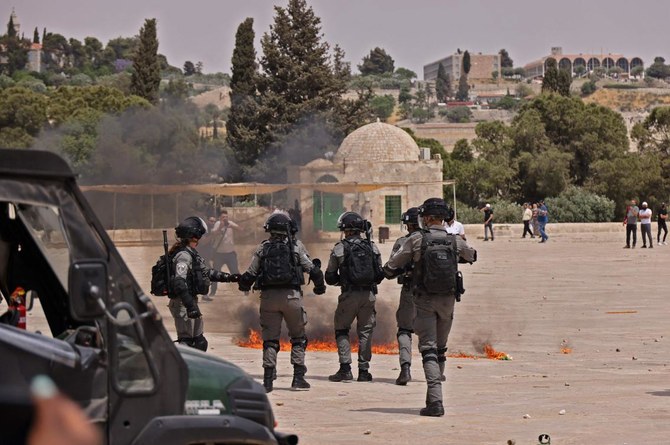
JERUSALEM: Israeli police on Sunday escorted around 50 Jewish visitors to a flashpoint holy site in Jerusalem where police actions in recent weeks had ignited protests and violence that triggered war in Gaza, according to the Islamic authority overseeing the site.
The Waqf said police cleared young Palestinians out of the Al-Aqsa Mosque compound and barred entry to Muslims under the age of 45.
Muslims who entered were required to leave their IDs with police at the entrance. It said three Muslims were arrested, including a guard.
Israeli police spokesman Micky Rosenfeld said the site was open for “regular visits” and that police had secured the area to prevent “incidents,” without elaborating.
Israeli police had briefly clashed with Palestinian protesters after Friday prayers in an early test for the truce, which had taken effect hours earlier.
The Waqf said Sunday it was the first time Jews had been allowed to visit the site since May 4, a week before the war broke out.
The Al-Aqsa Mosque is the third holiest site in Islam. It sits on a sprawling hilltop in Jerusalem’s Old City that is revered by Jews as their holiest site because it was the location of the biblical temples. The site has often been the scene of Israeli-Palestinian violence and was the epicenter of the 2000 Palestinian intifada, or uprising.
Israeli police repeatedly clashed with Palestinian protesters in the days leading up to May 10, when Gaza’s militant Hamas rulers fired long-range rockets at Jerusalem. The threatened eviction of dozens of Palestinian families from a nearby Jerusalem neighborhood was cited as another major trigger of the 11-day war, which was halted by a cease-fire on Friday.
In recent years, increasing numbers of religious and nationalist Jews have visited the site. Palestinians fear Israel plans to eventually take over the compound or partition it. The Israeli government has repeatedly said it has no intention of changing the status quo, under which the Waqf oversees the site under Jordanian custodianship.


![]()

Israeli police allow Jews to visit flashpoint Jerusalem site
Short Url
https://arab.news/6ph9c
Israeli police allow Jews to visit flashpoint Jerusalem site
- Police clear young Palestinians out of the Al-Aqsa Mosque compound, bars entry to Muslims under the age of 45


Latest updates




© 2026 SAUDI RESEARCH & PUBLISHING COMPANY, All Rights Reserved And subject to Terms of Use Agreement.