UNESCO exhibit in Venice focuses on rebuilding Mosul sites

1 / 2
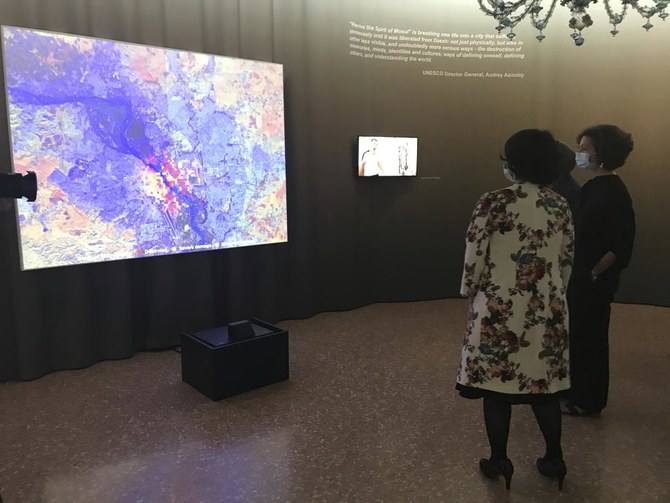
Audrey Azoulay, UNESCO's director general, right, attends the exhibition " Revive the Spirit of Mosul ", in Venice, Italy Friday, May 21, 2021. (AP)
2 / 2
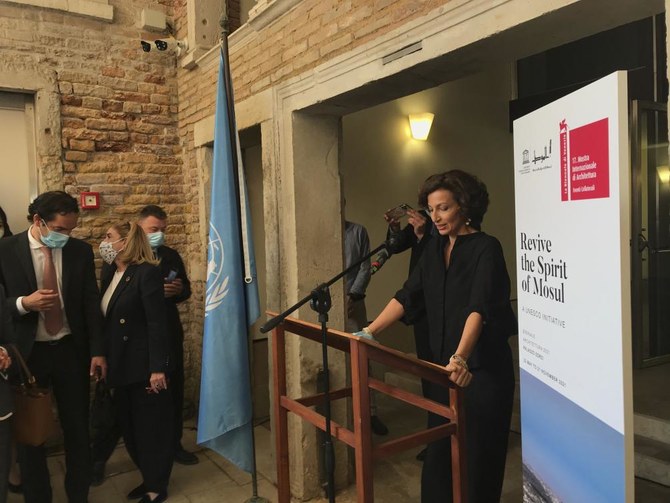
Audrey Azoulay, UNESCO's director general, speaks on the occasion of the unveiling of the exhibition " Revive the Spirit of Mosul ", in Venice, Italy Friday, May 21, 2021. (AP)
Short Url
Updated 22 May 2021
Follow

UNESCO exhibit in Venice focuses on rebuilding Mosul sites

  • UNESCO’s $50 million project to revive Mosul was announced in 2018 and is funded by the UAE
  • It also aims to revive the cultural life and diversity of a city that for thousands of years was a commercial, intellectual and cultural crossroads

VENICE: The United Nations’ cultural agency has opened an exhibit detailing plans to restore multicultural landmarks in the Iraqi city of Mosul, underlining the role of architecture in helping heal wounds.
The exhibit, “Revive the Spirit of Mosul,” is being on the sidelines of the 17th International Architecture Exhibition, which opened Saturday after a one-year pandemic delay under the title: “How will we live together?”
The Venice Biennale’s central question resonates in particular in Iraq, which is experiencing turbulent change, and the old city of Mosul, where 80% of the city’s monuments were destroyed by extremists during the city’s 36-month occupation by Daesh.
Iraq is one of three countries participating for the first time at the Biennale, with an exhibit by Rashad Salim titled “Ark Re-Imagined” that is an artistic examination of the impact of the great flood in ancient Mesopotamia.
The UNESCO exhibit, in the Zorzi Palace where the agency’s regional offices are houses, unveils the winning project for restoring the Al-Nouri Mosque, built in the 12th century and once famous for its leaning minaret. Daesh leader Abu Bakr Al-Baghdadi declared a caliphate from the mosque in 2014, and extremists blew it up as Iraqi forces closed in in 2017.
“Healing wounds means rebuilding the city and its historic fabric. It also means reviving the spirit of Mosul, through heritage, culture and education,’’ UNESCO Director-General Audrey Azoulay said in an speech opening the exhibit on Friday. “The spirit of Mosul is, first and foremost, reflected in the diversity of its communities, which had lived together peacefully for centuries.”
An international jury last month chose a project by Egyptian architects led by Salah El Din Samir Hareedy to rebuild the mosque, part of a UNESCO project that will also rebuild the Al-Habda minaret and the churches of Al-Tahera and Al-Saa’a.
The new Al-Nouri Mosque will be nearly identical to the old one to the casual eye, while the prayer hall will contain more natural light and enlarged areas for women and VIPs. The winning project also aims to enhance the role of the mosque’s central courtyard as an urban hub for the old city.
Work to stabilize the sites began in 2020. Local communities have indicated a preference to restore the Al-Habda minaret as it was before the Daesh occupation, UNESCO officials said, while designs for the two churches have not yet been chosen.
UNESCO’s $50 million project to revive Mosul was announced in 2018 and is funded by the United Arab Emirates. It also aims to revive the cultural life and diversity of a city that for thousands of years was a commercial, intellectual and cultural crossroads. UNESCO is also rehabilitating historic houses in the old city with European Union support.


At Jazan festival, Suad Al-Asiri paints memory, land and leadership

Updated 19 sec ago
Follow

At Jazan festival, Suad Al-Asiri paints memory, land and leadership

  • Local artist channels personal hardship into works that reflect Jazan’s identity, heritage
  • Centerpiece of display, Jazan: A Nation and a Prince, places the region at the heart of a composition featuring Prince Mohammed bin Abdulaziz and Prince Nasser bin Mohammed bin Abdullah bin Jalawi

RIYADH: At the Ahad Al-Masarihah pavilion at Jazan Festival 2026, Suad Al-Asiri’s paintings blend memory, place and personal history, offering visual narratives shaped by beauty and hardship. 

A novelist and visual artist, Al-Asiri has long used art as a storytelling tool. After a near-fatal car accident in March 2024, her work took on a new urgency. Bedridden for 11 months, cut off from the public world for more than a year, she describes that period as one of the most painful in her life — yet also transformative. 

“First of all, praise be to God for granting me life, as the accident was extremely severe,” she said. “By God’s grace, I was given a new life. All my thinking after the accident was about becoming an inspiration to others — about enduring pain and obstacles, and still leaving an impact.” 

Her return to public life came in 2025, when she participated in National Day celebrations with the ministry of interior. By the time she arrived at Jazan Festival, she was ready to channel that experience into her art. 

The centerpiece of her display, “Jazan: A Nation and a Prince,” places the region at the heart of a composition featuring Prince Mohammed bin Abdulaziz and Prince Nasser bin Mohammed bin Abdullah bin Jalawi, governor and deputy governor of Jazan respectively. 

Visitors linger over the details: the painting incorporates coffee beans, sesame and khudair — materials drawn from local products.

“I wanted people to recognize these products immediately,” she said. “They are part of Jazan’s daily life, and using them makes the work more tangible, more connected to everyday experience.” 

The painting sparks conversation. Visitors discuss leadership, identity, and the intimate relationship between people and their environment. 

Beyond the central piece, Al-Asiri presents individual portraits of the two princes, expanding the dialogue into a broader exploration of heritage and memory.  

Her journey into art is tied to her life as a storyteller. Early experiments with charcoal and pencil evolved into abstract art, drawn by its expressive freedom. 

From there, she explored realism, surrealism, and eventually modern art, particularly pop art, which has earned her wide recognition in artistic circles. Her novels and media work complement her visual practice, earning her the title “the comprehensive artist” from the governor.

Yet what stands out most in this exhibition is how Al-Asiri’s personal resilience flows through each piece. Her experience of surviving a devastating accident, enduring months of immobility, and returning to the public eye informs every brushstroke. 

Visitors sense not just her artistic skill, but her determination to turn life’s hardships into inspiration for others. 

Walking through the pavilion, one can see it in the way she blends heritage symbols, southern landscapes, and scenes of daily life. 

Each painting becomes both a document and a dialogue — a celebration of Jazan’s culture, a reflection on identity, and a testament to the power of human perseverance. 

At Jazan Festival 2026, Suad Al-Asiri’s art is a quiet, persistent inspiration for anyone who pauses long enough to listen.