

Social media giants ‘violated’ Palestinians’ digital rights: report

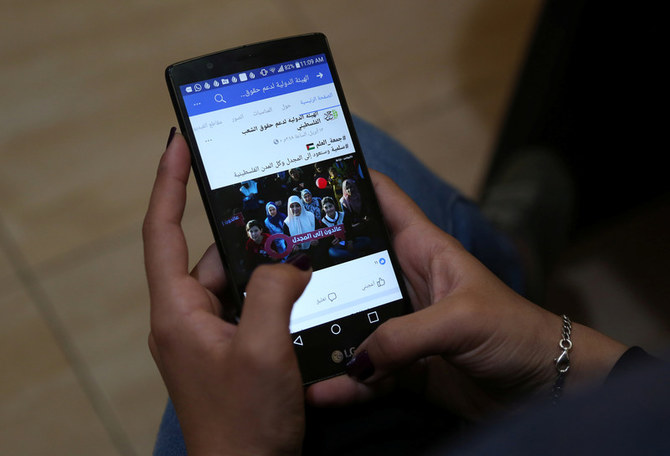
Facebook, Twitter and Instagram were all used widely by Palestinian citizens and activists to share information on evictions from the East Jerusalem neighborhood of Sheikh Jarrah. (Reuters/File Photo)
Short Url
Updated 21 May 2021
Follow

Social media giants ‘violated’ Palestinians’ digital rights: report

  • Digital rights monitor 7amleh said it has documented 500 cases of what it called digital rights violations of Palestinians
  • In one notable case of erroneous censorship, Instagram’s algorithm deemed the al-Aqsa mosque a terrorist organization

LONDON: There was a “dramatic increase” in censorship of Palestinians engaging in political speech on social media during the period of intense fighting between Israel and Gaza-based militants.

A report by 7amleh, The Arab Center for the Advancement of Social Media, seen by The Independent, said that social media companies’ moderation attempts and codes of conduct have resulted in numerous citizens being censored.

Facebook, Twitter and Instagram were all used widely by Palestinian citizens and activists to share information on evictions from the East Jerusalem neighborhood of Sheikh Jarrah, among other hotbutton issues among Palestinains.

According to The Independent, 7amleh said it had documented 500 cases of what it called digital rights violations of Palestinians from May 6 to May 18.

These violations include content being taken down and accounts being removed or their visibility restricted.

Of the 500 instances, half were related to Instagram, and its parent company Facebook was found to have carried out 179 cases of censorship or other rights violations.

Facebook also engaged in geo-blocking — geographically targeted content moderation — with “a number of these cases (documented) for activists from the occupied Palestinian territory,” according to 7amleh.

The rights organization said that 45 percent of reported violations on Instagram were related to the abrupt removal of stories.

Instagram did not respond directly to 7amleh about 143 of the cases submitted, but confirmed that “only one case violated the community standards.” According to 7amleh, nearly 70 percent of reported rights violations occurred after the problem seemed to have been addressed.

Aside from content moderation problems, a number of dramatic cases of harmful and offensive content moderation occurred throughout the nearly two weeks of violence. 

One notable example saw Instagram removing posts with hashtags for the al-Aqsa mosque — the third holiest site in Islam — after the tech company’s moderation system mistakenly deemed the mosque a terrorist organization.

Facebook told The Independent: “We know there have been several issues that have impacted people’s ability to share on our apps, including a technical bug that affected Stories around the world, and an error that temporarily restricted content from being viewed on the Al Aqsa hashtag page. While these have been fixed, they should never have happened in the first place.” 

The company also explained that it “understand(s) that the word ‘Zionist’ is frequently used in important political debate ... that’s why we allow critical discussion of Zionists, but remove attacks against them in specific instances when context suggests the word is being used as a proxy for Jews or Israelis, both of which are protected characteristics under our hate speech policies.”

Social media is seen as an important tool by Palestinian activists and citizens who use it to tell their own stories in a global media system that, they believe, does not always portray their struggle accurately.

Marwa Fatafta, a policy manager at Access Now, told The Independent that she also believes that Facebook’s content moderation policy is biased against the Palestinians.

“Facebook's rules related to Israel-Palestinian have always been opaque and one-sided,” she said. “It's no secret that Facebook often bows to government pressure and converts such demands into rules governing online speech. But that’s only half of the story (as) social media platforms rely on algorithms to moderate speech at scale and being blind to context as they are, lots of legitimate content get flagged and taken down.” 

Such issues stress the need for algorithmic transparency, which Fatafta says is “clearly biased.”

According to 7amleh, social media companies should hire specific fact checkers for the Israel-Palestine conflict, allow people to access geo-spatial data for humanitarian purposes, provide transparency on takedown requests, and conduct human rights assessments “that include the impact of Israel on Palestinians in Israel and the occupied Palestinian territory.”

Censorship and bias have been issues for years, however, and the escalation of violence over the past two weeks “only scaled it up and made it more pronounced,” said Fatafta.

She continued: “Social media has been a life-line for Palestinian activists deprived of access to mainstream media, and despite the ceasefire, the reality of occupation and oppression continues. So Palestinians will continue to use social media to organize and dissent.”

Fatafta added: “The main question here is: would social media companies learn their lessons this time?”


Saudi Media Forum urges ethical coverage as crises redefine Arab journalism

Updated 04 February 2026
Follow

Saudi Media Forum urges ethical coverage as crises redefine Arab journalism

  • Raw news without context can mislead audiences and distort credibility, experts say

RIYADH: Arab media was born in crisis and shaped by conflict rather than stability, Malik Al-Rougi, general manager of Thaqafeyah Channel, said during the Saudi Media Forum in Riyadh on Wednesday.

Al-Rougi was speaking during a panel titled “Media and Crises: The Battle for Awareness and the Challenges of Responsible Coverage,” which examined how news organizations across the region navigated credibility and professional standards amid fast-moving regional developments.

“Today, when you build a media organization and invest in it for many years, a single crisis can destroy it,” he said.

Referring to recent events, Al-Rougi said that he had witnessed news channels whose credibility “collapsed overnight.”

“In journalistic and political terms, this is not a process of news production. It is a process of propaganda production,” he said. “The damage caused by such a post … is enormous for an institution in which millions, perhaps billions, have been invested.”

When a media outlet shifts from professionalism and credibility toward “propaganda,” he added, it moves away from its core role. 

Saudi media leaders, journalists, and experts gathered at the Saudi Media Forum in Riyadh to discuss credibility, ethics, and innovation. (AN photo by Huda Bashatah/Supplied)

“A crisis can work for you or against you,” Al-Rougi added. “When, in the heart of a crisis, you demonstrate high credibility and composure, you move light-years ahead. When you fail to adhere to ethical standards, you lose light-years as well.”

Abdullah Al-Assaf, professor of political media studies at Imam Muhammad bin Saud Islamic University, said that in many crises across the Arab world, agendas and directives had often prevailed over professionalism.

“Credibility was buried,” he added.

Hasan Al-Mustafa, writer and researcher at Al-Arabiya channel, said that raw information could be subject to multiple interpretations if not placed within a proper political, security, historical or geographical context.

He added that such an approach was urgently needed during periods of political and security volatility in the Middle East. 

When, in the heart of a crisis, you demonstrate high credibility and composure, you move light-years ahead. When you fail to adhere to ethical standards, you lose light-years as well.

Malik Al-Rougi Thaqafeyah, Channel general manager

“This objectivity, or this reliability, is a great responsibility,” Al-Mustafa said. “It is reflected not only in its impact on the audience, but also on the credibility of the content creator.”

Al-Mustafa warned against populism and haste in coverage, saying that they risked deepening crises rather than providing informed public perspectives.

He also said that competition with social media influencers had pushed some traditional outlets to imitate influencer-driven models instead of strengthening their own professional standards.

“Our media has been crisis-driven for decades,” he said, describing much of the region’s coverage as reactive rather than proactive.

During a separate panel titled “The Official Voice in the Digital Age: Strategies of Influence,” speakers discussed how rapid technological and social changes were reshaping the role of institutional spokespersons.

Abdulrahman Alhusain, official spokesperson of the Saudi Ministry of Commerce, said that the role was no longer limited to delivering statements or reacting to events.

“Today, the spokesperson must be the director of the scene — the director of the media narrative,” he said.

Audiences, he added, no longer accept isolated pieces of information unless they were presented within a clear narrative and structure.

“In the past, a spokesperson was expected to deliver formal presentations. Today, what is required is dialogue. The role may once required defense, but now it must involve discussion, the exchange of views, and open, candid conversation aimed at development — regardless of how harsh the criticism may be.”

He said that spokespersons must also be guided by data, digital indicators and artificial intelligence to understand public opinion before speaking.

“You must choose the right timing, the right method and the right vocabulary. You must anticipate a crisis before it happens. That is your role.”

Abdullah Aloraij, general manager of media at the Riyadh Region Municipality, said that the most important skill for a spokesperson today was the ability to analyze and monitor public discourse.

“The challenge is not in transferring words, but in transferring understanding and impact in the right way,” he said.