

Lebanon president says PM-designate incapable of forming cabinet

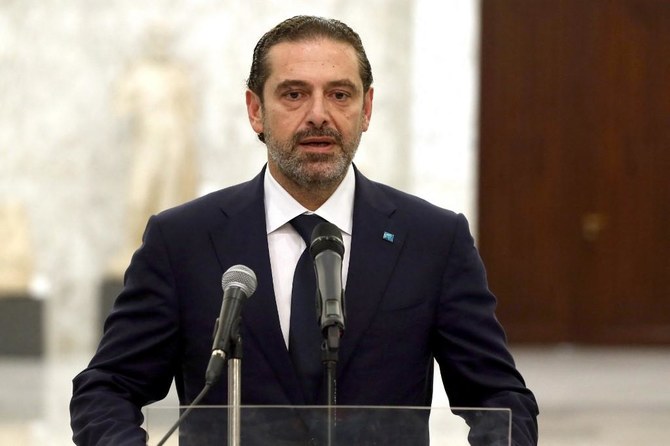
Lebanese prime minister-designate Saad Hariri addressing reporters following a meeting with President Michel Aoun (unseen) at the presidential palace in Baabda on March 18, 2021. (File/AFP)
Short Url
Updated 21 May 2021
Follow

Lebanon president says PM-designate incapable of forming cabinet

  • Aoun’s letter described as ‘full of fallacies and distorted facts’ as he asks parliament to dismiss PM-designate Hariri
  • MP Yassin Jaber tells Arab News: ‘I do not expect solutions, but I fear debate will take on a sectarian dimension’

BEIRUT: Lebanon’s President Michel Aoun said that he believes Prime Minister-designate Saad Hariri is incapable of forming a government to pull the nation out of its financial crisis.

Aoun’s verdict was contained in a letter read out to parliament on Friday and which will be discussed on Saturday.

Lebanese Parliament Speaker Nabih Berri postponed discussion of the controversial letter.

In the letter, Aoun said he would not be responsible for the consequences of obstructing the formation of the government, and held Hariri responsible for the delays in an attempt to have him dismissed and assign a replacement.

Hariri, however, described Aoun’s letter as “exercising the policy of distorting facts, and covering up the racist diplomatic scandal of the foreign minister toward the brothers in the Arab Gulf.”

The letter sets a precedent in the history of Lebanese politics, and according to a number of parliamentarians and jurists, it is “an attempt to amend the Taif Agreement and the constitution.” The MPs also expressed their fear that “the scientific and substantive constitutional debate will diverge into a sectarian and doctrinal nonpolitical debate.”

Former prime ministers Najib Mikati, Fouad Siniora and Tammam Salam expressed their astonishment at Aoun’s letter, which they described as “full of fallacies and distorted facts.”

They were dismayed that Aoun “assigned himself the role of guardian of the mission and the role of the prime minister-designate, but he went beyond that to give himself the role of the officer of his mission.”

The former prime ministers stressed in a statement that Hariri “stated more than once that he was ready for dialogue with the president of the republic to reach an understanding with him over the government, but he did not receive a response and was not met with cooperation.”

They added: “Rather, the president tried to impose obstacles, including the issue of the blocking third, and other new norms that are inconsistent with the provisions of the constitution.”

The former prime ministers recalled “the principle of separation of powers, and that every authority must abide by the limits of its powers.”

They described the contents of Aoun’s letter as “a true coup against the constitution.”

The three former leaders demanded that “Aoun sign the decree forming the government according to the lineup presented to him by Hariri and send it to parliament.”

The parliamentary session, which was held on Friday at the UNESCO Palace instead of the parliament headquarters due to social distancing measures, lasted only a few minutes.

As soon as the director-general of the sessions, Riad Ghannam, finished reading Aoun’s message to the MPs, including Hariri and MP Gebran Bassil, Speaker Berri announced that the session would be concluded and held again on Saturday for discussion.

Hariri, who returned from abroad to attend the session, and Bassil avoided looking at each other as they entered the parliamentary session in light of the raging disagreement between them.

It was reported before the parliamentary session that Bassil had prepared a tirade to confront Hariri, and that the prime minister-designate had set out a speech in an effort to put the record straight.

MP Yassin Jaber of the Development and Liberation bloc told Arab News: “I do not expect solutions tomorrow during the parliamentary debate, which I fear will take on a sectarian dimension. But there is a dilemma.”

The MP added: “The Sunni sect in Lebanon has designated its representative, who represents them most, to hold the position of prime minister, and in return, the president and his team say that they are the best representatives of their sect and want to name the Christian ministers in the government.

“How can a strong president remove the most representative prime minister?”

In the letter, which parliament released to the media, Aoun said that the delay in forming the government after more than six months of Hariri’s assignment damaged political stability as well as health, social, economic, financial and service security, and prevented the effective handling of critical files.

Aoun said: “It is not permissible to have no deadline for the formation of the government.”

He accused the prime minister-designate of “insisting, to date, not to present a government lineup that enjoys our agreement and the required confidence from parliament in accordance with the constitutional provision.”

The president said: “This is in addition to his interruption of conducting the necessary parliamentary consultations with various parliamentary blocs as well as refraining from the continuous and necessary consultation with the president to agree on a government lineup.”

Aoun also said that Hariri presented to the president a government lineup that failed to meet the principles set by the president in order to achieve national partnership.

“In light of this, the situation cannot remain as it is.”

According to Aoun’s party, the Free Patriotic Movement, Hariri “did not respond to the calls addressed to him to present a lineup of 24 ministers as the parties agreed.”

Hariri and his political team “want to deny the president the right to participate in forming the government and want him to be just someone who signs the decree, contrary to the phrase ‘by agreement’ in the constitution,” the party claimed.


A look at Ramadan and how Muslims observe the holy month

Updated 17 February 2026
Follow

A look at Ramadan and how Muslims observe the holy month

  • Ramadan is the ninth month of the Islamic lunar calendar; the month cycles through the seasons
  • Ramadan is followed by the Islamic holiday of Eid Al-Fitr

CAIRO: Observant Muslims the world over will soon be united in a ritual of daily fasting from dawn to sunset as the Islamic holy month of Ramadan starts. For Muslims, it’s a time for increased worship, religious reflection and charity. Socially, it often brings families and friends together in festive gatherings around meals to break their fast.
Ramadan is followed by the Islamic holiday of Eid Al-Fitr.
First day of Ramadan expected around Feb. 18-19
Ramadan is the ninth month of the Islamic lunar calendar; the month cycles through the seasons.
The start of the month traditionally depends on the sighting of the crescent moon. This year, the first day of Ramadan is expected to be on or around Feb. 18 or 19. The actual start date may vary among countries and Muslim communities due to declarations by multiple Islamic authorities around the globe on whether the crescent had been sighted or different methodologies used to determine the beginning of the month.
This year, the start of Ramadan is expected around the same time as Ash Wednesday, a solemn day of fasting and reflection that signals the start of Lent, the most penitential season of the church calendar for Catholics and many other Christians.
Fasting is one of the pillars of Islam
Fasting is one of the Five Pillars of Islam, along with the profession of faith, prayer, almsgiving and pilgrimage.
Muslims see various meanings and lessons in observing the fast.
It’s regarded as an act of worship to attain piety and one of submission to God. The devout see benefits, including practicing self-restraint, cultivating gratitude and empathizing with people who are poor and hungry.
The daily fast in Ramadan includes abstaining from all food and drink — not even a sip of water is allowed — from dawn to sunset, before breaking the fast in a meal known as “iftar” in Arabic.
Muslims typically stream into mosques for congregational prayers and dedicate more time to religious contemplation and the reading of the Qur’an, the Muslim holy book.
Charity is a hallmark of Ramadan. Among other ways of giving, many seek to provide iftar for those in need, distributing Ramadan boxes filled with pantry staples, handing out warm meals alongside such things as dates and juice or helping hold free communal meals.
Muslims eat a predawn meal, called “suhoor,” to hydrate and nurture their bodies ahead of the daily fast.
Exemptions from fasting
There are certain exemptions, such as for those who are unable to because of illness or travel. Those unable to fast due to being temporarily ill or traveling need to make up for the missed days of fasting later.
Cultural and social traditions associated with Ramadan
Muslims are ethnically and racially diverse and not all Ramadan traditions are rooted in religion. Some customs may transcend borders, while others can differ across cultures.
Many social rituals center on gathering and socializing after the daily fast. Some Muslims decorate their homes, put out Ramadan-themed tableware and centerpieces or throng to markets and Ramadan bazaars.
In Egypt, Ramadan is typically a festive time. Colorful lanterns, in different shapes and sizes, dangle from children’s hands and adorn homes. Ramadan songs may be played to welcome the month.
Ramadan’s soundscape in Egypt has traditionally included the predawn banging on drums by a “mesaharati” who roams neighborhoods, calling out to the faithful, sometimes by name, to wake them up for the suhoor meal.
New TV shows and communal meals
A lineup of new television series is another social fixture of the month in some countries, and advertisers compete for viewers’ attention.
In various regions, some Muslims worry that the month is getting commercialized, and say an emphasis on decorations, TV shows, outings or lavish iftar banquets can detract from Ramadan’s religious essence. Others say that a balance can be struck and that, in moderation, such rituals are part of the month’s festive spirit.
In Indonesia, Ramadan rituals vary across regions, reflecting the diversity of cultures. In deeply conservative Aceh province, animals are slaughtered during Meugang festivities, the meat cooked and shared with family, friends, poor people and orphans.
Hundreds of residents in Tangerang, a city outside the capital, Jakarta, flock to the Cisadane River to wash their hair with rice straw shampoo and welcome the fasting month with a symbolic spiritual cleansing.
Across the island of Sumatra, after evening prayers, many boys and girls parade through the streets, carrying torches and playing Islamic songs.
In the United States, where Muslims make up a racially and ethnically diverse minority, gathering at mosques and Islamic centers when possible for iftar meals and prayers provides many Muslim families with a sense of community. Some Muslims also organize or attend interfaith iftar meals.