Food, drinks prices and VAT pushes inflation to 5.3% in April

Short Url
Updated 21 May 2021
Follow

Food, drinks prices and VAT pushes inflation to 5.3% in April

  • The General Authority for Statistics (GASTAT) said in its latest report that prices ‘still reflect’ the VAT increase
  • Annual inflation was 3.4 percent in 2020, picking up in the second half of the year

RIYADH: The increase in value-added tax (VAT) last summer and the resultant rise in food and drink prices has seen Saudi Arabia’s inflation rate jump to 5.3 percent in April, up from 4.9 percent in March and 1.3 percent in April 2020, according to official data.

In the wake of the economic impact of the coronavirus (COVID-19) pandemic, the Kingdom increased VAT from 5 percent to 15 percent in July 2020.

The inflation rate rose from 0.5 percent in June to 6.1 percent in July, hitting a peak of 6.2 percent in August, before steadying back to 4.9 percent in March.

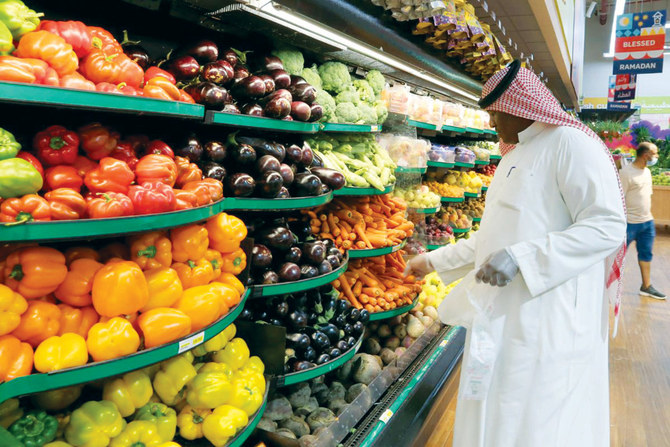
The General Authority for Statistics (GASTAT) said in its latest Consumer Price Index report that prices “still reflect” the VAT increase and the increased inflation rate was mainly due to the 8.4 percent rise in food and beverages and 14.9 percent increase in transport prices. The food and drinks changes were mainly due to rising meat prices, which increased by 9.7 percent in April, and vegetable prices, which rose 6.1 percent.

Overall, the GASTAT said food and beverage expenses account for around 17 percent of consumer expenditure.

In the transport sector, the report said rising inflation was mainly due to an increase in the price of new vehicles. Other sectors to see price increases in April include telecommunications (up 13.5 percent), tobacco (13.1 percent), restaurants and hotels (8.3 percent), furnishings, household equipment and maintenance (7.4 percent), clothes and footwear (5.8 percent) and healthcare (3.3 percent).

Meanwhile, the education sector saw prices drop 9.1 percent, as school fees dipped, while the price of utilities — such as housing, water, electricity, gas and other fuels — declined by 2.6 percent.

“Looking ahead, we think that the headline inflation rate will continue to drift higher over the rest of this quarter, peaking at around 6.5 percent year-on-year in June, largely due to stronger energy price inflation. But inflation will drop sharply from July as the effects of the VAT hike drop out of the annual price comparison and stay at around 1-2 percent year-on-year over the course of this year and next,” James Swanston, an economist at London-based Capital Economics, said in a report on Thursday.

The issue of the increase in VAT was addressed by Crown Prince Mohammed bin Salman in his televised interview at the end of April, where he said the increase would only be short-term. “It’s a temporary decision. It will continue for a year, maximum five years, and then things will go back to what they were ... We’re targeting it to be between 5 to 10 percent only until we reinstate our balance after the pandemic, so maybe after a year. So, depending on the economic situation or what may transpire but maximum five, minimum one year,” he said.

While the Saudi economy contracted 3.3 percent in the first quarter of this year, it is expected to grow 2.1 percent overall in 2021, according to the International Monetary Fund.

Earlier this month, business activity in the Saudi Arabian non-oil private sector in April accelerated at the fastest pace in three months, owing to a significant rise in new sales as businesses recovered from the impact of the COVID-19 pandemic, according to the latest IHS Markit Purchasing Managers’ Index (PMI) survey. Firms in the Kingdom also expanded staff numbers for the first time in five months, the index showed.

David Owen, an economist at IHS Markit, said: “The Saudi Arabia PMI rebounded in April to indicate a strengthening of growth across the non-oil economy. New orders picked up at the quickest rate for three months as business conditions continued to recover from COVID-19. The rise helped lead to a renewed uplift in employment, with the pace of increase the fastest since November 2019.”

G7 countries to release oil reserves as IEA agrees to largest ever market intervention

Updated 11 March 2026
Follow

G7 countries to release oil reserves as IEA agrees to largest ever market intervention

  • IEA recommends release of 400 million barrels

RIYADH: Germany, Japan and Austria will release part of their oil reserves after the International Energy Agency recommended the release of 400 million barrels of oil ‌from stockpiles, the largest ‌such move in IEA ​history.

In a statement, IEA Executive Director Fatih Birol said the flow of oil, gas and other commodities through the Strait of Hormuz have all but stopped, leading global energy supply to fall by around 20 percent.

Ahead of the confirmation of the move — a larger intervention than the 182.7 million barrels that were released in 2022 by in response to Russia’s invasion of Ukraine — several countries began setting out plans to bring their reserves into play as countries grapple with ​soaring crude prices amid ​the US-Israeli war with Iran. 

Birol said: “I can now announce that IEA countries have decided to launch the largest ever release of emergency oil stocks in our agency's history. 

“IEA countries will be making 400 million barrels of oil available to the market to offset the supply lost through the effective closure of the strait.

“This is a major action aiming to alleviate the immediate impacts of the disruption in markets.”

Germany’s Economy ⁠Minister ​Katherina Reiche ⁠confirmed on Wednesday her government plans to limit petrol price increases at filling stations to once a day and to introduce more stringent antitrust regulation of the sector.

She did not ⁠give an exact timing for ‌those measures, but added that ‌the US and ​Japan would be the ‌largest contributors to the release of the ‌oil reserves.

The US has not confirmed it would do so, but its Interior Secretary Doug Burgum told Fox News on Wednesday that “these are the kinds of moments that these reserves are used for.”

The announcements did not stop oil prices rising, with Brent crude up 3.26 percent to $90.66 a barrel at 4:29 p.m Saudi time, and West Texas Intermediate up 3.12 percent to $86.05. Both were some way below the $119 a barrel seen earlier in the week.

“The situation regarding oil supplies is tense, as the Strait of Hormuz is currently virtually impassable,” Germany’s Reiche said.

“We will comply with this request and ‌contribute our share, because Germany stands behind the IEA’s most important principle: mutual ⁠solidarity,” Reiche ⁠said about the IEA’s request.

According to a statement by Reiche’s ministry, Germany will contribute 2.64 million tonnes of oil. This corresponds to 19.51 million barrels.

Reiche stressed there was no supply shortage in the country, which has a legally mandated reserve of oil and oil products intended to cover 90 days’ demand.

South Korea will release 22.46 million ​barrels of oil, which represents 5.6 percent of the total IEA ask, the ⁠country's industry ministry said.

“The government will consult with the IEA ⁠secretariat on details, such ‌as ‌the ​timing ‌and amount, from ‌the perspective of national interests in accordance with domestic conditions,” ‌the ministry said in a statement.

The ⁠ministry ⁠said it would continue to coordinate closely with major countries in responding to high oil prices to minimise any domestic ​impact.

Austrian Economy Minister Wolfgang Hattmannsdorfer said his country was releasing part of the emergency oil reserve and extending the national strategic gas reserve, adding: “One thing is clear: in a crisis, there must be no crisis winners at the expense of commuters and businesses.”

Acting ahead of the IEA move, G7 ​member Japan announced plans to release 15 days' worth of ‌private-sector oil reserves and one month's worth of state oil reserves.

“Rather than wait for formal IEA approval ‌of a coordinated international reserve release, Japan will act first to ease global energy market supply and demand, releasing reserves as early as the 16th of this month,” Prime Minister Sanae Takaichi said in a broadcast statement.

Following a meeting with the IEA on Wednesday, G7 energy ministers said: “In principle, we support the implementation of proactive measures to address the situation, including the use of strategic reserves.”

All IEA member countries are required to keep 90 days’ worth of their nation’s oil use in reserve in case of global disruption.