

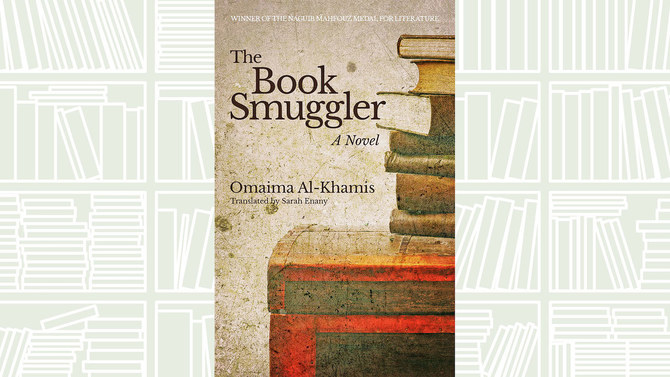
Review: ‘The Book Smuggler,’ an award-winning novel by Saudi author Omaima Al-Khamis

Omaima Al-Khamis won the Naguib Mahfouz Medal for Literature in for her work of historical fiction, “The Book Smuggler.” (Supplied)
Short Url
Updated 20 May 2021
Follow

Review: ‘The Book Smuggler,’ an award-winning novel by Saudi author Omaima Al-Khamis

CHICAGO: In 2018, Riyadh native Omaima Al-Khamis won the Naguib Mahfouz Medal for Literature in for her work of historical fiction, “The Book Smuggler,” an extraordinary tale set in the 11th century CE, in the Golden Age of Islam.

The book, newly translated into English by Sarah Enany, follows Mazid Al-Najdi Al-Hanafi, a scribe and bookseller from the village of Hijr Al-Yamama on the Arabian peninsula, who embarks on a journey to see the world and feed his great passion for learning.

The story begins three years after Mazid leaves his home. The Islamic world is in constant transition between dynasties (the Fatimid, Umayyad, and Abbasid) and political and religious groups as civil wars and conflicts engulf the region during the Era of Sedition.

Mazid discovers that although many people share his love of learning and discovery, other equate it to blasphemy. Books and manuscripts of great thinkers — Al-Mutanabbi, Al-Isfahani, Abu Hayan, Al-Kindi, Ibn Haytham, the Greek philosphers and others — are under threat of being burned and lost forever. Mazid, whose career as a bookseller puts him in a precarious situation, must transport his treasures from Baghdad to Jerusalem and Cairo to Andalusia in secret, spreading knowledge of the scientific and philosophical works he is committed to protecting.

The way that Al-Khamis captures the era is reminiscent of the great Lebanese-born French author Amin Maalouf — filled with vivid descriptions, incredibly detailed history and a vibrant lightness that brings the age to life. Through Mazid, a man of little means but great heart, Al-Khamis enthralls her readers with an epic tale exploring history and its heroes as Mazid sits in on discussion circles at the mosques of every city he visits to hear about the events of the time and their protagonists and antagonists. As his world begins to change, Mazid finds himself shedding the innocence of youth and becoming a man who is driven by his desire for knowledge.

Through her perfectly paced, patiently illuminating tale, Al-Khamis pays homage to a deep-rooted history, one that is tense and joyful, in which the passion of men and women outweighs the fear of the time and those who want to control thoughts and lives.


Decoding villains at an Emirates LitFest panel in Dubai

Updated 25 January 2026
Follow

Decoding villains at an Emirates LitFest panel in Dubai

DUBAI: At this year’s Emirates Airline Festival of Literature in Dubai, a panel on Saturday titled “The Monster Next Door,” moderated by Shane McGinley, posed a question for the ages: Are villains born or made?

Novelists Annabel Kantaria, Louise Candlish and Ruth Ware, joined by a packed audience, dissected the craft of creating morally ambiguous characters alongside the social science that informs them. “A pure villain,” said Ware, “is chilling to construct … The remorselessness unsettles you — How do you build someone who cannot imagine another’s pain?”

Candlish described character-building as a gradual process of “layering over several edits” until a figure feels human. “You have to build the flesh on the bone or they will remain caricatures,” she added.

The debate moved quickly to the nature-versus-nurture debate. “Do you believe that people are born evil?” asked McGinley, prompting both laughter and loud sighs.

Candlish confessed a failed attempt to write a Tom Ripley–style antihero: “I spent the whole time coming up with reasons why my characters do this … It wasn’t really their fault,” she said, explaining that even when she tried to excise conscience, her character kept expressing “moral scruples” and second thoughts.

“You inevitably fold parts of yourself into your creations,” said Ware. “The spark that makes it come alive is often the little bit of you in there.”

Panelists likened character creation to Frankenstein work. “You take the irritating habit of that co‑worker, the weird couple you saw in a restaurant, bits of friends and enemies, and stitch them together,” said Ware.

But real-world perspective reframed the literary exercise in stark terms. Kantaria recounted teaching a prison writing class and quoting the facility director, who told her, “It’s not full of monsters. It’s normal people who made a bad decision.” She recalled being struck that many inmates were “one silly decision” away from the crimes that put them behind bars. “Any one of us could be one decision away from jail time,” she said.

The panelists also turned to scientific findings through the discussion. Ware cited infant studies showing babies prefer helpers to hinderers in puppet shows, suggesting “we are born with a natural propensity to be attracted to good.”

Candlish referenced twin studies and research on narrative: People who can form a coherent story about trauma often “have much better outcomes,” she explained.

“Both things will end up being super, super neat,” she said of genes and upbringing, before turning to the redemptive power of storytelling: “When we can make sense of what happened to us, we cope better.”

As the session closed, McGinley steered the panel away from tidy answers. Villainy, the authors agreed, is rarely the product of an immutable core; more often, it is assembled from ordinary impulses, missteps and circumstances. For writers like Kantaria, Candlish and Ware, the task is not to excuse cruelty but “to understand the fragile architecture that holds it together,” and to ask readers to inhabit uncomfortable but necessary perspectives.