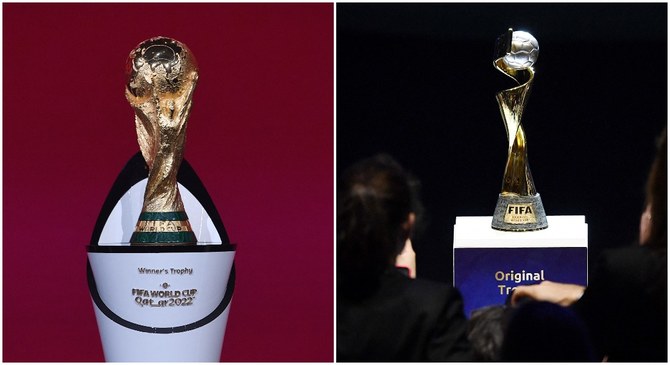

LONDON: The proposal was always going to be met with equal embrace and resistance.
Saudi Arabia’s request that “a feasibility study to be carried out on the impact” of hosting the men’s and women’s World Cup every two years instead of four be put to FIFA’s annual meeting of all its 211 members on Friday has already been automatically dismissed in some parts of the world but the idea is worthy of debate.
The idea will no doubt be welcomed by nations that rarely, if ever, qualify to the World Cup.
Alongside the expansion of the tournament from 32 to 48 teams from 2026, increasing the frequency of FIFA’s showpiece events will multiply the chances of smaller football nation to take join the party.
Many purists, however, will not see it that way.
Already some see that having more teams will dilute the quality of football on offer.
Playing the competition every two years instead of four will be seen as further stripping of the tournament’s exclusivity, not to mention that it will be interfering with other global events such as the Euros, Copa America, Africa Cup of Nations, AFC Asian Cup and the Olympics.
That is before we get into the logistics of fitting in more qualifying campaigns.
More resistance will surely come for European nations and some of their most powerful clubs who stand to gain little from more football for their already over-utilized, often exhausted, footballers.
But when it comes to the women’s game, the arguments against a biennial tournament are much weaker than those made on behalf of men.
For a start, compared to the men, there are fewer existing demands on the top women players.
The English Premier League has 38 games compared to the Women’s Super League’s 22.
The female final played on May 16 was the ninth in the Champions League for Barcelona and Chelsea.
Chelsea’s men have also reached the same stage and their game against Manchester City on May 29 will be game number 13.
There is more room in the calendar at the top of the European game and more still when you move down the levels around the world.
And the popularity of the women’s game is growing at rapid rate.
The 2019 Women’s World Cup in France was watched by a record-breaking 1.2 billion people.
The average live match audience more than doubled in comparison to the 2015 tournament that was held in Canada.
Much progress has been made then but there is still a long way to go. Doing it all more often would increase the audience and improve the profile of the players and teams tremendously.
Meeting every two years instead of every four would pump more money into the female game; more sponsorship, more broadcasting and more ticketing revenue.
It means more possibilities for federations around the world and especially those that do not yet invest much in the female side.
The more money there is in the women’s game the more motivation there is for federations to develop, the more coaches there are, the more facilities are built and the more attractive and realistic a professional career seems to youngsters.
Also, qualification to the Women’s World Cup is quicker and more convenient than for the men’s.
In Asia for example, while the men play 22 games over almost three years on the road to their World Cups, the female participants had no qualifiers at all for the 2019 World Cup with places in France dependent on performances at the AFC Asian Cup.
It would not be a major issue to insert another tournament into the four-year cycle.
For Europe’s women, there are more demands on qualification for World Cups and European Championships but it could be that merging the two qualifying campaigns (as the men do in Asia) would simplify things.
FIFA president Gianni Infantino is known to be a supporter of halving the time between women’s World Cups and surely few could argue that - regardless of whether it actually happens or not - there should at least be a debate.
When it comes to the men however, the situation is very different and there is a deep-seated belief that there is nothing to discuss.
Arsene Wenger found that when he called for it back in March.
"If you look at the teams in the World Cups, usually the average age is 27 or 28,” said the former Arsenal coach who is now the Chief of Global Football development at FIFA.
“Because the World Cup is every four years there are very few chances to win it again because when they go back to the next World Cup they are 32 or 33. That's why maybe we should organize the World Cup every two years."
Players may not appreciate that so much if they are injured or exhausted. To appear in every English Premier League game and go far in the UEFA Champions League means 50 games.
Add domestic cups and international commitments and it is a heavy schedule and while there is rotation, the demands on the players would be serious.
The top clubs would be dead against it and what of the confederations?
Europe and South America are concerned about what it would mean for their continental competitions that are held every four years.
If football moves in a four-year cycle, then if two of those are filled with World Cups then it doesn’t leave much time for anything else.
At the very least, qualifying for global and continental tournaments would have to change which is something that Wenger suggested.
If Saudi Arabia is serious then conversations should start in Asia where there are federations interested in the possibilities that open up if the World Cup doubles in frequency.
It will be an uphill battle convincing the football family about the men but the audience when it comes to the women's game should be more receptive.