ISLAMABAD: An agreement with Saudi Arabia to revive deferred payments for oil imports to Pakistan was “almost done,” the Pakistani minister of information was quoted by local media as saying, after Islamabad made a fresh request for a resumption of the facility during a recent visit of Prime Minister Imran Khan to the kingdom.
In 2018, Saudi Arabia agreed to give Pakistan $3 billion in foreign currency support for a year and a further loan worth up to $3 billion in deferred payments for oil imports to help stave off a current account crisis.
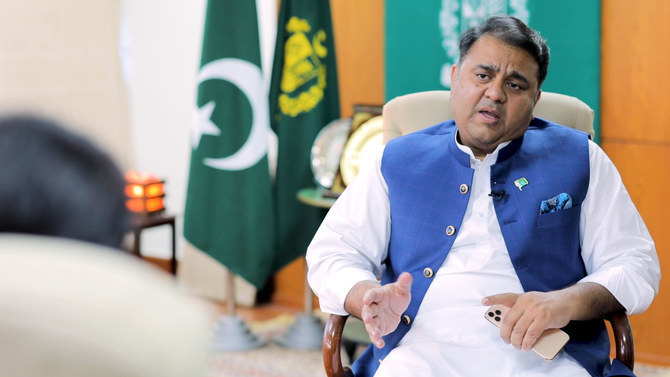
“The Saudi authorities have agreed in principle to grant their nod, but its exact details will be known when both sides will sign the formal deal,” Pakistan’s The News newspaper reported on Wednesday. “When Federal Minister for Information and Broadcasting Fawad Chaudhry was contacted and asked about the resumption of SOF [Saudi oil facility] for an extended period, he said, ‘Yes, it’s almost done’.”
“Islamabad is vying for all available alternative plans to overcome its external account problems and resumption of the SOF can go a long way to get the desired results,” the newspaper said. “Pakistan’s budget makers for the next fiscal year 2021-22 will get a sigh of relief in the wake of agreement with the Kingdom of Saudi Arabia (KSA) for resumption of Saudi Oil Facility (SOF) from a three to five years period.”
The previous oil facility from Saudi Arabia was signed for a three year period and made operational from July 2019 with the understanding that the first-year bill would be paid on a monthly basis and oil would be obtained on deferred payment in the second year.
“So, this whole facility would be ended in the fourth year upon the maturity of getting oil for the third year,” The News said. “It was assessed at that time that Pakistan would require a $275 million oil facility on a monthly basis from the KSA, so it accounted for $3.2 billion on per annum basis for three-year period.”
“Such facility was agreed upon for three years with the possibility of rollover of second and then third year. Both sides had agreed that this facility would be provided through the IDB’s Islamic Trade Finance Facility (ITFC). It is not known how much Pakistan had availed from the SOF in its first year, but then this facility got suspended. The IDB had also agreed to provide $1.5 billion oil facility on deferred payment, so in totality there was a provision of $4.7 billion oil on deferred payment,” The News reported.


![]()

Saudi agreement on deferred oil payments ‘almost done’ — Pakistani minister
Short Url
https://arab.news/4c7wk
Saudi agreement on deferred oil payments ‘almost done’ — Pakistani minister
- In 2018, Saudi Arabia gave Pakistan $3 billion in foreign currency support for a year and loan worth up to $3 billion in deferred oil payments
- The previous oil facility from Saudi Arabia was signed for a three year period and made operational from July 2019
Latest updates


© 2026 SAUDI RESEARCH & PUBLISHING COMPANY, All Rights Reserved And subject to Terms of Use Agreement.