KARACHI: Pak-Saudi telehealth platform Educast has joined hands with Palestine’s Young Explorer to provide medical support through e-doctors to mothers and children facing Israeli attacks in Gaza and the West Bank, the two companies announced this week.
Startup firm Young Explorer is an online platform created to offer parents of special needs children customized consultations and access to multiple written and video resources, while Educast, a Saudi-Pakistan technology group, is a virtual education platform that runs the eDoctor project, launched in 2019, to re-train and return to the health care industry hundreds of Pakistani women doctors who never joined the profession due to family pressure or stopped practicing once they got married or relocated abroad.
After training them, Educast virtually connects the doctors with female patients around the world.
Under a joint collaboration, Educast will, through Young Explorer, offer the consultation services of more than 100 female doctors living in North America, Saudi Arabia, the United Arab Emirates and Pakistan to Palestinian families in need.
“We consider all children facing war and violence as children with special needs,” Ayah Dajani, founder and chief executive officer of Young Explorer, told Arab News from the Palestinian city of Ramallah on Monday.
“That’s why we volunteered to open our platform to families and extend free support to them and their children with the help of our team of therapists, developers and media … Educast will provide us with a big set of experienced doctors to contact the families and give them much needed support.”
“Educast is bringing over 150 Pakistani licensed women doctors from 12 countries for teleconsulting and remote health care diagnostic and mental health counselling to women and children suffering Israeli atrocities,” Abdullah Butt, chief executive officer of Educast, told Arab News.
“Palestine’s Young Explorer organization will funnel our services through its system and redirect it to about 20,000 women currently using its platform who will be able to receive video-based consultation from Pakistani e-doctors,” he said. “We will be providing our services to war-torn areas of Al Quds, the West Bank and Gaza Strip.”
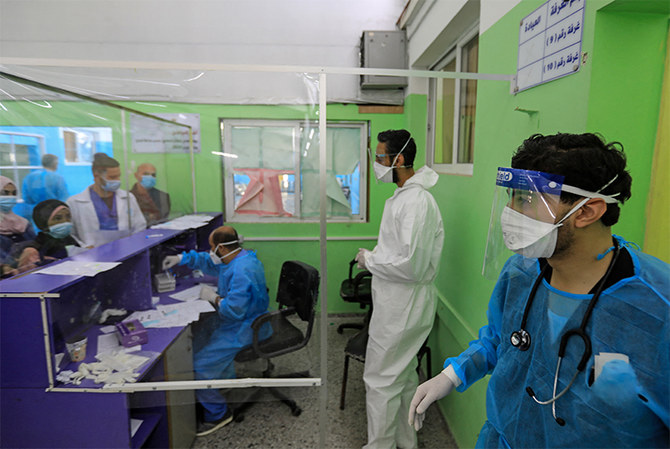
Young Explorer aims to facilitate Educast in areas where basic health facilities and infrastructure have been destroyed by Israeli forces.
“We are giving our platform for the telehealth campaign,” Dajani said. “All our human resources will work on tech, marketing, social media, design and coordination with doctors. The service is expected to start within a week.”
“In Gaza, access to health is very limited due to the continuous rocket attacks,” she added. “Kids are under intense pressure and fear. In the West Bank, there are medical centers, but we will use the power of social media and the Internet to reach large numbers of people.”
Doctors who have volunteered for the service expressed deep emotions while discussing the opportunity of serving the people of Palestine.
“I will be pleased to utilize my knowledge of medicine to serve Palestinian sisters and children,” Dr. Rehana Din Mohammad, a physician based in Oman, said.
“I have gained experience of handling hundreds of COVID-19 patients in Pakistan,” Dr. Faizah Ayub Khan, a doctor based in the United Arab Emirates, told Arab News. “Now I am determined to provide full support to my Palestinian sisters.”
Dr. Tayeba Khan, a mental health expert based in Canada, said women and children in Palestine were facing traumatic circumstances unleashed by Israeli attacks, saying she “could not wait” to provide the required assistance to these people.
Educast has previously provided similar services to people in Yemen.
“After successfully establishing three maternal child health tele-centers in the war zone of Yemen, we are now launching another timely initiative in Palestine,” Butt said.
Educast and Young Explorers are both winners of the 2019 Islamic Development Bank’s Transform Fund. The funding is part of the bank’s $500 million grant established to improve quality of life in the Muslim world through technological innovation.


![]()

Pak-Saudi telehealth platform joins hands with Palestinian startup to aid war-ravaged families
Short Url
https://arab.news/95z5m
Pak-Saudi telehealth platform joins hands with Palestinian startup to aid war-ravaged families
- Educast will offer Palestinian startup Young Explorer the consultation services of over 100 female doctors to help families in Gaza and West Bank
- About 20,000 women currently using the Young Explorer platform will be able to receive video-based consultation from Pakistani doctors
Latest updates


© 2026 SAUDI RESEARCH & PUBLISHING COMPANY, All Rights Reserved And subject to Terms of Use Agreement.