Pakistan, Saudi Arabia condemn Israeli attacks on Palestinians

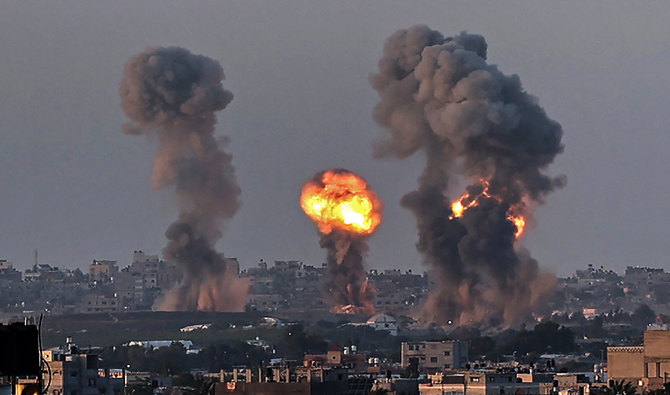
Smoke and a ball of fire rise above buildings in Khan Yunis in the southern Gaza Strip, during an Israeli air strike, on May 12, 2021. (AFP)
Short Url
Updated 13 May 2021
Follow

Pakistan, Saudi Arabia condemn Israeli attacks on Palestinians

  • Attacks started in the final days of Ramadan when Israeli forces opened fire on Palestinians at Al-Aqsa Mosque
  • Violence has further spilled since Monday when Israel launched airstrikes on the Gaza Strip

ISLAMABAD: Pakistani Prime Minister Imran Khan and Saudi King Salman condemned Israeli attacks on Palestinians during a telephone conversation on Wednesday evening.
The latest wave of violence in the Middle East escalated in the final days of the fasting month of Ramadan after Israeli police fired tear gas, rubber-coated steel bullets, and stun grenades at Palestinians gathered at Al-Aqsa Mosque in Jerusalem — the third holiest site in Islam.
The violence was triggered by protests and clashes as Israeli forces tried to expel Palestinians from their houses in the Sheikh Jarrah neighborhood of East Jerusalem and hand over their property to Jewish settlers.
During Wednesday’s call, King Salman and Khan “reviewed the latest developments, particularly the Israeli attacks in the city of Jerusalem,” the Saudi Press Agency (SPA) reported, saying that King Salman expressed Saudi Arabia’s “strong condemnation of the Israeli measures in Jerusalem and the acts of violence carried out by Israel in the vicinity of Al-Aqsa Mosque.”
The Pakistani PM said, as quoted by his office, that the “heinous attacks” by Israeli forces during the fasting month of Ramadan were “defying all norms of humanity and international law.”
Earlier on Wednesday, Khan took to Twitter to say that he and Pakistan stand with Palestine, as violence in the region has further spilled when Israel launched airstrikes on the Gaza Strip, killing more than 56 Palestinians, including 14 children, and wounding hundreds of others since Monday.
In response to the Israeli airstrikes, Hamas, which controls the self-governing Palestinian territory, fired rockets into Israel, killing six people.
The flareup is the deadliest outbreak of violence in the region since the seven-week Israeli war on Gaza in 2014, during which 2,300 Palestinians were killed and over 10,000 wounded as Israeli forces bombed residential buildings, hospitals and schools.


Pakistan says UN liquidity crisis undermining peacekeeping, urges predictable financing

Updated 7 sec ago
Follow

Pakistan says UN liquidity crisis undermining peacekeeping, urges predictable financing

  • Pakistan is one of world’s top troop-contributing countries and has deployed more than 250,000 peacekeepers to 48 UN missions
  • If financial commitments wane, the readiness of troop contributing countries to maintain forces can also be affected, envoy warns

ISLAMABAD: Pakistan has warned that a liquidity crisis at the United Nations (UN) is undermining the effectiveness of peacekeeping missions, warning of its “serious consequences” for mandate delivery, civilian protection and deterrence against violence.

Pakistan is one of the world’s top troop-contributing countries and has deployed more than 250,000 peacekeepers to 48 UN missions across four continents over the past eight decades. A total of 182 of its peacekeepers have also lost their lives while serving under the UN flag.

Speaking at the opening of the Special Committee on Peacekeeping Operations, Pakistan’s Permanent Representative to the UN, Asim Iftikhar Ahmad, said several missions have transitioned or drawn down in recent years and no new UN peacekeeping mission has been established in over a decade, despite rising global instability and the highest levels of conflict since World War-II.

“If financial commitments wane and missions continue to contract without clear strategic direction, the readiness of troop contributing countries to maintain forces earmarked for UN deployment could also be affected, including standby arrangements, rapid deployment capabilities and specialized units,” Ahmad said, calling for a “serious and structured review” of financial architecture underpinning UN peacekeeping.

The liquidity crisis has reduced patrols, mobility and field presence, according to the Pakistani envoy. UN peacekeeping must become more agile, focused and better equipped to address evolving threats, including through technology and stronger partnerships.

“Protection of civilians, deterrence against violations, and ceasefire monitoring and verification remain foundational tasks,” he said. “Lack of political progress should not be used as a pretext for withdrawing missions.”

Pakistan has contributed both military and police personnel to UN operations, deploying more than 50 formed police units to missions including Haiti, Darfur, Timor-Leste and Côte d’Ivoire, according to Pakistan’s UN mission.

Pakistan’s top diplomat at the UN also flagged the issue at a UN Security Council briefing on peacekeeping police components this month.