

UK urged to bring home family stranded with COVID-19 in Syrian camp

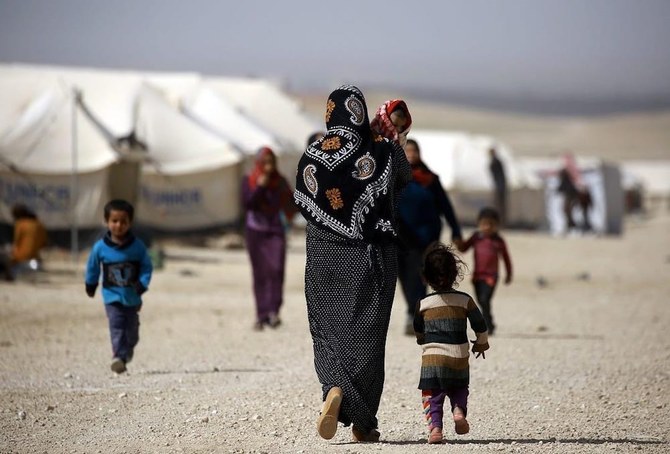
Refugees in al-Hol camp, Syria, 13 March, 2017. (AFP)
Short Url
Updated 12 May 2021
Follow

UK urged to bring home family stranded with COVID-19 in Syrian camp

  • Family, including toddler, face ‘real risk of life-threatening illness and possibly death’
  • They are among dozens stranded in former Daesh territory

LONDON: The UK government is being asked to repatriate a family stuck in a detention camp on the Syria-Iraq border who have contracted COVID-19.

UK charity Reprieve said the family, including a toddler with breathing difficulties and another member with asthma, were experiencing serious symptoms and had no access to proper healthcare in the camp.

The family, who the charity says were trafficked into territory formerly held by Daesh, faces a “real risk of life-threatening illness, and possibly death.”

Maya Foa, executive director of Reprieve, told The Guardian: “This is a family which is very likely to include victims of trafficking and they have been in this camp for a few years now. They all have roots in the UK. They are British and I have spent time with them in the camp.”

She added: “As well as the imperative to bring them back to receive treatment, surely the British government should also now be looking to investigate trafficking, and they would be happy to speak to the authorities.”

The plea comes as a group of UK politicians try to pressure the government to help British citizens return home from the region.

Around 800 have traveled to Daesh territory since the group emerged. Reprieve says 25 adults, mainly women, and 35 children are still there.

Baroness Sayeeda Warsi, a Conservative peer, said: “I would absolutely make the case on compassionate grounds for why British nationals should not be left in the middle of a pandemic stateless in the middle of a desert.”

She added: “We cannot hold ourselves up as a bastion for our policy against trafficking, modern-day slavery and sexual violence in conflict … and then simply close our eyes when it comes to our own citizens being subjected to the very actions that we are campaigning against.”

Conservative MP Andrew Mitchell said: “There is a danger that if these people are left stranded in an ungoverned space, they could be prey to terrorists and weaponized against us, which is why it’s so important to agree with the arguments which the Americans have made about bringing them back to their country of origin.”

A Foreign Office spokesperson said: “Our priority is to ensure the safety and security of the UK. Those who remain in Syria include dangerous individuals who chose to stay to fight or otherwise support a group that committed atrocious crimes including butchering and beheading innocent civilians.

“Where we become aware of British unaccompanied or orphaned children, or if British children are able to seek consular assistance, we will work to facilitate their return, subject to national security concerns.”

Russia strikes power plant, kills four in Ukraine barrage

Updated 13 January 2026
Follow

Russia strikes power plant, kills four in Ukraine barrage

KHARKIV: Russia battered Ukraine with more than two dozen missiles and hundreds of drones early Tuesday, killing four people and pummelling another power plant, piling more pressure on Ukraine’s brittle energy system.
An AFP journalist in the eastern Kharkiv region, where four people were killed, saw firefighters battling a fire at a postal hub and rescue workers helping survivors by lamp light in freezing temperatures.
Ukrainian President Volodymyr Zelensky said “several hundred thousand” households near Kyiv were without power after the strikes, and again called on allies to bolster his country’s air defense systems.
“The world can respond to this Russian terror with new assistance packages for Ukraine,” President Volodymyr Zelensky wrote on social media.
“Russia must come to learn that cold will not help it win the war,” he added.
Authorities in Kyiv and the surrounding region rolled out emergency power cuts in the hours after the attack, saying freezing temperatures were complicating their work.
DTEK, Ukraine’s largest energy provider, said Russian forces had struck one of its power plants, saying it was the eighth such attack since October.
The operator did not reveal which of its plants was struck, but said Russia had attacked its power plants over 220 times since Moscow invaded Ukraine in 2022.
Daily attacks
Moscow has pummelled Ukraine with daily drone and missile barrages in recent months, targeting energy infrastructure and cutting power and heating in the frigid height of winter.
The Ukrainian air force said that Tuesday’s bombardment included 25 missiles and 247 drones.
The Kharkiv governor gave the death toll and added that six people were wounded in the overnight hit outside the region’s main city, also called Kharkiv.
White helmeted emergency workers could be seen clambering through the still-smoking wreckage of a building occupied by postal company Nova Poshta, in a video posted by the regional prosecutor’s office.
Within Ukraine’s second city, Kharkiv Mayor Igor Terekhov said a Russian long-range drone struck a medical facility for children, causing a fire. No casualties were reported.
The overnight strikes hit other regions as well, including southern city Odesa.
Residential buildings, a hospital and a kindergarten were damaged, with at least five people wounded in two waves of attacks, regional governor Sergiy Lysak said.
Russia’s use last week of a nuclear-capable Oreshnik ballistic missile on Ukraine sparked condemnation from Kyiv’s allies, including Washington, which called it a “dangerous and inexplicable escalation of this war.”
Moscow on Monday said the missile hit an aviation repair factory in the Lviv region and that it was fired in response to Ukraine’s attempt to strike one of Russian President Vladimir Putin’s residences — a claim Kyiv denies and that Washington has said it does not believe happened.