

Gaza violence: 40 killed, more than 200 wounded in relentless Israeli airstrikes and Hamas rocket barrage

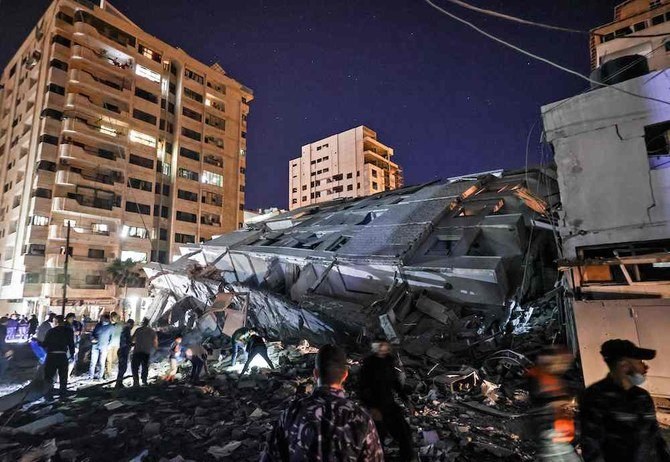
People gather at the site of a collapsed building in the aftermath of Israeli air strikes on Gaza City on May 11, 2021. (AFP)
Short Url
Updated 12 May 2021
Follow

Gaza violence: 40 killed, more than 200 wounded in relentless Israeli airstrikes and Hamas rocket barrage

  • At least 35 people in the Palestinian enclave and 5 in Israel have been killed so far
  • Israel Airports Authority halt take-offs at Tel Aviv's Ben Gurion airport "to allow defense of nation's skies"

GAZA CITY/JERUSALEM/CAIRO: Dozens of people died in relentless Israeli air strikes on the Gaza Strip and a rocket barrage by Hamas militants on Israeli targets on Tuesday and early Wednesday.

It was the heaviest fighting between the bitter enemies since 2014, and it showed no signs of slowing.

The death toll in Gaza rose to 35 Palestinians, including 10 children, according to the Health Ministry. Over 200 people were wounded.

Five Israelis, including three women and a child, were killed by rocket fire Tuesday and early Wednesday, and dozens of people wounded. 

Israel stepped up its attacks Tuesday night, flattening a high-rise building used by the Hamas militant group and killing at least three militants in their hideouts as Palestinian rockets rained down almost nonstop on the southern Israeli town of Ashkelon.
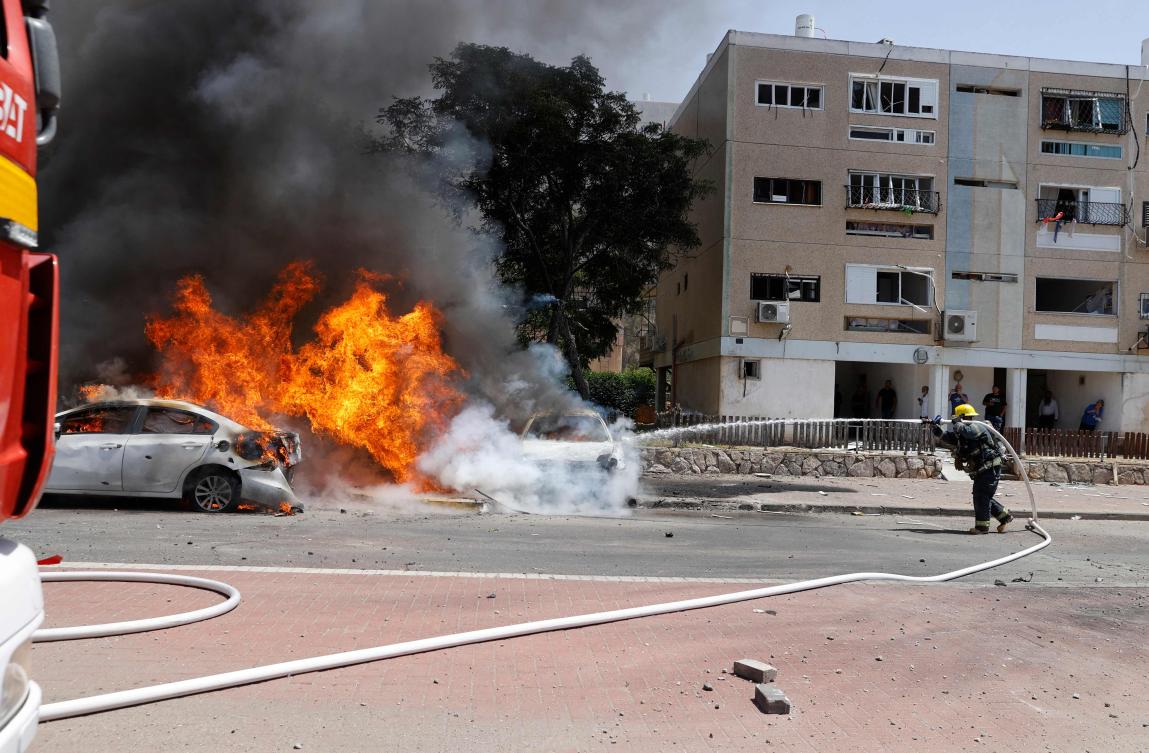


Israeli firefighter extinguishes a burning vehicle on Tuesday after Hamas launched rockets from Gaza Strip to Ashkelon, at southern Israel. (AFP)

As the death toll mounted, Israel snubbed an offer by Egypt to broker an end to the violence. 

“Egypt extensively reached out to Israel and other concerned countries urging them to exert all possible efforts to prevent the deterioration of the situation,” Egyptian Foreign Minister Sameh Shoukry said. “But we did not get the necessary response.” Instead, Israeli Prime Minister Benjamin Netanyahu vowed to rain more death on Gaza. 

“Both the strength of the attacks and the frequency of the attacks will be increased,” he said, and military spokesman Lt. Col. Jonathan Conricus said Israel was increasing its forces on the Gaza border.

The US State Department urged restraint on both sides.

Arab League chief Ahmed Aboul Gheit said the attacks on Gaza were a “miserable show of force at the expense of children’s blood,” and “Israeli provocations” were an affront to Muslims on the eve of the Eid holiday.

The Organization of Islamic Cooperation, which held an emergency meeting in Jeddah, “praised the steadfastness of the Palestinian people in the occupied city of Jerusalem.”
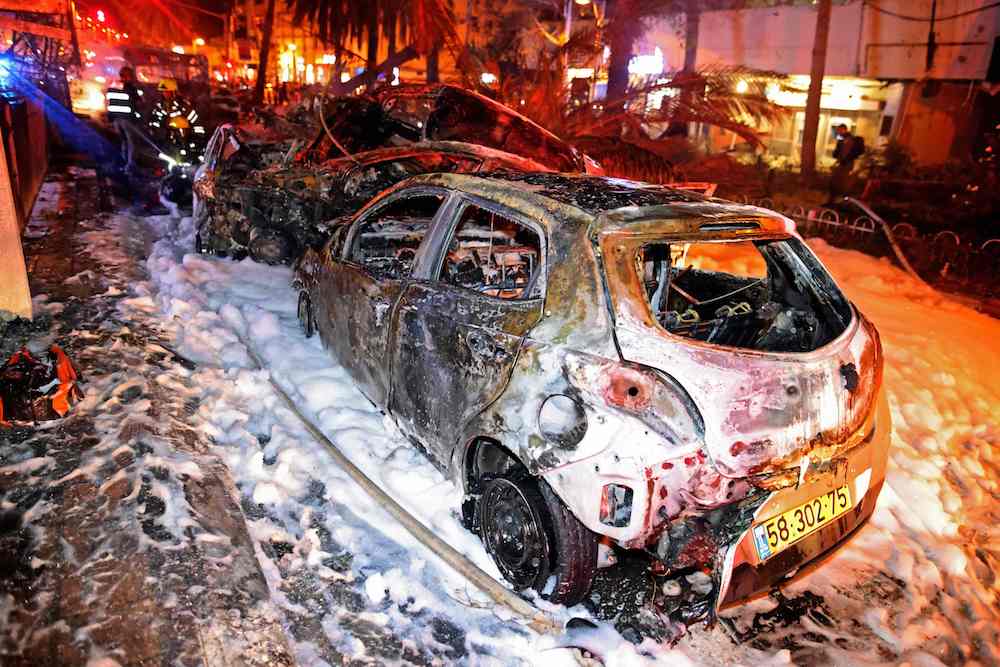


Burnt vehicles are seen in the town of Holon near Tel Aviv after rockets were launched towards Israel from the Gaza Strip by Hamas. (AFP)

The conflict spread to Gaza after days of protests in occupied East Jerusalem, where hundreds of Palestinians — including worshippers praying in Al-Aqsa Mosque, Islam’s third-holiest site — were injured in a violent Israeli crackdown with stun grenades, tear gas and plastic bullets.
On Monday and Tuesday, Gazans endured a long night and day of bombardment and terror. Some lost their loved ones, others their homes.
Rashad Al-Sayed, 57, who lives on the sixth floor of the Tiba building in Al-Shati refugee camp, west of Gaza City, said the roof of the house collapsed on his family as they tried to sleep after dawn prayers.
From a bed in Gaza’s Al-Shifa Hospital, he told Arab News: “It was a harsh night, we could not sleep, and when we decided to sleep, the roof fell on us. Israeli warplanes struck an apartment above my flat on the seventh floor.”
Al-Sayed was slightly injured, but his eldest son, Ahmed, 23, was badly hurt and is in intensive care in the same hospital.
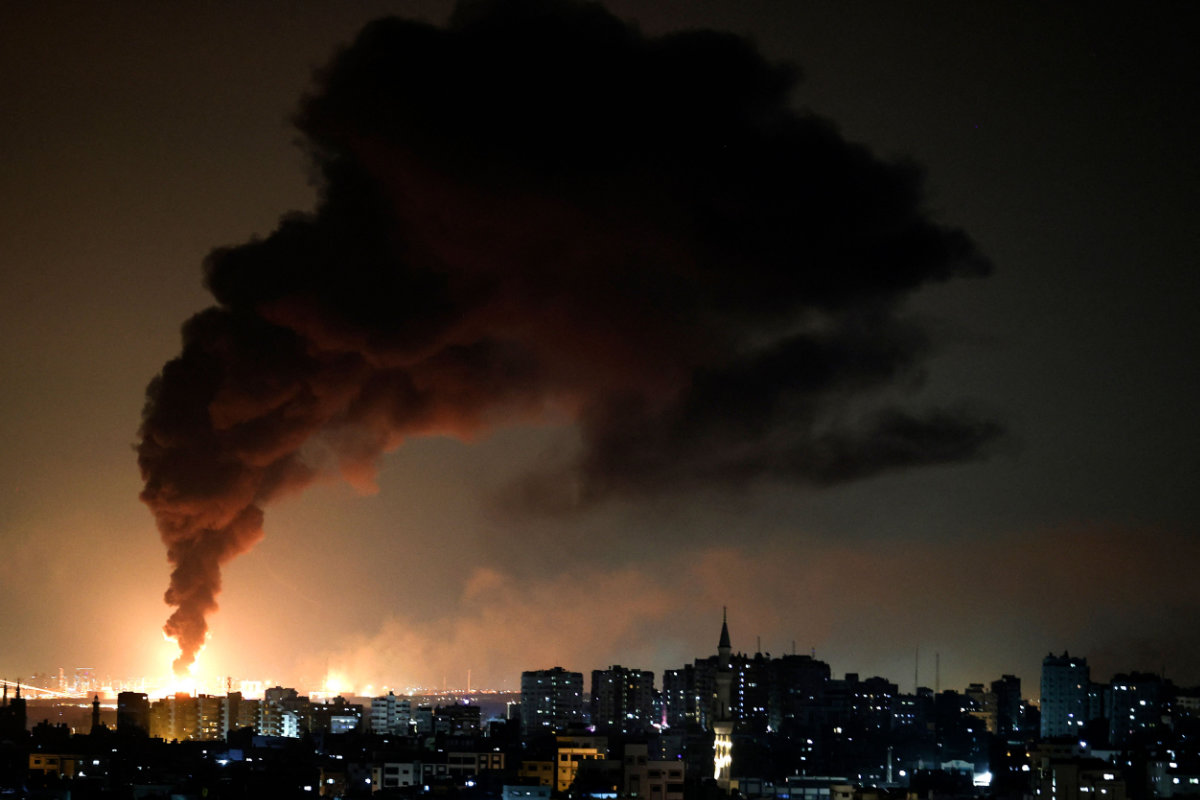


A huge column of smoke billows from an oil facility in the southern Israeli city of Ashkelon on May 11, 2021, after rockets were fired by the Palestinian Hamas movement. (AFP)

Witnesses told Arab News that Israeli warplanes fired four missiles at an apartment on the seventh floor of a tower block during dawn prayers at about 4:30 a.m., causing damage in most of the building, and killing a woman, her 19-year-old disabled son and another man on the floor below.
At midday, an air strike hit a building in the city center, sending terrified residents running into the street, including women and barefoot children. The Islamic Jihad militant group said the strike killed three of its commanders.
A 13-story residential block in the Gaza Strip collapsed on Tuesday night after being hit by an Israeli air strike. Three plumes of thick smoke rose from the tower, its upper stories still intact until it collapsed to the ground. The tower housed an office used by the Hamas political leadership.
The Gaza Health Ministry said 28 people, including 10 children and the woman, had been killed and 152 injured since Monday. Ministry spokesman Ashraf Al-Kidra said Israel’s “relentless assault” was overwhelming the healthcare system, which has been struggling with COVID-19.
Electricity in the surrounding area went out, and residents were using flashlights.
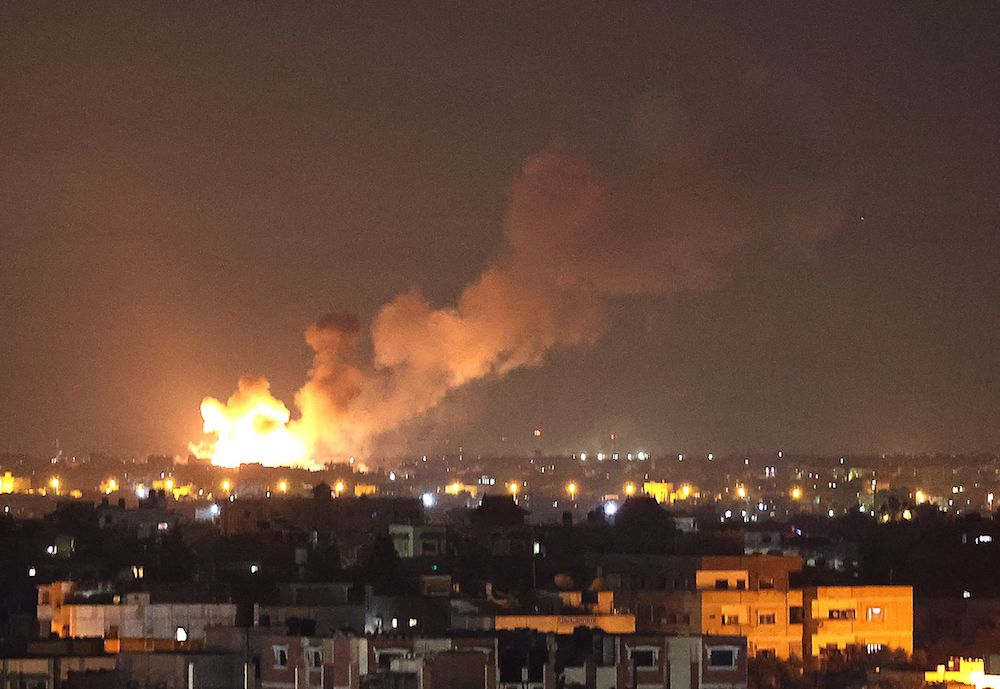


Flames are seen following an Israeli air strike on Rafah, in the south of the Gaza Strip controlled by the Palestinian Hamas movement, on May 11, 2021. (AFP)

Shortly after the attack, Hamas and the Islamic Jihad group said they would respond by firing rockets at Tel Aviv.
Air raid sirens and explosions were heard around the city, and the skies were lit up by the streaks of multiple interceptor missiles launched toward the incoming rockets.
Pedestrians ran for shelter, and diners streamed out of Tel Aviv restaurants while others flattened themselves on pavements as the sirens sounded.
Israeli television stations said three people had been wounded in the suburb of Holon.
The Israel Airports Authority said it had halted take-offs at Tel Aviv’s Ben Gurion airport “to allow defense of (the) nation’s skies.”
“We are now carrying out our promise,” Hamas’s armed wing said in a statement. “The Qassam Brigades are launching their biggest rocket strike against Tel Aviv and its suburbs, with 130 rockets, in response to the enemy’s targeting of residential towers.”
Hours earlier, Israel had sent 80 jets to bomb Gaza and massed tanks on the border as rocket barrages hit Israeli towns for a second day, deepening a conflict in which at least 28 people in the Palestinian enclave and two in Israel have been killed.
Residents of the block and people living nearby had been warned to evacuate the area around an hour before the air strike, according to witnesses, and there were no reports of casualties two hours after it collapsed.
The most serious outbreak of fighting since 2019 between Israel and armed factions in Gaza was triggered by clashes between Palestinians and Israeli police at Jerusalem’s Al-Aqsa Mosque on Monday.

Opinion

This section contains relevant reference points, placed in (Opinion field)

The city, holy to Jews, Muslims and Christians, has been tense during the Muslim fasting month of Ramadan, with the threat of a court ruling evicting Palestinians from homes claimed by Jewish settlers adding to the friction.
Prime Minister Benjamin Netanyahu said Israel would step up its strikes on Gaza, an enclave of 2 million people, in response to the rocket attacks.
“Both the strength of the attacks and the frequency of the attacks will be increased,” he said in a video statement.
Within an hour, Israel said it had deployed jets to bomb rocket launch sites in and around Gaza City.Officials said infantry and armor were being dispatched to reinforce the tanks already gathered on the border, evoking memories of the last Israeli ground incursion into Gaza to stop rocket attacks, in 2014.
More than 2,100 Gazans were killed in the seven-week war that followed, according to the Gaza health ministry, along with 73 Israelis, and thousands of homes in Gaza were razed.
On Tuesday, before the block collapsed, the Gaza health ministry said at least 28 Palestinians, including 10 children, had been killed and 152 wounded by Israeli strikes since Hamas on Monday fired rockets toward Jerusalem for the first time since 2014.
Israel’s national ambulance service said two women had been killed in rocket strikes on the southern city of Ashkelon.
The International Committee of the Red Cross urged all sides to step back, and reminded them of the requirement in international law to try to avoid civilian casualties.


‘People are suffering in a way you can’t even imagine’: Al Arabiya journalist recounts Sudan devastation

Updated 21 December 2025
Follow

‘People are suffering in a way you can’t even imagine’: Al Arabiya journalist recounts Sudan devastation

  • Al Arabiya anchor Layal Alekhtiar’s journey through Sudan exposes the brutal reality behind the headlines
  • Millions are displaced, aid deliveries blocked, and camps are filled with traumatized women and children

RIYADH: Al Arabiya anchor Layal Alekhtiar arrived in Sudan expecting to interview the de facto president. What she encountered along the way, over six harrowing days on the ground, reshaped her understanding of violence, survival, and the limits of language itself.

Speaking to Arab News after her return, Alekhtiar described what she witnessed not as collateral damage or the fog of war, but as something far more deliberate and systematic: a “gender-ethnic genocide.”

What she saw was a campaign of targeted killings of men and the mass rape of women that has shattered entire communities and displaced millions. “People are suffering, suffering in a way you cannot imagine,” Alekhtiar told Arab News.

“Firstly, I am speaking about the displaced people in the refugee camps. Fifty percent of the women who had arrived there had been raped. These are the women I encountered in the camps.

“For them (the militias), this is something they have to do to the women before allowing them to exit the war zone that they are in.

“Some of the women are much older, some of them are young girls, very young girls, 13, 14, 15, 16, and they have children who they don’t even know who the father is because they were raped by three or four, multiple masked men.”

Since the conflict erupted in April 2023, the civil war in Sudan — driven by a power struggle between the Sudanese Armed Forces and the Rapid Support Forces — has displaced millions and left a trail of murder and sexual violence in its wake.

Alekhtiar does not believe placing further sanctions on Sudan is necessarily the solution. (Supplied)

Men are killed before reaching aid sites while women and girls are often raped so violently they require surgery. Mothers are found dead, still clutching their children. Pregnancies from gang rape are widespread.

This was not abstract reporting for Alekhtiar. It was what she saw.

She travelled to Port Sudan on Dec. 2 to interview Abdel Fattah Al-Burhan, the head of the Sudanese Armed Forces and Sudan’s de facto president.

However, at the request of his office, the interview was to take place in Khartoum — a city without functioning airport infrastructure and retaken from the RSF only in March.

With a small team — a videographer, producer and driver — Alekhtiar undertook the gruelling 12-hour drive from Port Sudan to the capital.

“Looking from one area to another area, you see the difference, you see the depression, you see it on the faces, you see it on the street, you see it everywhere, and you see the effect of the war,” she said.

The destruction was physical as well as psychological. “We saw so many cars and even RSF trucks that were scorched and burned on the side of the road.”

What unsettled her most was not only the scale of the devastation, but the fact that it was inflicted by Sudanese on Sudanese.

“What I have heard from them, there is no way someone can be a human being and can do that. No way. It’s impossible,” she said.

“And the way the city, the way Khartoum is destroyed, no way a person in their own country would do something like this. It’s crazy.”

Along the journey, Alekhtiar spoke to locals wherever she could, asking what they wanted from a war that had consumed their lives.

“They don’t want war. Definitely, they want peace. All of them want that. But at the same time they will not accept being under the leadership of the RSF. For them, there’s no way. And this is something I have heard from all of the people I have spoken to. I did not hear otherwise.”

From outside Sudan, the conflict is often reduced to brief news alerts. Alekhtiar says those accounts fall far short. When asked whether the coverage reflects reality on the ground, she replied without hesitation: “No, not at all, not at all.”

Nearly everyone she met had lost everything — homes destroyed, savings wiped out when banks were looted and burned. According to UNHCR, nearly 13 million people have been forced from their homes, including 8.6 million internally displaced.

Alekhtiar does not believe placing further sanctions on Sudan is necessarily the solution. (Supplied)

On the road from Port Sudan to Khartoum, the scale of death was impossible to ignore. Alekhtiar recalls seeing clouds of flies everywhere, drawn by bodies buried hastily or not at all along the route.

During her six days in the country, her team stopped in Al-Dabbah, where UNHCR tents shelter displaced civilians. What she saw there still stays with her. “I want to emphasize one thing and it is very alarming,” she said.

“What I was witnessing in the camps was only women and children; there were no men. The only men I saw were very old in age. It’s a genocide. They are killing all men. They cannot go out.

“What we saw in the videos, it was real,” she said, referring to the graphic footage of atrocities circulating on social media. “It’s not true that it was one video and the reality is different than that. No, it was real.

“It’s a gender-ethnic issue. It is really a genocide. I’m not just using the word genocide for the sake of using the word. This is actually a genocide.”

Life in the camps was defined by scarcity. There were no spare clothes, almost no supplies, and most people slept directly on the ground. The UN was scrambling to respond, Alekhtiar said, but had never anticipated displacement on this scale.

She watched buses arrive packed with women, screaming babies in their arms. When she asked why the infants were crying, the answer was devastatingly simple.

“Because they are hungry … they are breastfeeding and we cannot feed them because we have not eaten,” they told her. The women’s bodies, starved and exhausted, could no longer produce milk.

UN staff told Alekhtiar they lacked resources as funding was insufficient. RSF fighters were also blocking the main roads, preventing aid from reaching those who needed it most.

Alekhtiar wished she had more time in the camps because this — bearing witness and amplifying suffering — is the core purpose of journalism, she said.

What the women told her there continues to haunt her. Rape survivors said they were treated as slaves, stripped of humanity by their attackers. “They need help, on a psychological level, human level, all levels,” Alekhtiar said.

“These women, I don’t know how they will live later. Some of them cannot talk. They are sitting and looking at me; they cannot talk. Some of them keep crying all day long. Some of them don’t go out of the tent.

“Some of them have kids with them. They don’t know who these kids are, because they found them on their way, and they took them, because they were children alone.

“One woman told me she took a child from his mother’s arms who was murdered, and the child doesn’t speak, even at his age of 3 years, he stopped being able to speak. So many stories, so many stories.

“The problem is the war is still ongoing, and they will come from other cities in their millions. We are not talking about tens or hundreds of thousands. We are talking about millions.”

Alekhtiar does not believe placing further sanctions on Sudan is necessarily the solution.

Alekhtiar does not believe placing further sanctions on Sudan is necessarily the solution. (Supplied)

“The international community, countries, right now are announcing sanctions on Sudan, but that’s not enough,” she said.

“What people need there is support, humanitarian support, and they need real support from the whole world to stop this war because it’s not a normal war.

“A whole race is being killed. Being killed because they want to change the identity of one region. It’s a genocide.”

International sanctions have targeted individuals accused of mass killings and systematic sexual violence. The UK has sanctioned senior RSF commanders over abuses in El-Fasher.

The US, meanwhile, has sanctioned the Sudanese Armed Forces over the use of chlorine gas, a chemical weapon that can cause fatal respiratory damage.

Asked about her own experience in the field, Alekhtiar said the availability of clean water was among the biggest challenges she faced.

“Showering was not an option,” she said, as most water came out black, contaminated, its contents unknown.

She barely ate, overwhelmed by what she was witnessing.

“I was crying all the time there, to be honest. I was sick for two days when I arrived back,” she said.

“After you leave, you become grateful for what you have when you see the suffering of others. They changed my whole perspective on life. It changed me a lot.”